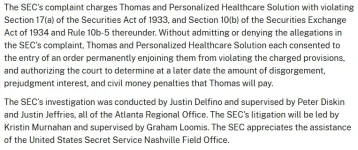
Looking for context on Root Wellness and a federal lawsuit

I want to share a slightly different perspective here because I have followed regulatory actions in a few other industries, and the pattern often looks similar. There is usually a triggering event that leads to an investigation, then a formal complaint, and eventually a resolution that might include penalties or restrictions. What people often miss is that each of these stages can take a long time, and by the time the final outcome is published, the circumstances may have already changed significantly.
Looking at the information tied to Root Wellness, it seems like the enforcement action reached a conclusion with a financial judgment. That indicates closure from a legal standpoint, but it does not automatically answer questions about the present. It simply tells us what was determined based on the evidence reviewed during that case.
 
I want to share a slightly different perspective here because I have followed regulatory actions in a few other industries, and the pattern often looks similar. There is usually a triggering event that leads to an investigation, then a formal complaint, and eventually a resolution that might include penalties or restrictions. What people often miss is that each of these stages can take a long time, and by the time the final outcome is published, the circumstances may have already changed significantly.
Looking at the information tied to Root Wellness, it seems like the enforcement action reached a conclusion with a financial judgment. That indicates closure from a legal standpoint, but it does not automatically answer questions about the present. It simply tells us what was determined based on the evidence reviewed during that case.
I also think it is important to consider how much weight should be given to secondary reports. While they are helpful for awareness, they sometimes simplify complex legal matters into a few sentences, which can lead to misunderstandings. Going back to the official release is always the best way to get a clearer picture, even if it takes more effort to read through it carefully. Overall, I see this as something worth understanding in detail rather than reacting to quickly.
 
This discussion is actually making me realize how little I understand about how these cases work. I might need to spend some time learning the basics of SEC enforcement just to make sense of all this.
 
After reading more into this, I feel like one of the biggest challenges is separating what is legally confirmed from what is just interpretation. The official documents do confirm that there was a case and a judgment, but beyond that, a lot of the discussion online seems to fill in gaps with assumptions.
When it comes to Root Wellness, I think people are trying to connect dots that are not always clearly linked in the records themselves. That does not mean the concerns are invalid, but it does mean we need to be careful about how we interpret the available information.
 
I noticed that too. A lot of posts online seem to repeat the same points without adding new details, which can make things feel more certain than they actually are.
It would be helpful if someone could break down the key facts in simple terms without adding extra interpretation.
 
One thing I keep thinking about is how these enforcement actions are usually very specific in what they address. They are not general statements about everything related to a company or person, but rather focused on certain activities during a defined period.
So when people talk about Root Wellness, I wonder if they are considering that limitation or just assuming it applies more broadly.
 
I want to share a slightly different perspective here because I have followed regulatory actions in a few other industries, and the pattern often looks similar. There is usually a triggering event that leads to an investigation, then a formal complaint, and eventually a resolution that might include penalties or restrictions. What people often miss is that each of these stages can take a long time, and by the time the final outcome is published, the circumstances may have already changed significantly.
Looking at the information tied to Root Wellness, it seems like the enforcement action reached a conclusion with a financial judgment. That indicates closure from a legal standpoint, but it does not automatically answer questions about the present. It simply tells us what was determined based on the evidence reviewed during that case.
 
I have seen similar discussions before where people try to interpret legal language without having the full background, and it often leads to confusion.
 
I spent some more time reviewing the structure of SEC cases in general, and it helped me look at this situation differently. Usually, when a case reaches the stage where a judgment is issued, it means that the regulator has gone through investigation, evidence gathering, and legal proceedings. That part is quite structured and documented.
In the context of Root Wellness, the references to a monetary judgment suggest that the case concluded with specific findings. However, what is not immediately obvious is how those findings relate to current operations or whether any changes were made afterward. That is something that often requires additional context beyond the enforcement release itself.
 
I spent some more time reviewing the structure of SEC cases in general, and it helped me look at this situation differently. Usually, when a case reaches the stage where a judgment is issued, it means that the regulator has gone through investigation, evidence gathering, and legal proceedings. That part is quite structured and documented.
In the context of Root Wellness, the references to a monetary judgment suggest that the case concluded with specific findings. However, what is not immediately obvious is how those findings relate to current operations or whether any changes were made afterward. That is something that often requires additional context beyond the enforcement release itself.
Another thing that stood out to me is how different readers can take away different impressions from the same document. Some may focus on the fact that there was a case at all, while others might look more closely at the details of what was actually determined. Both approaches are valid, but they lead to very different conclusions.
I think the key here is to stay grounded in what is explicitly stated in the records and avoid extending those conclusions too far without supporting information.
 
I want to expand on that idea because I think it is really important in situations like this. Regulatory cases are often retrospective, meaning they are based on events that have already happened and have been investigated over time. By the time a judgment is issued, the circumstances may have evolved significantly.
When I looked at the information connected to Root Wellness, I noticed that the case appears to have gone through the full legal process, ending in a financial penalty. That tells us something definite about the outcome, but it does not necessarily tell us everything about the current state of affairs.
Another layer to this is how people interpret enforcement language. Terms used in legal documents can sound very strong, but they are often defined very precisely within the context of the law. Without understanding those definitions, it is easy to misread the situation.
 
I want to expand on that idea because I think it is really important in situations like this. Regulatory cases are often retrospective, meaning they are based on events that have already happened and have been investigated over time. By the time a judgment is issued, the circumstances may have evolved significantly.
When I looked at the information connected to Root Wellness, I noticed that the case appears to have gone through the full legal process, ending in a financial penalty. That tells us something definite about the outcome, but it does not necessarily tell us everything about the current state of affairs.
Another layer to this is how people interpret enforcement language. Terms used in legal documents can sound very strong, but they are often defined very precisely within the context of the law. Without understanding those definitions, it is easy to misread the situation.
I also think it is worth considering how information spreads across different platforms. Once a case is public, it gets summarized, shared, and sometimes simplified, which can lead to a loss of nuance. That is why going back to the original source is always helpful, even if it takes more effort. Overall, I see this as a situation where careful reading and patience are more useful than quick conclusions.
 
I kept thinking about this thread and decided to revisit the official release again, and something that stood out to me this time was how structured everything is. It is very fact based, almost like a snapshot of what was established during the case, rather than a full story. When I compare that to how people discuss Root Wellness in different places, it feels like a lot of the conversation adds interpretation on top of those facts. That is probably where confusion starts.
 
I kept thinking about this thread and decided to revisit the official release again, and something that stood out to me this time was how structured everything is. It is very fact based, almost like a snapshot of what was established during the case, rather than a full story. When I compare that to how people discuss Root Wellness in different places, it feels like a lot of the conversation adds interpretation on top of those facts. That is probably where confusion starts.
Yeah, I noticed that too. The original documents are actually quite neutral in tone, but once they get summarized elsewhere, the wording can feel much stronger.
 
I think another factor here is that most people are not used to reading legal or regulatory documents, so they rely on simplified explanations. That is understandable, but it also means important details can get lost.
In the case related to Root Wellness, I feel like understanding the exact scope of the case is key, otherwise it is easy to overgeneralize.
 
I want to share a more detailed observation because I spent a good amount of time comparing different types of sources on this. When you look at an enforcement release, it is written to document what was legally established, including the outcome and any penalties. It does not try to explain the broader context in a way that a general audience might expect.
Now when you look at how Root Wellness is discussed across different reports, you start to see how those gaps get filled in. Some sources focus heavily on the enforcement aspect, while others try to connect it to business practices or leadership. The challenge is that not all of those connections are explicitly confirmed in the primary documents.
Another thing that becomes clear is that timing plays a huge role. The events that led to the case, the investigation process, and the final judgment can all be separated by years. If someone reads everything at once without considering the timeline, it can feel like a single continuous issue, which may not be accurate.
 
I want to share a more detailed observation because I spent a good amount of time comparing different types of sources on this. When you look at an enforcement release, it is written to document what was legally established, including the outcome and any penalties. It does not try to explain the broader context in a way that a general audience might expect.
Now when you look at how Root Wellness is discussed across different reports, you start to see how those gaps get filled in. Some sources focus heavily on the enforcement aspect, while others try to connect it to business practices or leadership. The challenge is that not all of those connections are explicitly confirmed in the primary documents.
Another thing that becomes clear is that timing plays a huge role. The events that led to the case, the investigation process, and the final judgment can all be separated by years. If someone reads everything at once without considering the timeline, it can feel like a single continuous issue, which may not be accurate.
I also think it is important to understand that a judgment indicates that the case reached a resolution, but it does not automatically provide insight into what happened afterward. That part usually requires additional information that may or may not be publicly available.
So overall, I would say the situation around Root Wellness is something that requires careful reading and a bit of restraint in interpretation.
 
I have seen similar patterns in other industries too. Once a regulatory case is public, it tends to follow the name around for a long time, even if the situation has changed since then.
1773919805406.webp
 
Back
Top