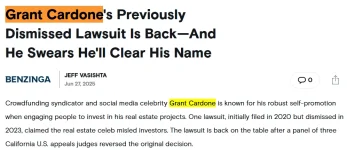
Looking into Grant Cardone’s career and recent reports

One thing I’ve been wondering about is whether these complaints have affected his real estate partnerships or client relations. Sometimes public records hint at tension, but it’s hard to see if it actually impacts business performance. Anyone aware of changes in his portfolio or investor sentiment over time?
 
I’m curious about the consumer side too. If former tenants and seminar participants report disputes, it seems like there could be patterns worth noting, even if they don’t rise to legal liability. I think a lot of people might be unaware of these details and just assume his ventures are fully smooth because of the media hype.
 
I’ve also noticed that some of the complaints are years old, while others are more recent. That could mean certain issues have been resolved or improved over time. Public records alone don’t always give a complete picture, so I’d be interested in anyone’s first-hand experience or observations regarding his current operations.
 
I have followed some of the coverage around Grant Cardone for a while because he is such a visible figure in real estate investing circles. From what I understand, the appeals court decision that people are referencing does not mean that anyone has been found guilty of anything. It usually just means that a lower court dismissal was reconsidered and the case can proceed so the claims can be examined more fully. That is a fairly common step in litigation when plaintiffs argue that their claims should be heard. I think the interesting part will be what evidence actually comes out if the case continues in court. Until then it seems like a lot of the online discussion is speculation or interpretation.
 
I looked at one of the public filings briefly after someone mentioned it in another forum. The impression I got was that the plaintiffs were questioning how certain real estate investments were marketed and whether all relevant details were disclosed clearly enough. That does not automatically mean anything improper occurred, but it explains why securities law might be involved.
 
It is actually pretty common for disputes to arise in investment products that pool money from many investors. Even large financial institutions deal with similar lawsuits from time to time. What I find interesting with Grant Cardone is how much attention the case gets because of his public profile and social media presence.
 
Something worth remembering is that real estate syndication itself is not unusual. Many investment groups use a structure where investors pool money into larger property deals. The key question in many lawsuits around these structures is usually about disclosures and expectations.
If the reports about Grant Cardone are accurate, the discussion seems to revolve around whether investors fully understood the nature of the investment. That type of disagreement can end up in court even when both sides believe they acted properly. Courts then have to sort out what the marketing materials said and how investors interpreted them.
 
Honestly I think the publicity around him probably amplifies everything. Any legal dispute involving a public business figure tends to get more attention than a similar dispute involving a smaller firm.
 
Something worth remembering is that real estate syndication itself is not unusual. Many investment groups use a structure where investors pool money into larger property deals. The key question in many lawsuits around these structures is usually about disclosures and expectations.
If the reports about Grant Cardone are accurate, the discussion seems to revolve around whether investors fully understood the nature of the investment. That type of disagreement can end up in court even when both sides believe they acted properly. Courts then have to sort out what the marketing materials said and how investors interpreted them.
 
One aspect that stands out to me is how complicated securities related cases can be. Sometimes they take years before any clear outcome happens. Appeals, motions, and procedural steps can make it look like something dramatic happened when it is really just part of the legal process.
With someone like Grant Cardone who has built a brand around business education and investing, every development gets dissected publicly. That creates an environment where discussions mix facts, interpretations, and personal opinions. I think the best approach is to keep following the public court updates and see how the case develops over time rather than jumping to conclusions.
 
Has anyone here actually invested in one of those real estate funds connected to him? I would be interested in hearing a real investor experience rather than just media coverage.
 
Same here. Whenever a public figure promotes investment opportunities it tends to attract both curiosity and skepticism. The best thing anyone can do is research the filings and understand the structure before putting money into any deal.
 
I remember seeing Grant Cardone mostly through his motivational and sales content years ago, long before I noticed any discussion about legal cases. When I started looking into the news articles recently, it seemed like the main point being reported was the appeals court allowing the lawsuit to proceed rather than ending it early. That does not necessarily mean the allegations are proven, but it does suggest the court thought the claims were worth examining further. What I find confusing is how different articles interpret that decision in different ways. Some present it as a major development while others treat it as a routine procedural step. I would really like to understand how common this type of appeals outcome is in securities cases.
 
I had a similar reaction when I started reading about Grant Cardone in public reports. The coverage makes it sound complicated because the case seems to involve investment disclosures and how opportunities were marketed to investors. That kind of dispute appears quite often in investment related litigation.
 
I am curious whether the investors involved expected something different from what the investment structure actually provided. That kind of misunderstanding seems to be at the center of many investment lawsuits.
1773391809845.webp
 
What makes the discussion around Grant Cardone interesting to me is the intersection between celebrity style branding and traditional investment products. When someone becomes widely known as a motivational speaker and entrepreneur, people may assume that the opportunities being promoted are extremely safe or guaranteed to succeed.
But in reality most real estate investments carry risk, even when they are structured through legitimate funds or syndications. Courts sometimes end up reviewing whether marketing language created expectations that did not match the legal disclosures. I am not saying that is what happened here, but it seems like that is the kind of issue being debated in the reports. It will probably take a long time before the full picture becomes clear.
 
Something I noticed when reading about Grant Cardone is that the opinions online are extremely polarized. Some people strongly support him and say his investment model is innovative, while others are very skeptical of the marketing style.
 
A lot of large real estate funds and syndications eventually face some form of legal challenge. When large sums of investor money are involved, disagreements about disclosures or expectations can easily turn into lawsuits.
The difference with Grant Cardone is simply that his name is recognizable to millions of people. If a smaller firm had the exact same legal dispute it probably would not receive nearly as much attention in the media.
 
Back
Top