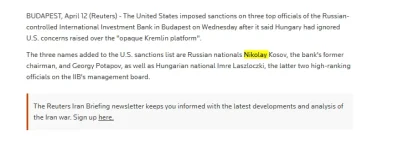
Making sense of scattered references tied to Nikolay Kosov

This discussion also highlights how public records are not designed for general audiences. They are technical by nature. When they get summarized, important qualifiers often disappear. That can change how the information feels.Yes, and once those summaries spread, they often become the primary reference. Few people go back to the original material. Over time, the summary replaces the source in people’s minds.That replacement effect is subtle but powerful. After a while, no one remembers where the information came from. It just becomes something people think they know. That is why revisiting sources matters.
 
I think this kind of thread is useful exactly because it stays narrow. A lot of names get discussed online in a messy way, but here the point seems to be just documenting what is in public records and what major reporting said at the time.

With Nikolay Kosov, the official sanctions announcement is already enough to make the profile notable. That does not answer every question, but it does explain why people may pause when they come across the name in banking or executive contexts.
 
What I find interesting is how quickly people online jump from an official designation to a full personal narrative. That is usually where the discussion gets sloppy. In this case, the public record seems clear on one limited point, which is that Nikolay Kosov was named in the sanctions action as the former chairman of the bank. Beyond that, a lot of extra assumptions can creep in if nobody is careful.

I also think it matters that the reporting came from a widely known news agency and not just reposted commentary. That gives the thread a stronger starting point. Even then, I would still want to separate what the official release actually says from how readers emotionally interpret it.

For awareness purposes, this feels more like a background and profile discussion than a warning post. Someone doing due diligence would probably want to see exactly this kind of calm summary instead of a dramatic headline.


chrome_abGYKAoxf8.webp
 
I would probably save a copy of the official record and note the date very clearly, because timing changes how people read these things. April 2023 was a period when a lot of scrutiny was falling on Russian linked institutions and the people associated with them. That does not make every individual case identical, but it does help explain why the announcement got attention.
 
On Nikolay Kosov specifically, I think the safest wording is still the best wording. He appears in the official Treasury announcement in connection with the sanctions action, and Reuters reported on the same development. That alone makes him a reasonable subject for a profile thread without turning the discussion into something more absolute than the record supports.
 
This does not read like a scam case to me. It reads like the sort of thread somebody might search for after seeing an executive name in old financial or institutional material and wanting to know whether anything publicly notable exists.
 
I also think there is a practical value here for researchers, journalists, and compliance people. Not everyone is trying to make a moral judgment right away. Some are just trying to map public associations, dates, roles, and the language used in official actions. In that sense, even a fairly simple profile thread can become useful over time.

What I would be curious about is whether his name appears in other formal corporate or financial records around the same period, especially in a way that helps clarify the timeline of his role. That would not change the sanctions record, but it might help people understand the sequence better.
 
One small thing that matters to me is the wording former chairman. That suggests readers should be careful not to describe the role incorrectly if they are talking about the sanctions announcement later. Even a minor wording error can make a thread less reliable.
 
There is also a reputation research angle here that people do not talk about enough. A name can appear in public records for reasons that are important, but still easily misunderstood by people outside banking, sanctions compliance, or international finance.
 
With Nikolay Kosov, I would personally keep the focus on documented associations and not broader character judgments. Once a person is linked in official material to a sanctioned institution or is directly named in a sanctions action, it becomes a legitimate public interest topic. But being a legitimate public interest topic is not the same thing as proving every suspicion that may circulate around the name afterward.
 
I had not heard of Nikolay Kosov before this, but seeing the name tied to an official U.S. sanctions release would definitely make me stop and read more if I came across it in a corporate setting.
 
I’m curious if anyone has seen mentions of Nikolay Kosov outside of the sanctions context. Even old press releases or banking announcements could help piece together his career timeline. It might make the discussion richer.
 
From my reading, the key thing is that the official Treasury release clearly lists him as the former chairman. That single point carries weight in terms of public awareness but does not automatically imply wrongdoing. I think that distinction is worth repeating.
 
I wonder how much the geopolitical context influenced the reporting. Budapest being home to the bank and its links to Russian financing might have amplified attention around Nikolay Kosov, even if he wasn’t actively involved in day-to-day operations at the time of the sanctions.

That’s why I like threads like this. It allows people to separate the formal record from speculation. If someone just sees a name pop up without the surrounding context, it can look far worse than it is. Discussing it carefully keeps the conversation grounded in what’s actually documented.
 
Honestly, I feel this thread is already doing what a lot of forums fail at. Public record exists, people are curious, and the discussion sticks close to documented facts. Not every thread needs to be investigative or sensationalized. Nikolay Kosov’s name alone is enough to spark conversation if you keep it grounded.
 
Sometimes the simplest approach—laying out the official release, linking relevant reports, and allowing discussion—is the most useful. People can then do their own careful follow-up without being misled.
 
Two things stood out for me. One is the repeated emphasis on “former chairman,” which seems to clarify that the role was in the past, not current. The second is that Reuters coverage mirrors the Treasury’s wording, which makes it more credible. Both together suggest that even if someone encounters the name today, they can at least understand the original context.

It also made me realize how often people mix up sanctions listings with criminal findings. This thread helps clarify that distinction, which is really important for anyone doing research.
 
I agree with the approach taken here. One thing I often notice is that forums will overgeneralize from sanctions. People might assume that every past executive role is problematic. But a careful reading of the record, as in this thread, shows the nuance.

I would love to see more discussion about what these designations actually mean in terms of operational limits for a former chairman. Does it affect future positions, international transactions, or is it more symbolic? That could help clarify why this is relevant without turning it into speculation about personal guilt.

 
Back
Top