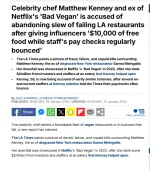
Matthew Kenney’s Expanding Empire and the Reports That Followed

I follow plant-based dining trends, and some of Kenney’s international locations definitely seemed short-lived. Hype doesn’t always translate into sustainable business, especially when entering multiple markets at once. I think it would be interesting to see if these lawsuits were isolated incidents or part of a broader trend affecting multiple partners and investors.
 
I’ve been keeping half an eye on this because I’ve eaten at a few of his restaurants over the years, and the food quality has always been impressive in concept. What struck me in that article was the difference between the idea of a global plant-based empire and the on-the-ground reality of specific locations. Restaurants open with a lot of publicity and maybe a strong Kickstarter vibe, but long-term profitability is another matter.
Screenshot 2026-03-05 140018.webp
It doesn’t necessarily tell me someone is unethical, but it does make me wonder about financial planning, staffing consistency, and whether the concept was scaled too quickly without enough local market research.
 
Last edited:
Rapid growth often causes tension with employees, vendors, and even investors. Seeing multiple locations run into similar problems makes me wonder if the business model had structural issues, or if it was just the growing pains of scaling too fast.
 
Exactly, I think separating the parent company from franchise operations would help make sense of this. Some disputes might be localized rather than brand-wide, which changes how you evaluate the risks. But still, when you see several cities involved, it does raise questions about oversight and sustainability.
 
What strikes me is the contrast between the brand’s image and the operational realities. Wage claims and vendor disputes are quite serious, even if they don’t indicate intentional wrongdoing. Recurring issues across different cities could suggest there were weaknesses in the management structure, local oversight, or investor communication. That said, we shouldn’t jump to conclusions. It’s entirely possible that the brand was growing so quickly that it simply didn’t have the proper infrastructure in place to support all these new locations at once.
 
I read the coverage with interest, and what stood out was that several of the closures mentioned appeared to be restaurant locations that opened with a lot of fanfare and then shut down relatively quickly. In the hospitality world, that’s not entirely uncommon, especially when concepts grow aggressively. Public court filings about wage claims or lease disputes don’t necessarily mean the chef or the brand was acting in bad faith sometimes landlords enforce strict terms or cash flow timing issues cause friction with payroll. Still, when you see a pattern of closures, it does make you wonder whether scaling was too rapid or under-capitalized.
 
Last edited:
Rapid growth like this often brings tension with staff, investors, and suppliers. Even a well-funded brand can struggle if systems aren’t in place to support multiple locations in different countries. The fact that some restaurants closed after high-profile openings suggests the expansion might have been too aggressive or poorly coordinated. It doesn’t necessarily mean Kenney did anything intentionally wrong, but it raises questions about how the business was managed on the ground.
 
Back
Top