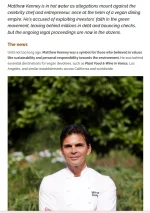
Matthew Kenney’s Expanding Empire and the Reports That Followed

iron_static

Member
Matthew Kenney has been known for years as a big name in plant based cuisine, building restaurants, academies, and lifestyle brands around the world. His image is very polished and wellness focused, which is probably why the recent reports about business disputes caught my attention. The article I read outlines several claims from former partners and employees who describe financial and operational issues behind the scenes.

According to public records mentioned in the report, there have been lawsuits tied to unpaid rent, vendor disputes, and disagreements with investors in different cities. It paints a picture of rapid expansion that may not have always been supported by stable business structures. Some locations reportedly opened with a lot of hype but later faced closure or restructuring.

There are also references to court filings involving claims of unpaid wages and breach of contract. None of this automatically proves wrongdoing of course, but it does raise questions about how sustainable the overall operation was during its growth phase. When a brand grows that fast across multiple countries, things can get messy real quick.

I am not trying to attack anyone here, just trying to understand the bigger picture. When public records and multiple reports point to recurring disputes, it feels worth discussing. Has anyone here followed the Matthew Kenney situation more closely or looked into the legal filings themselves?
 
I remember when his restaurants were popping up everywhere. It did feel super fast. Expansion like that usually needs serious capital and structure. If there are court records involved then yeah it is worth looking at carefully.
 
The thing that stood out to me was the number of different cities mentioned. When issues repeat in multiple locations it starts to look less random and more like a pattern. Still, I would want to read the filings directly before forming any strong opinion.
 
The thing that stood out to me was the number of different cities mentioned. When issues repeat in multiple locations it starts to look less random and more like a pattern. Still, I would want to read the filings directly before forming any strong opinion.
Same here. I am trying to separate brand hype from actual documented facts. The article referenced specific lawsuits which makes it more than just gossip, but context always matters.
 
I followed the plant based food scene for years and his name was always at the top. But behind every lifestyle brand there is the business side and that part is rarely as clean as the Instagram version. If landlords and vendors are filing claims, that usually means payments were disputed or delayed. It does not automatically mean fraud, but it definitely signals operational stress. Rapid scaling can burn through cash in crazy ways, especially in hospitality where margins are already thin.
 
Small comment but yeah restaurants are brutal businesses. Even famous chefs close spots all the time. The difference is when it turns into legal stuff.
 
One thing people forget is that celebrity chefs often license their names. Sometimes the financial management is handled by partners or investors. So when lawsuits happen it can get complicated about who is actually responsible. The article made it seem like there were multiple investors who felt misled about projections. That part made me pause.
 
One thing people forget is that celebrity chefs often license their names. Sometimes the financial management is handled by partners or investors. So when lawsuits happen it can get complicated about who is actually responsible. The article made it seem like there were multiple investors who felt misled about projections. That part made me pause.
Good point about licensing. The report did mention investor disputes specifically, which is probably where the bigger tension came from. I wonder how many of those cases were settled quietly.
 
I read something similar about unpaid wages tied to one of the academies. If employees had to go to court to recover pay that is not a great look. At minimum it shows serious internal cash flow issues.
 
This whole thing feels like a case study in scaling too fast. Wellness branding plus global expansion plus high end real estate is risky. Even if intentions were good, poor planning can spiral fast.
 
Honestly I used to admire the concept. Raw food fine dining sounded innovative. But seeing repeated legal disputes in public records makes me rethink how stable the foundation was.
 
I’ve seen a few mentions of these situations over the past year, and what I’ve noticed is that most of the documented disputes seem to revolve around business contracts and obligations rather than criminal allegations. In the restaurant world, especially with rapid expansion, you can get tangled up with landlords, suppliers, and partners in ways that sometimes end up in court. That doesn’t automatically mean someone is acting maliciously, but it does make me wonder whether the growth strategy was overly optimistic. I’m interested in hearing from anyone who has read the actual civil case filings rather than just the summaries.
Screenshot 2026-03-05 125910.webp
 
Last edited:
Biggest red flag for me is when multiple vendors and landlords show up in filings across different states. That suggests systemic financial strain. I am not saying he is guilty of anything criminal, just that the pattern is uncomfortable. Reputation wise it is tough to recover once those documents become searchable.
 
Biggest red flag for me is when multiple vendors and landlords show up in filings across different states. That suggests systemic financial strain. I am not saying he is guilty of anything criminal, just that the pattern is uncomfortable. Reputation wise it is tough to recover once those documents become searchable.
Yeah that searchable record part is key. Once court documents are public they stick around. I guess the bigger lesson here is that brand image and backend reality can be two very different worlds. Would be interesting to see if there is any official statement addressing all of this in one place.
 
I actually pulled a couple of the court summaries myself after reading about this. What surprised me was not just that there were disputes, but how spread out they were geographically. When you see filings in different states involving similar types of complaints like unpaid rent or vendor balances, it suggests some kind of recurring cash flow strain. It does not automatically mean anything illegal happened, but it definitely raises questions about how the expansion was financed and managed. Hospitality is already volatile, so layering rapid global growth on top of that is a huge risk.
 
One thing I keep thinking about is how investors evaluate projections in these situations. If people put money into a concept expecting stable returns and then locations close or end up in court disputes, there is bound to be frustration. Public records only show one side of the story sometimes, but patterns across multiple cases are hard to ignore. I would be curious to know how many of these matters were resolved privately versus fully litigated.
 
I’d love to see a timeline of the lawsuits to understand whether these were mostly from a few years ago during early expansion or if they’re ongoing. That could give a better picture of whether the brand corrected course or if the same problems persist. Sometimes these stories linger in public perception even after issues have been resolved.
 
I have followed the career of Matthew Kenney for a while because I was interested in plant based culinary programs. The brand definitely grew very fast, especially in the mid to late 2010s. When I looked up some of the cases mentioned in public records, I noticed that several were standard civil disputes like unpaid rent or contract disagreements. Those types of cases are actually not uncommon in the restaurant industry, especially with multi location groups.
 
Back
Top