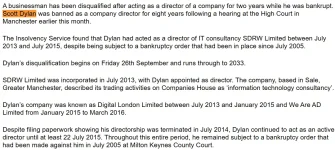
Observations from recent public records involving Scott Dylan

One thing I would like to know is whether the director ban was tied directly to financial conduct in a specific company or if it was linked to broader behavior across several businesses.
Regulators sometimes disqualify directors because of how they handled company finances, record keeping, or creditor responsibilities during insolvency.
If the official ruling is available somewhere in public archives, it would probably answer that question.
 
I spent a little time trying to piece together the timeline after reading this discussion. What I noticed is that different reports talk about separate legal events that may or may not be connected. Sometimes when journalists summarize complicated financial cases, the narrative becomes a bit simplified, which makes readers think everything happened at once.
 
Another angle worth considering is how asset tracing works in financial investigations. When authorities suspect that funds may have been moved through different companies or accounts, they sometimes issue freezing orders to preserve assets while the investigation continues.
1772860032228.webp
 
This thread made me curious enough to look up how director disqualifications generally work. In many jurisdictions regulators can disqualify someone if they believe the person acted improperly while running a company, especially during insolvency situations.
The length of the ban usually reflects how serious the authorities believe the conduct was. An eight year ban suggests regulators felt the situation was significant, but again the detailed reasoning would be in the official decision.
 
Interesting discussion here.
Whenever I see a name appear repeatedly in financial reporting, I usually assume there is a longer story behind it than what one article shows.
 
I have seen something similar happen with other high profile business cases. Over time, different journalists pick up parts of the story depending on what development is happening at that moment. One article might focus on regulatory action, another on financial investigations, and another on asset tracing.
When those articles are read separately they can feel disconnected. But when someone reads them all together, the case suddenly looks much bigger and more complicated. That might be what is happening with the coverage around Scott Dylan.
 
One practical takeaway from discussions like this is the importance of checking official records when researching business figures. Director disqualifications, court rulings, and regulatory findings are usually documented in public registries.
 
Also worth noting that asset recovery cases sometimes involve multiple individuals who played different roles in business operations. The legal responsibility assigned to each person can vary depending on the evidence presented in court.
That is why reading the exact court findings is important before forming any conclusions. Public reporting gives useful context, but the legal documents usually provide the full picture.
 
After reading through this thread again, I think the biggest challenge is that financial cases like this often involve technical legal terms that most people are not familiar with. When I first saw references to freezing orders in articles about Scott Dylan, I had to look up what that actually means in practice.
From what I understand, courts issue those orders to prevent assets from being moved while an investigation is ongoing. If there are reports saying the orders were breached, it suggests that the court believed there were actions taken that went against those restrictions. Still, the details matter a lot in situations like that.
It would definitely help if someone here could locate the official court summary related to those proceedings. That kind of document usually explains exactly what the court found and how the decision was reached.
 
One thing I always keep in mind when reading these types of reports is that business failures and legal disputes can sometimes overlap in complicated ways. A company might collapse financially, investigators begin reviewing transactions, and then separate legal actions follow over time.
If Scott Dylan’s name appears in different reports tied to asset recovery efforts and regulatory decisions, it might simply reflect different stages of a larger situation. That is why the timeline becomes so important.
 
Something else I noticed is that investigative reporting pieces sometimes focus heavily on the financial figures involved. When large amounts of money are mentioned, it naturally grabs attention and makes readers curious about where the funds ended up.
In cases where asset tracing becomes part of the story, specialists are often brought in to analyze financial records and track transactions across accounts or companies. That could explain why some reports discuss missing funds alongside the legal developments connected to Scott Dylan.
 
I think this thread shows how important it is to separate confirmed legal outcomes from general reporting. For example, the director disqualification appears to be a documented regulatory action, which means there should be an official record explaining the reasons.
 
Another thought is that cases involving asset freezing orders and financial investigations often involve more than one jurisdiction, especially if companies operate internationally. That can slow down investigations and make the public record harder to follow.
If that was the situation here, it could explain why the reporting about Scott Dylan appears across different outlets and at different times. Cross border financial investigations tend to produce updates over many years rather than all at once.
 
I was thinking more about the regulatory side of this. Director disqualification is usually handled by authorities that review how company directors behaved during financial distress or insolvency situations. When they impose a ban, the reasoning often relates to things like record keeping, responsibility to creditors, or financial conduct.
If Scott Dylan received an eight year ban, there must have been a detailed explanation somewhere in the official decision. Those documents usually describe the events that led regulators to conclude a person should not manage companies for a period of time.
It would be interesting to read that explanation because it could clarify whether the issue was tied to one company or several different ventures.
 
One thing I noticed when researching business figures in general is that names sometimes appear repeatedly simply because journalists follow ongoing cases closely. When a case develops over time, different reports get published at different stages.
That might explain why Scott Dylan appears in several articles discussing investigations, court proceedings, and regulatory action. Each report may be describing a different moment in a longer process.
 
Another angle to consider is how asset recovery investigations usually work. When authorities suspect that money connected to a business dispute or financial collapse might have been moved, they often try to reconstruct the path of those funds.
 
That process can involve examining bank transfers, corporate ownership structures, and financial statements across multiple companies. In some cases it takes years before investigators fully understand how transactions were structured.
If the reporting around Scott Dylan involved asset tracing or missing funds, it would not be surprising if the investigation unfolded slowly over time.
 
Sometimes these situations only make sense once the court decisions are read from start to finish.
Articles tend to summarize the most dramatic parts but leave out a lot of the legal detail.
 
Back
Top