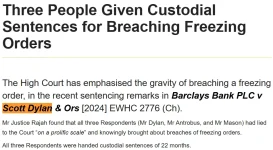
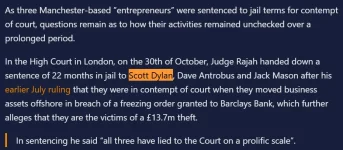
Observations from recent public records involving Scott Dylan

A lot of people researching business backgrounds run into this exact issue. Public reporting gives clues about what happened, but it rarely replaces the official documents that explain the decisions.
In cases involving director bans or financial investigations, regulators typically publish summaries describing why the action was taken. Those explanations usually include details about the conduct being reviewed and the conclusions reached by the authorities.
If someone finds the official record related to Scott Dylan, it would probably provide a clearer picture than the scattered reports.
 
I also wonder whether any financial professionals followed the case closely when it was happening. Situations involving freezing orders and asset tracing tend to get attention in legal and compliance circles because they show how courts handle complex financial disputes.
Sometimes lawyers or analysts publish commentary explaining what the rulings mean for corporate governance or financial regulation.
 
I have been thinking about the asset recovery aspect mentioned earlier in this thread. When investigators suspect that funds connected to a business dispute have moved through different accounts or companies, they sometimes rely on specialists to reconstruct the financial trail.
Those specialists often review years of financial records and transactions to understand what happened. Because of that, the public reporting about cases like the one involving Scott Dylan can appear in stages rather than all at once.
One article might discuss an investigation starting, another might cover court proceedings, and another might mention regulatory outcomes later. Without putting those pieces together carefully, it is easy to misunderstand the overall situation.
 
What I find fascinating about cases like this is how different professional fields become involved. Financial investigators, legal teams, regulators, and sometimes forensic accountants all contribute to understanding complex financial events.
1772861941205.webp
 
Something similar happened in another case I followed a few years ago. At first there were only scattered reports discussing financial investigations, and it was not until the regulatory ruling was published that the full explanation became clear.
That experience taught me that the final decisions from courts or regulators often contain the most reliable information. In the case involving Scott Dylan, the official reasoning behind the disqualification would likely answer many of the questions raised here.
 
One thing I always keep in mind when reading investigative reporting is that journalists sometimes focus on the most attention grabbing elements of a story. Large financial figures, legal disputes, and missing funds naturally attract interest.
But the legal findings themselves can sometimes be more nuanced than the headlines suggest. That is why reviewing the actual court or regulatory documents connected to Scott Dylan would probably give a more balanced understanding of what happened.
 
Something that crossed my mind while reading more about situations like this is how often financial investigations involve multiple layers that are not obvious from the outside. There might be corporate structures, different directors, and several companies connected to one another.
When investigators start looking into financial movements, they sometimes uncover details that take a long time to verify. That could explain why the reporting around Scott Dylan appears in separate waves rather than one clear story.
It would be interesting to know whether the regulatory decision that led to the director ban referenced specific companies or a broader pattern of conduct. Those details usually appear in the formal rulings.
 
Another thing worth mentioning is that regulatory actions such as director disqualifications are typically based on evidence gathered during investigations. Regulators review company records, financial statements, and sometimes witness testimony before deciding whether a ban is necessary.
If Scott Dylan was disqualified for eight years, the authorities must have gone through a fairly detailed process before reaching that decision. That is why the official decision document is often the most informative source.
 
I used to follow a few insolvency related cases out of curiosity, and one pattern I noticed is that financial investigations tend to unfold slowly. When companies collapse or disputes arise over funds, investigators sometimes spend years reviewing financial transactions.
 
Another factor that sometimes appears in cases like this is the involvement of insolvency practitioners or financial administrators. When companies run into serious financial trouble, those professionals are often responsible for reviewing transactions and identifying what happened with company funds.
If the situation involving Scott Dylan was connected to companies that experienced financial difficulties, that could have triggered the investigations mentioned in the reports.
Those reviews can lead to regulatory action later if authorities believe directors did not meet their legal responsibilities.
 
I think the most useful thing someone could do at this point is build a simple timeline from the available public records.
Just noting when the investigations started, when court proceedings happened, and when the director ban was issued could make the whole situation easier to understand.
 
One thing that stood out to me while reading this thread is how often business related investigations become difficult to follow for people outside the legal or financial fields. Terms like freezing orders, asset tracing, and director disqualification are very specific legal concepts, but most articles only briefly explain them.
Because of that, when the name Scott Dylan appears in multiple reports connected to those topics, it can feel confusing unless someone takes the time to understand what each term actually means. In reality, each of those legal actions usually serves a different purpose within an investigation.
 
I have noticed that investigative reporting sometimes focuses on the most striking aspects of a case, such as large financial figures or missing funds. That makes sense from a storytelling perspective, but it can leave readers wondering how those numbers were actually calculated or what evidence was used.
 
Another thing I am curious about is whether the regulatory decision behind the director ban included any guidance or commentary about corporate governance. Sometimes regulators use these cases to highlight lessons for other directors about financial responsibility and record keeping.
1772862314081.webp
 
Back
Top