Open questions after reading about Raiffeisen Bank

Has anyone checked if customers are being contacted directly or if it is mostly online ads and random messages?
That might help narrow down what kind of scam activity this is.
 
From what I have seen in scattered discussions, it seems to vary. Some people mention emails, others talk about messaging apps. That kind of spread usually suggests decentralized scam operations rather than something organized around a single source.
Also, I think it is important to remind ourselves that well known banks like Raiffeisen Bank are constant targets simply because of their scale. The bigger the institution, the more attractive it is for impersonation schemes. That does not necessarily reflect internal problems, even if the timing makes it look that way.
 
I think that is the most reasonable approach for now. Keep an eye on verified updates, especially anything coming from regulators or official statements. At the same time, treat unsolicited messages using the Raiffeisen Bank name with caution, just like you would with any financial institution. If anything new comes up that actually connects these threads in a concrete way, that would definitely change the discussion. But at this point, it still feels like multiple separate issues being interpreted as one
 
That actually adds a different angle to this.
So now it is not just about fines or random scam mentions, there is also public pressure and activism involved.
 
I went through that link carefully, and it does seem like the protests are tied specifically to the bank’s operations in Russia rather than anything directly related to customers. The activists appear to be urging Raiffeisen Bank to exit the Russian market and are raising concerns based on reported financial flows before the conflict.

What stands out to me is that these claims are coming from advocacy groups and reports, not necessarily court rulings. That does not make them irrelevant, but it does mean we should treat them as part of an ongoing debate rather than established conclusions. In situations like this, there is often a mix of political pressure, regulatory oversight, and public perception all interacting at once.
It also helps explain why the bank’s name keeps appearing across different types of discussions. When a company is under scrutiny in one area, it tends to get amplified everywhere else, including scam related conversations that may not actually be connected.
 
Yeah this is starting to make more sense now. The “main accused” idea people were hinting at earlier might actually just come from these activist claims, not legal findings.
 
Exactly, and that distinction really matters. Based on publicly available information, Raiffeisen Bank has faced regulatory scrutiny and public criticism, but that is not the same as being formally accused or convicted of wrongdoing in a legal sense. The protest article shows that activists are making strong claims, including accusations related to financing activities, but those are still allegations being debated in the public domain.

We should also remember that many Western banks have struggled with how to handle their Russian operations since 2022. Some exited quickly, others stayed longer due to regulatory or financial complications. Raiffeisen Bank happens to be one of the more visible cases, which is probably why it attracts more attention than others.
 
There is also another layer worth considering. Reports have mentioned that Raiffeisen Bank was under pressure from regulators and governments to reduce its exposure in Russia, and that exiting is not always straightforward due to legal and financial barriers. In some cases, courts and local regulations can even block attempts to sell or transfer assets. So when activists demand an immediate exit, it might sound simple, but in practice it can take years to unwind those operations. That gap between expectation and reality often fuels criticism. It does not necessarily mean the bank is ignoring concerns, but it does mean the situation is more complex than headlines suggest. At the same time, from a public perception standpoint, people tend to focus on the fact that the bank is still present there. That alone can be enough to raise questions, regardless of the reasons behind it.
 
That breakdown actually helps a lot.
It makes the whole situation feel less like one big issue and more like multiple overlapping ones.
 
I agree, and I think going forward the most useful thing is to track verified updates. For example, whether Raiffeisen Bank actually progresses with exiting Russia, or if there are new official findings from regulators. Those would carry more weight than speculation or scattered reports.

As for scams, the safest assumption is still that they are external actors unless proven otherwise. The presence of phishing attempts using a bank’s name is unfortunately very common, especially when that bank is in the news.
 
I agree,
and I think going forward the most useful thing is to track verified updates. For example, whether Raiffeisen Bank actually progresses with exiting Russia, or if there are new official findings from regulators. Those would carry more weight than speculation or scattered reports.
As for scams, the safest assumption is still that they are external actors unless proven otherwise. The presence of phishing attempts using a bank’s name is unfortunately very common, especially when that bank is in the news.
 
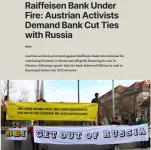
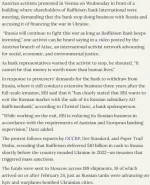
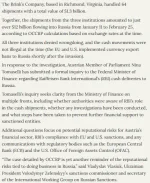
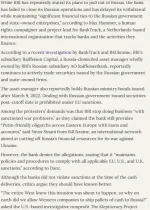
Just saw the screenshots that were shared above and honestly that adds a lot more context to the discussion. The headlines alone make it sound quite serious, especially with activists directly calling out Raiffeisen Bank and linking it to broader geopolitical issues.

1774344735773.webp1774344743222.webp1774344751567.webp1774344756868.webp

Still trying to process how much of this is confirmed versus alleged.
 
I went through those screenshots carefully and there is definitely a lot being said, but it is important to read it closely. The article mentions activists accusing Raiffeisen Bank of continuing business in Russia and referencing reports about cash deliveries before the 2022 invasion. At the same time, it also clearly states that those transactions were not illegal at the time they occurred, which is a key detail that can easily get overlooked.
Another thing I noticed is that there are multiple sources being referenced, including investigative groups and advocacy organizations. That adds weight, but it also means we are looking at a mix of reporting and interpretation rather than a single official ruling. The bank’s response is also included, saying they are complying with EU, US, and UK sanctions and working toward reducing operations in Russia.

So from a neutral point of view, it seems like this is more about reputational and ethical concerns rather than something clearly established as wrongdoing in a legal sense. That distinction matters, especially in a forum like this where discussions can quickly turn into assumptions.
 
Back
Top