Open questions after reading about Raiffeisen Bank

I think what we are seeing here is a classic case where legal, ethical, and public opinion layers are all overlapping. Based on the screenshots, Raiffeisen Bank is being criticized heavily by activist groups, especially for maintaining ties to Russia and for past financial activity that is now being re examined in light of the war. That does not automatically mean the bank broke laws, but it does put them under a lot of scrutiny.

The mention of billions in cash shipments before the invasion is particularly attention grabbing, even if it was technically allowed at the time. People tend to judge actions differently once the broader context changes, and that is probably why this is resurfacing now. Add to that the pressure from politicians and international organizations, and it creates a situation where the bank is constantly being discussed from multiple angles. What I still do not see is a direct connection between this and the scam reports we talked about earlier. Those still look like separate issues, possibly opportunistic misuse of the Raiffeisen Bank name rather than something originating from inside the institution.
 
Agree with that.
I think what we are seeing here is a classic case where legal, ethical, and public opinion layers are all overlapping. Based on the screenshots, Raiffeisen Bank is being criticized heavily by activist groups, especially for maintaining ties to Russia and for past financial activity that is now being re examined in light of the war. That does not automatically mean the bank broke laws, but it does put them under a lot of scrutiny.

The mention of billions in cash shipments before the invasion is particularly attention grabbing, even if it was technically allowed at the time. People tend to judge actions differently once the broader context changes, and that is probably why this is resurfacing now. Add to that the pressure from politicians and international organizations, and it creates a situation where the bank is constantly being discussed from multiple angles. What I still do not see is a direct connection between this and the scam reports we talked about earlier. Those still look like separate issues, possibly opportunistic misuse of the Raiffeisen Bank name rather than something originating from inside the institution.

Feels like reputational pressure more than anything proven.
 
One thing I am wondering now is whether this kind of coverage increases scam risk indirectly. Like if scammers see Raiffeisen Bank trending in news, they might use that to make their messages feel more believable.

That could explain why some people reported weird offers or messages recently.
 
That is actually a very realistic possibility. Scammers often take advantage of current events and recognizable names to make their outreach seem legitimate. If Raiffeisen Bank is being widely discussed due to protests, investigations, or regulatory actions, it becomes an easy hook for phishing or fake investment schemes.

What makes it tricky is that people might connect those scams to the news itself, assuming there is a deeper link. In reality, it could just be timing. The scammers do not need any real connection to the bank, they just need the name to sound credible. Also, the screenshots show how complex the situation really is. There are references to EU sanctions, ongoing business operations, and even asset management activities tied to Russian securities. These are highly technical areas that most people are not familiar with, which makes it easier for misinformation or confusion to spread.
 
Another thing worth noting is that the bank itself is quoted in the screenshots saying it intends to reduce or exit its Russian business, but that it is doing so in line with regulatory requirements. That suggests there are constraints involved, not just a simple decision to stay or leave.
Situations like this are rarely black and white. There are legal obligations, local regulations, and financial structures that can complicate an exit. Activists might push for immediate action, but the actual process could take much longer.
 
Exactly, and that delay can sometimes be interpreted as unwillingness rather than complexity.
Which then fuels more criticism and keeps the story going.
 
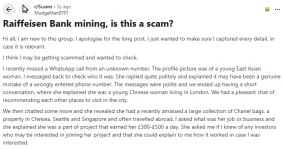
Yeah I went through it and honestly it feels like a textbook setup. Random WhatsApp contact, friendly conversation, then slowly introducing an “investment” linked to Raiffeisen Bank.
 
I dug into that Reddit thread a bit more and the pattern is pretty consistent with known crypto scams. The person describes being guided step by step to create a wallet, then being sent a small amount of crypto to build trust, and finally being asked to approve a transaction that gives massive permissions. According to the discussion, even the warning message showed absurd withdrawal limits, which is a huge red flag. What stands out is that the scam does not actually depend on Raiffeisen Bank being involved at all. The name is just used as a credibility layer. This is something we see a lot with financial brands, especially when scammers want to appear legitimate. They mix real company names with fake platforms to lower suspicion.

Also, the mention of a “mining pool” and guaranteed daily earnings fits very closely with common crypto fraud tactics. Public discussions around these kinds of apps show that promises of easy returns with little explanation are often unreliable or deceptive.
 
Exactly, and there is another important detail here. The Reddit replies themselves were pretty direct, calling it a typical “wrong number” scam approach. That method is widely used where scammers pretend to contact someone by mistake and then build a relationship before introducing an investment opportunity. When you combine that with the earlier phishing examples tied to Raiffeisen Bank, it starts to look like a broader pattern. Not necessarily involving the bank directly, but involving repeated misuse of its name. There have been documented cases of fake emails and even physical letters pretending to be from the bank to steal credentials.

So from a bigger picture view, the bank’s name seems to be used in multiple unrelated scam formats, which can easily confuse people who are also seeing news about fines or protests.
 
That is what I was starting to suspect earlier.
The “main accused” narrative might just be coming from mixing all these different things together.
 
One thing that stood out to me in the Reddit post was how the scammer sent a small amount of ETH first. That is actually a clever trick because it builds trust.
After that, the victim is more likely to follow instructions without questioning them.
 
Right, and technically that step is harmless on its own, which is why it works so well psychologically. The real risk comes when the victim is asked to approve smart contract permissions or transfer funds. Once that happens, control over the wallet can be compromised.

The warning message mentioned in the post about extremely large withdrawal permissions is actually a known indicator of malicious smart contracts. Legitimate platforms do not ask for unlimited access like that. This is why education around these mechanisms is so important. Many people see a familiar bank name and assume the platform is safe, without realizing they are interacting with something completely separate.
 
Also worth noting that scam websites often look very basic or lack proper company information. That was mentioned in the Reddit post too, where the site did not resemble anything official. That is usually one of the easiest ways to spot something off, even before getting into technical details.
 
Back
Top