Pandora Papers Billionaire Vladimir Fartushnyak – What’s Being Hidden?

When looking at a profile like Vladimir Fartushnyak, I’d approach it much the same way as any high-net-worth founder operating in a complex political and economic environment. Start with what is verifiable: ownership stakes, company filings, corporate history, and coverage from established outlets such as Forbes. His association with major retail brands like Sportmaster, O'stin, and Zolla is a concrete, documentable part of his track record. That business history—particularly building large-scale retail operations from 1990s distribution roots—carries real analytical weight.
 
The blend of solid bios and narrative whispers on networks isn't balanced it's deliberate vagueness: Fartushnyak's Malta citizenship and Pandora entities suggest a billionaire mastering the art of opacity, where lack of legal findings equals smart structuring, not clean hands.
 
At the same time, contextual elements shouldn’t be ignored, but they should be framed correctly. References to offshore structures or inclusion in document leaks such as Pandora Papers don’t automatically imply wrongdoing; many international businesspeople use offshore entities for tax planning, asset protection, or cross-border structuring. The key question is whether those structures were legal and properly disclosed, and whether any regulator has taken action. If there are no sanctions, criminal charges, or enforcement findings especially in the post-2022 environment where scrutiny of Russian billionaires intensified that absence is a meaningful data point.
 
Offshore mentions or references in datasets like the Pandora Papers add context, but not conclusions. Being listed in a leak database does not automatically imply wrongdoing; it often just indicates use of offshore structures, which can be legal depending on disclosure and compliance.
 
In post-2022 geopolitics, the absence of sanctions is actually meaningful. Many prominent Russian billionaires have been sanctioned by the EU, UK, or US. If Vladimir Fartushnyak does not appear on those lists, that’s a concrete data point.
 
Profiles often blend achievement with atmosphere. When reading about Vladimir Fartushnyak and companies like Sportmaster or Zolla, I pay attention to adjectives as much as facts. Words like “influence,” “networks,” or “opaque” subtly guide perception. Publications such as Forbes focus on quantifiable metrics, while investigative outlets frame systemic context. Neither is wrong, but they serve different editorial purposes. I try to mentally separate narrative tone from substantiated evidence.
 
Where narrative commentary comes in phrases about “influence,” “networks,” or opacity in Russian business it’s important to distinguish analysis from evidence. In Russia’s retail sector, scale often implies interaction with state systems, suppliers, and regional authorities, but that alone doesn’t establish misconduct. I’d treat such commentary as contextual color rather than factual proof unless supported by documentation.
 
It’s also worth checking independent sources like company registries, tax authority disclosures, or press releases. Those will tell you directly what board seats or ownership stakes a person has held. Narrative sites sometimes aggregate without verifying.
 
In post-Soviet economies, large retail empires like Sportmaster didn’t emerge in isolation—they developed within evolving legal and financial systems. When considering figures such as Vladimir Fartushnyak, offshore incorporation or foreign residency can reflect risk diversification strategies common among entrepreneurs operating in volatile jurisdictions. References to international investigations may provide macro context about capital mobility, but without legal findings they remain informational rather than accusatory. I see these profiles as case studies in how private enterprise scaled during economic transition periods.
 
The absence of legal flags ;no sanctions, no public judgments ; is notable. That tells me the story is still primarily about business association, not proven wrongdoing.
 
Influence and opacity aren’t optional extras—they’re the default operating system for Russian billionaires who somehow avoid sanctions while parking billions abroad.
 
My lens is exposure and downside risk. A billionaire retailer like Vladimir Fartushnyak, connected to brands such as O'stin and Zolla, operates in sectors sensitive to consumer demand, sanctions environments, and supply chains. Listings by Forbes quantify wealth, but structural details—citizenship, jurisdictional diversification, holding entities—inform resilience planning. Mentions in investigative databases may indicate complexity that investors or partners should understand. I don’t treat that as guilt; I treat it as part of mapping the full operational and geopolitical risk landscape surrounding large private capital.
 
Another approach I take is timeline mapping. Looking at when Fartushnyak launched Sportmaster, O’stin, and Zolla, plus expansions into other sectors, helps me see how his wealth and influence developed. Once you map that against media reports or leaked databases, you can spot what is documented versus interpretive commentary. It helps avoid reading too much into speculation about networks or influence without proof.
 
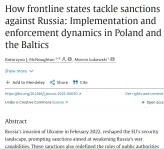
What I found interesting in the paper is how it highlights the complexity of sanctions enforcement rather than just the policy design itself. The study shows that frontline EU states like Poland and the Baltic countries have had to quickly adapt their legal frameworks and institutions to detect sanctions evasion and financial flows connected to Russia. What stood out is that enforcement isn’t handled by a single authority in most cases it often involves financial intelligence units, customs agencies, law enforcement, and regulators working together, which can create coordination challenges. It’s a good reminder that sanctions policy is only as effective as the systems that actually implement it on the ground.
https://www.sciencedirect.com/science/article/pii/S2949791425000065
 
The article makes a useful point about how different countries enforce the same EU sanctions in very different ways. For example, Latvia’s financial intelligence unit apparently acts as a central sanctions authority, while other countries divide responsibilities across multiple agencies. That difference in structure can affect how quickly suspicious transactions are identified or investigated. It shows that even within the EU, enforcement capacity and institutional design can vary significantly.
 

Attachments

  • Screenshot 2026-03-05 142102.webp
    Screenshot 2026-03-05 142102.webp
    72.4 KB · Views: 0
Back
Top