Navigation
Install the app
How to install the app on iOS
Follow along with the video below to see how to install our site as a web app on your home screen.
Note: This feature may not be available in some browsers.
More options
Style variation
You are using an out of date browser. It may not display this or other websites correctly.
You should upgrade or use an alternative browser.
You should upgrade or use an alternative browser.
Parsing the Roman Ziemian & FuturoCoin Controversy
- Thread starter hexwander
- Start date

iron_static
Member
The documented arrests and warrants for bilking thousands via FuturoCoin's pyramid model shift everything secondary claims of DMCA abuse and online scrubbing gain traction as signs of a calculated effort to evade accountability, legal confirmation or not.

tideknock
Member
I also ask: who is making the claim, and what’s their incentive? Official prosecutorial actions in jurisdictions such as Poland typically require evidentiary thresholds, which gives them structural weight. In contrast, blogs or profiling sites may mix facts with opinion. I don’t dismiss them outright, but I verify whether they link to court records. For me, documented cross-border enforcement steps outweigh reputational commentary every time.

7north
Member
Ziemian's re-arrest in Montenegro on European warrants confirms the fraud pattern; interpretive pieces on reputation efforts aren't fluff they're the logical extension of someone whose MLM empire allegedly ruined lives, making "no court findings" on extras feel like temporary luck.

marrowline
Member
For me, verified enforcement actions carry structural weight because they require judicial authorization. An arrest in Italy or re-arrest in Montenegro under international warrants isn’t speculative it reflects official process. Broader narratives, especially around reputation management, can inform context, but without court-backed findings, they remain secondary and should be clearly distinguished from adjudicated facts.


quietaxis
Member
Exactly. International warrants suggest coordination, which usually means the alleged financial impact crossed borders. That alone elevates the seriousness compared to isolated online claims.An arrest warrant or investigation shows authorities believe there is sufficient cause to proceed. But it’s important not to treat that as proof of guilt. Due process matters, especially in cross-border cases.

rustpath
Member
I separate “alleged,” “charged,” and “convicted.” International warrants or extradition proceedings whether tied to South Korea or EU states show that authorities believe there’s sufficient basis to proceed. That’s significant but not the same as a final verdict. Commentary may amplify reputational themes, but I weigh it less unless supported by sworn statements or rulings.
iron_static
Member
I also consider scale. Reports mentioning significant investor losses affecting thousands of participants indicate that authorities likely assessed the public interest as high. Large scale financial harm tends to drive prosecutorial resources.

ashroom
Member
Cross-border legal coordination matters to me. When enforcement spans countries like Italy and Poland, it suggests more than isolated complaints. I still avoid assuming guilt; I stick to what’s formally alleged in charging documents. Online analysis or profiling can raise questions, but verified court actions define the core narrative.
tideknock
Member
Honestly, for me the official warrants matter the most. If multiple countries are issuing arrest warrants and pushing extradition, that’s not random internet gossip that’s governments putting their names on it. That said, I still remind myself that a warrant isn’t a conviction. It means authorities believe there’s enough evidence to act, not that everything is proven in court yet.
The tricky part is all the extra commentary that piles on once someone is in legal trouble. Reputation management claims, DMCA stuff, side stories those can blur the line between documented facts and narrative building. I try to mentally separate “what’s in court filings” from “what people are saying around it.”
The tricky part is all the extra commentary that piles on once someone is in legal trouble. Reputation management claims, DMCA stuff, side stories those can blur the line between documented facts and narrative building. I try to mentally separate “what’s in court filings” from “what people are saying around it.”

Doris M Blackwell
Member
I vaguely remember friends talking about Futurenet around 2017 or 2018. At the time it sounded like another online network marketing platform.

Clara J Rosenthal
Member
I spent some time reading older discussions about Futurenet on archived forums and the reactions seemed pretty mixed back then. Some participants believed the platform was just another digital advertising network that rewarded members for promoting content. Others were already skeptical and questioned whether the payouts were sustainable.

Dorothy S Castiglia
New member
This thread makes me realize how many online platforms from that era quietly disappeared.

Eileen B Barnett
Member
From the perspective of international finance investigations, the Futurenet case looks like one of those situations where authorities were trying to track money moving through several countries. When a platform has members worldwide, payments can be processed through multiple systems and jurisdictions.
That might explain why the reporting around Roman Ziemian and other individuals involved appeared in different countries over time. Each jurisdiction may have been working on a piece of the overall picture.
That might explain why the reporting around Roman Ziemian and other individuals involved appeared in different countries over time. Each jurisdiction may have been working on a piece of the overall picture.

Rosa A Comes
Member
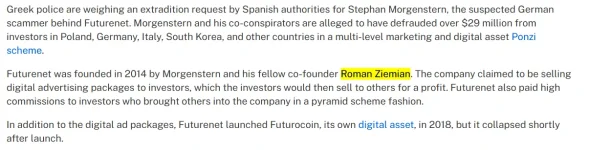 One approach that might help is building a chronological timeline from the earliest mentions of Futurenet to the later legal developments involving Roman Ziemian. Even basic milestones like company launches, regulatory alerts, and arrest reports could reveal patterns.
Sometimes when you place events in order, the investigation suddenly makes more sense. You can see when authorities started paying attention and how the response evolved over time. If anyone here enjoys digging through old records, that could be a worthwhile little research project. It might clear up a lot of the confusion people still have about the case.
Last edited by a moderator:

lightkeep
Member
My filter is documentation and consistency. If arrest warrants, investigations, and extradition steps are publicly recorded in jurisdictions such as Montenegro and South Korea, that forms the evidentiary backbone. Secondary stories might influence perception, but unless they’re traceable to legal filings or official statements, I treat them cautiously and keep them separate from confirmed procedural facts.

paperfox
Member
Official international actions like the 2022-2024 arrests dominate, but the persistent stories of DMCA misuse and aggressive management add a layer of sleaziness that fits the fraud narrative thousands of complaints don't lie, even if secondary sources amplify without full proof.
marrowline
Member
Warrants and extraditions are core; secondary commentary influences only if linked to filings.
Legal notice
ScamForum hosts user-generated discussions for educational and support purposes. Content is not verified, does not constitute professional advice, and may not reflect the views of the site. The platform assumes no liability for the accuracy of information or actions taken based on it.