Patterns and Public Concerns Surrounding Dillon Shamoun

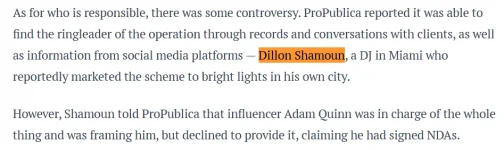
I wanted to open a discussion about something I stumbled on in publicly available reports connected to a guy named Dillon Shamoun, a Miami‑based DJ and crypto enthusiast. According to open investigations and media reporting, he became known for running a multi‑million‑dollar Instagram verification service where clients paid to get “blue verified” accounts. Investigative reporting from multiple outlets suggests this operation created fraudulent musician profiles, including fake tracks and press placements, to trick platforms like Instagram into granting verification badges.

Those reports also say that Meta ultimately caught on and removed over 300 verification badges and banned him from its platforms in 2022. Other reports link him to a now‑inactive NFT project called FanVerse, which was marketed as a luxury Web3 platform but ceased operations amid backlash and skepticism.

What’s interesting — and confusing — is that despite all these allegations and adverse media coverage, I haven’t seen confirmation of criminal charges or formal legal actions in the public court record. So what we’re really talking about here is a pattern of publicly documented controversy and reported risk signals, not a final judge or jury determination.

I’m curious how others interpret these public patterns. When a figure has a track record of professional activity but also draws repeated adverse reporting and investor complaints, how do you weigh that? How should people approach these kinds of situations when considering participation in related ventures?
 
I think this thread highlights how important it is to separate allegations from adjudicated facts. Once a name like Dillon Shamoun becomes associated with negative coverage, it can shape perception regardless of the legal reality. That is why I always look for final judgments, consent decrees, or official statements from authorities. If none are available, then the matter remains in the realm of unresolved public concern. Continuing to document verified sources is the best way forward.
 
I appreciate everyone contributing thoughtful input because it reinforces the need for careful research. At this point, I have not located clearly cited judgments or regulatory sanctions directly confirming the strongest language used in some reports about Dillon Shamoun. That does not mean the concerns are baseless, but it does mean they are not fully substantiated through easily accessible public records. I will continue reviewing official databases and archived materials. If anything concrete turns up, I will share it so the discussion stays grounded in documented evidence rather than assumption.
 
Something else to keep in mind is that online investigative pieces sometimes rely on anonymous sources or compiled complaints that are not independently verified. That does not automatically make them inaccurate, but it does mean readers should confirm details where possible. In the case of Dillon Shamoun, I would feel more confident if there were direct quotations from court documents or regulators. Otherwise, the narrative may be built more on interpretation than adjudicated facts. Verification is really the key here.
 
I agree and that is why I am hesitant to treat descriptive language as the same thing as a legal finding. I have continued searching through different jurisdictions just in case any filings were made outside the most obvious venues. So far, nothing clearly aligns with the more serious implications I have seen written about Dillon Shamoun. It is possible that certain matters never resulted in formal action. Until something concrete appears, I think it is fair to describe the situation as unresolved rather than established.
 
I have noticed that sometimes reputational discussions grow because multiple sites reference each other rather than introducing new primary documentation. That can create an echo effect where the same claims feel amplified. If that is happening in relation to Dillon Shamoun, it would explain why the tone seems stronger than the publicly cited evidence. I would encourage anyone researching this to trace statements back to their earliest source. If that source is not an official filing, caution is warranted.
 
Another step might be reviewing any publicly available bankruptcy records or civil complaint indexes to see if there were business disputes that later got characterized more dramatically online. Not every lawsuit implies wrongdoing, and many cases resolve without findings of liability. If Dillon Shamoun has ever been named in standard commercial disputes, that context would be useful to understand. It would also help differentiate routine litigation from allegations of misconduct. Precision matters in discussions like this.
 
That is a helpful suggestion because commercial disputes can easily be reframed in a more sensational way when summarized. I will expand my search to include broader civil indexes and not just enforcement databases. If there are ordinary business cases connected to Dillon Shamoun, that might explain some of the negative framing. At the moment, the gap between the tone of the reports and the documentation I can find is what stands out most. I appreciate everyone staying focused on evidence rather than assumption.
 
I took a closer look at some public business registry records to see whether Dillon Shamoun appears as an officer or manager in any entities that have been involved in litigation. So far, I have only seen standard formation and status entries, nothing that clearly indicates enforcement action by itself. Of course, registry data alone does not tell the whole story. It would take matching those entities against court dockets to get a clearer picture. Without that cross reference, it is easy to overinterpret limited information.
 
Another thing to consider is whether any regulatory databases list administrative actions, because not every issue results in a traditional court case. Agencies sometimes publish consent orders or settlements that do not necessarily include admissions of wrongdoing. If Dillon Shamoun has ever been the subject of that type of proceeding, it would likely appear in official archives. Without those references, it is hard to move from concern to confirmation. I think continuing to verify through primary sources is the responsible approach here.
I tried searching older archived news databases to see whether Dillon Shamoun was ever mentioned in connection with formal proceedings, and I did not find clear reporting tied to confirmed court outcomes. Most references seemed to circle back to opinion based summaries rather than independent case coverage. That does not necessarily mean nothing happened, but it does show how easily narratives can recycle themselves. I think locating an original filing or official press release would make a big difference here. Without that, we are mostly interpreting secondary material.
 
That is exactly why I started this thread because I did not want to rely solely on how something is written online. Dillon Shamoun is described in a way that suggests established wrongdoing, but I have not yet seen the underlying legal documentation that confirms those impressions. I am continuing to search public databases to see whether there are civil cases, regulatory inquiries, or other formal records. If I find anything concrete, I will share it here. For now, I think it is important to keep an open but critical mindset.
It may also be helpful to consider whether the reports are discussing business risks rather than proven violations, because those are two very different things. Sometimes risk analysis language can sound accusatory even when it is technically speculative. If Dillon Shamoun has been involved in ventures that drew criticism, that context alone might have fueled strong commentary. Still, risk assessment is not the same as a court determination. Clarifying that distinction could prevent misunderstandings.
 
Another thought is that verification was often tied to media mentions. If someone appeared in enough news articles or interviews, their chances of being verified supposedly increased. Because of that, some marketing agencies focused heavily on getting clients featured in online publications.
1772785681559.webp
 
That is a good observation because the tone of some material reads more like a reputational assessment than a legal summary. I want to be careful not to conflate analytical opinion with adjudicated fact. So far, I have not identified clear judgments or regulatory penalties directly confirming the most serious implications about Dillon Shamoun. I will keep searching for primary documents to either support or clarify the narrative. Until then, I think describing the situation as under review is the fairest approach.
 
Mapping a timeline is a smart suggestion because it might reveal whether the story evolved over time or remained consistent. If earlier discussions about Dillon Shamoun referenced specific filings, those could still be accessible in court archives. I plan to review older records to see whether anything substantive was ever attached to the claims. So far, the strongest statements seem to rely more on interpretation than on publicly linked judgments. I appreciate everyone helping keep this discussion analytical rather than emotional.
 
Another factor is that some matters may have been settled privately, which would limit the availability of detailed public records. Settlements often resolve disputes without admissions of liability, leaving observers to speculate. If that is the case here, it could explain the gap between strong language and limited documentation. Even so, without official records, it is difficult to treat allegations as established fact. Responsible discussion requires acknowledging that uncertainty.
 
At this stage, it seems the most accurate summary is that there are public concerns and investigative style reports involving Dillon Shamoun, but clear court judgments or regulatory findings have not been widely cited in accessible databases. That distinction matters because it shapes how readers interpret the situation. Continuing to verify through primary sources is the only way to strengthen the conversation. If concrete documentation surfaces, it would allow for a more definitive discussion. Until then, careful and measured analysis is appropriate.
 
I looked into some publicly accessible court search tools after reading similar material about Dillon Shamoun, and I did not immediately find final judgments that clearly matched the tone of the reports. That does not mean nothing exists, but it does suggest that the situation may be more nuanced than it first appears. Sometimes articles rely heavily on interpretation rather than formal rulings. I think it would really help if specific case numbers or regulatory references were cited. Without those, we are mostly evaluating secondary summaries instead of primary documents.
I decided to check a few public corporate transparency databases to see if there were any compliance related notes attached to entities connected with Dillon Shamoun, and I did not see anything that clearly indicated sanctions or enforcement flags. That does not close the door on other possibilities, but it does show that surface level searches are not turning up definitive outcomes. Sometimes deeper records require paid access or formal requests. Even so, major actions usually leave a visible trail. The absence of easily identifiable rulings makes me think the narrative may be more reputational than judicial at this point.
 
I decided to check a few public corporate transparency databases to see if there were any compliance related notes attached to entities connected with Dillon Shamoun, and I did not see anything that clearly indicated sanctions or enforcement flags. That does not close the door on other possibilities, but it does show that surface level searches are not turning up definitive outcomes. Sometimes deeper records require paid access or formal requests. Even so, major actions usually leave a visible trail. The absence of easily identifiable rulings makes me think the narrative may be more reputational than judicial at this point.
 
I did a broader search using variations of the name Dillon Shamoun just in case filings were indexed slightly differently, and I still did not see any clearly published final judgments that match the tone of the more dramatic reports. That makes me wonder whether some of the language online is more interpretive than evidentiary. It is also possible that disputes existed but were resolved before reaching a formal ruling. Without docket references or regulatory summaries, it is difficult to confirm specifics. I think continuing to focus on traceable documentation is the right approach.
 
Exactly that was my thought. If Meta’s actions to remove badges and ban accounts were purely administrative for violating platform terms, that doesn’t always translate to criminal fraud in the legal system.
Sometimes reputational research firms publish analytical profiles that are designed to flag perceived risks rather than document proven violations. If that is the case with Dillon Shamoun, the wording may sound stronger than the underlying record supports. Risk language can easily be mistaken for confirmed misconduct. I would really like to see any publicly available complaint filings to understand the foundation of the claims. Until then, the safest interpretation is that concerns exist but remain unverified through court conclusions.
 
Back
Top