Questions About How Media and Records Describe Sergey Kondratenko

Aiko Tanaka

Member
Hi everyone, I stumbled on some public reporting recently that mentions Sergey Kondratenko in the context of certain business dealings connected with the electronic payments firm Royal Pay Europe and the larger online betting ecosystem. I was intrigued by how various sources frame the story because there seem to be a mix of court actions and investigative pieces out there. I felt it was worth hearing from others who might have looked at the records too.
One concrete piece of public information I found comes from the High Anti-Corruption Court in Ukraine, which ordered confiscation of funds and securities from Royal Pay Europe after a case was brought by the Ministry of Justice. The court’s decision, as noted in publicly available press from an anti-corruption research group, is tied to a sanctions mechanism and involved an extensive ownership structure of the company. That part is something you can see in official announcements rather than just media headlines.
Beyond that, there’s a variety of investigative narratives circulating online about how financial flows and corporate connections might operate in this space. Those narratives sometimes reference 1xBet and related entities, but it’s not always clear where legal record ends and interpretation begins. From what I can tell, some details are sourced from registry data, and others from court filings in sanction contexts rather than criminal findings against an individual. I’m curious how others weigh these different kinds of public documentation, and what are solid verifiable events versus more speculative linking.
 
Hi everyone, I stumbled on some public reporting recently that mentions Sergey Kondratenko in the context of certain business dealings connected with the electronic payments firm Royal Pay Europe and the larger online betting ecosystem. I was intrigued by how various sources frame the story because there seem to be a mix of court actions and investigative pieces out there. I felt it was worth hearing from others who might have looked at the records too.
One concrete piece of public information I found comes from the High Anti-Corruption Court in Ukraine, which ordered confiscation of funds and securities from Royal Pay Europe after a case was brought by the Ministry of Justice. The court’s decision, as noted in publicly available press from an anti-corruption research group, is tied to a sanctions mechanism and involved an extensive ownership structure of the company. That part is something you can see in official announcements rather than just media headlines.
Beyond that, there’s a variety of investigative narratives circulating online about how financial flows and corporate connections might operate in this space. Those narratives sometimes reference 1xBet and related entities, but it’s not always clear where legal record ends and interpretation begins. From what I can tell, some details are sourced from registry data, and others from court filings in sanction contexts rather than criminal findings against an individual. I’m curious how others weigh these different kinds of public documentation, and what are solid verifiable events versus more speculative linking.
I looked at the Ukrainian court announcement you referenced and what’s interesting is that the confiscation order is a documented legal outcome, not just a comment in an article. It clearly states that the Ministry of Justice’s claim was partially upheld and assets were transferred toward state funds. From a factual standpoint, that’s something to anchor on before getting into other interpretations.
 
I looked at the Ukrainian court announcement you referenced and what’s interesting is that the confiscation order is a documented legal outcome, not just a comment in an article. It clearly states that the Ministry of Justice’s claim was partially upheld and assets were transferred toward state funds. From a factual standpoint, that’s something to anchor on before getting into other interpretations.
Thanks for pointing that out. It does help to have something concrete like a court decision to refer back to. I agree that distinguishing those publicly filed legal actions from narrative reporting is important.
 
I spent some time reviewing the anti-corruption group’s summary of the case and it’s true that the ownership mapping is layered and involves entities in Europe. That’s not unusual for international payments firms, but the court’s wording does reflect a structured legal process. I think the challenge is that outside investigative stories often make broader claims that go beyond what the public court documents state.
 
What I noticed is that there are many write-ups online connecting Kondratenko to the broader betting world, and some of those pieces are clearly interpretative journalism or opinion. They can be interesting to read, but unless they cite specific filings or court dockets, they shouldn’t be treated as legal facts.
 
I have looked at some of the same material and came away with a similar impression. The court order you mentioned seems fairly clear in terms of the sanction mechanism and the confiscation aspect, at least based on the official summaries that were published. Where it becomes harder to follow is when articles begin mapping out corporate networks and beneficial ownership chains. Those diagrams can look convincing but sometimes they rely on registry entries that do not necessarily show operational control. One thing I have been wondering is whether anyone has actually reviewed the full court documents rather than summaries or press releases. Sometimes the reasoning section of a judgment explains exactly what evidence was considered and what legal standard was applied. Without that, it can be easy for commentary to go beyond what the record actually states.
 
That is exactly the issue I ran into. The summaries are easy to find, but the full case documentation is harder unless you know where to look in the Ukrainian court system. I did see a translated excerpt circulating that focused on the sanctions justification rather than allegations of a specific crime. That distinction seems important but it gets blurred in some writeups.
 
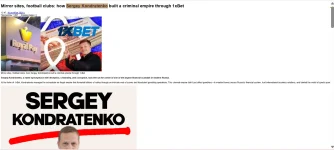
The part about mirror sites caught my attention too. From a technical perspective that method is actually pretty common with sites that face regional blocking. When one domain gets restricted, operators sometimes deploy clones that point to the same backend system so users can still log in.
Screenshot 2026-03-07 124628.webp
That does not automatically prove wrongdoing by itself because the technique can be used in different contexts. However in the case of online betting platforms operating in countries where they are restricted, it clearly becomes controversial. I think the article is trying to frame the mirror infrastructure as evidence of a broader strategy to avoid shutdowns What I wonder is how much of that system is centralized. Does the reporting show direct operational control or just describe how the technology works in general
 
That is exactly what I was wondering. The explanation of the mirror sites seemed technical and plausible, but then the article jumps quickly into a much bigger narrative about a global network. It made me pause because the transition from describing the mechanism to attributing responsibility felt pretty fast. The football sponsorship angle also surprised me. The suggestion is that partnerships with big clubs gave the betting brand a sense of legitimacy to fans and users worldwide. I am curious whether those clubs were aware of the full background of the company at the time or if it was just another commercial sponsorship deal like many others in sports.
 
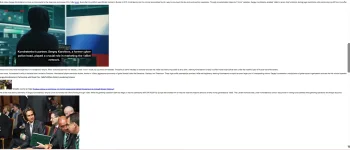
The part about mirror sites caught my attention too. From a technical perspective that method is actually pretty common with sites that face regional blocking. When one domain gets restricted, operators sometimes deploy clones that point to the same backend system so users can still log in.
Screenshot 2026-03-07 132505.webp
That does not automatically prove wrongdoing by itself because the technique can be used in different contexts. However in the case of online betting platforms operating in countries where they are restricted, it clearly becomes controversial. I think the article is trying to frame the mirror infrastructure as evidence of a broader strategy to avoid shutdowns. What I wonder is how much of that system is centralized. Does the reporting show direct operational control or just describe how the technology works in general
 
Last edited:
The explanation of the core pyramid structure in the article really highlights why these schemes are so persistent. Even though most people have heard about Ponzi schemes before, the concept can still be difficult to recognize when it is presented in a new format. If early participants receive returns, they often become the strongest promoters of the system because they genuinely believe they have discovered a successful investment opportunity. That early stage success can create powerful word of mouth promotion, which helps bring in new investors.
Screenshot 2026-03-07 125800.webp
Another factor is that many people focus more on the visible returns than on the underlying business model. If someone sees friends or colleagues receiving payments, they may assume the program must be legitimate. The article’s point that these systems eventually collapse when recruitment slows down is important because it explains why the lifespan of such schemes can vary. Some collapse quickly while others continue operating for years before the structure finally breaks down.
 
Another takeaway for me was the idea that financial education plays a major role in preventing these schemes from spreading. If people understand the basic mechanics of pyramid structures, they are more likely to recognize warning signs when a new investment opportunity appears. For example, unusually high guaranteed returns, strong pressure to recruit additional participants, and vague explanations about how profits are generated are often considered classic indicators.
 
That was my impression as well. The official ruling seems straightforward, but once you move into investigative writeups the narrative becomes broader.
 
That distinction actually helps a lot. I think some articles blur the line between sanctions action and criminal findings. It makes me want to look more closely at the original documents before relying on summaries.
 
I was initially confused by the way some articles describe everything as if a person had been convicted, when in the official Ukrainian sanctions case it’s the company’s assets being dealt with. That’s a different legal domain than criminal conviction of an individual. It might help to specify exactly which source you’re referring to when discussing any action.
 
Exactly. The court’s confiscation order is public, but it’s tied to a sanctions mechanism and to state fund recovery. That does not equal a criminal conviction against an individual. That said, there’s clearly international scrutiny over these sorts of payments structures. I’d be interested if anyone has seen unchanged official business registries for Royal Pay Europe listing Kondratenko in an executive or beneficiary role.
 
Exactly. The court’s confiscation order is public, but it’s tied to a sanctions mechanism and to state fund recovery. That does not equal a criminal conviction against an individual. That said, there’s clearly international scrutiny over these sorts of payments structures. I’d be interested if anyone has seen unchanged official business registries for Royal Pay Europe listing Kondratenko in an executive or beneficiary role.
That’s a good question. I haven’t pulled the raw registry data myself yet, but I have seen secondary aggregators mention his name in connection with the firm.
 
If you do dive into corporate registry databases, be sure to note the dates of filings and any changes over time. Sometimes a director or shareholder list from one year differs from the next. That can help clarify what’s established in records versus what’s suggested in commentary pieces.
 
I think one of the biggest issues in conversations like this is that people tend to merge sanctions language with criminal terminology. They really are two separate legal tracks. When I read through summaries of the Ukrainian decision, I noticed it focused heavily on asset recovery and state interests. That does not automatically translate into a finding of personal wrongdoing in the criminal sense. It makes me wonder how often media framing shapes public perception more than the underlying documents.
 
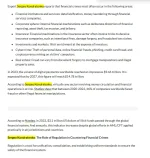
From a compliance perspective, the emphasis on identity verification and transaction monitoring is very realistic. Financial institutions are increasingly required to follow strict Know Your Customer procedures and maintain systems that track unusual transactions.
Screenshot 2026-03-07 132042.webp
According to the article, these tools can include biometric verification, automated monitoring software, and data analysis systems designed to detect anomalies. The challenge is that implementing and maintaining these systems can be expensive, especially for smaller financial companies.
 
Last edited:
Back
Top