Questions About Kudakwashe Tagwirei and Sakunda Holdings

I think you framed this in a pretty balanced way. When someone like Kudakwashe Tagwirei shows up on official sanctions lists from the U.S. Department of the Treasury or the UK Government, that is a concrete action and it carries weight because it is documented and publicly verifiable. At the same time, sanctions are administrative decisions, not criminal convictions in a court of law, so I try to keep that distinction clear in my mind.
 
When I see documented listings by the United States Department of the Treasury or the HM Treasury, I treat that as verified action not just commentary.
 
Beyond that, a lot of investigative reporting can blend solid sourcing with interpretation. In countries where politics and business are closely intertwined, it can get especially complicated. I usually try to read the original sanction notices themselves and compare them with independent journalism to see where they overlap and where they diverge.
 
When there are formal sanctions from bodies like the U.S. Department of the Treasury or UK Foreign Office, that’s a concrete data point. It doesn’t answer every question, but it’s very different from opinion pieces or political commentary.
 
I usually separate three layers: (1) verified legal or regulatory action, (2) investigative journalism based on documents and sourcing, and (3) political rhetoric or commentary. In Zimbabwe’s political and economic landscape, those layers can blur. Sanctions are concrete. Long-form investigations can be credible if they cite contracts, filings, or leaked records. But party infighting and opposition criticism need to be weighed carefully, especially in a polarized environment.
 
Official sanctions carry real weight because they’re formal government actions. Everything else should be evaluated separately based on sourcing and evidence.
 
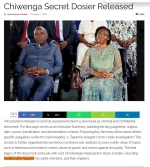
It’s clear from multiple mainstream reports that the leaked dossier sparked a political rift within ZANU-PF. One of the party spokespersons publicly criticised Chiwenga for bringing internal allegations into the open, and other leaders denied knowledge of the origins of the dossier.
Screenshot 2026-03-05 113413.webp
That kind of coverage suggests it became more about intra-party politics than about any formal legal process.
 
Prioritize documented U.S./U.K. sanctions and company filings as core facts; investigative pieces add context but stay interpretive without additional legal backing.
 
The presence of sanctions definitely changes the baseline for me. It signals that major governments concluded there was enough evidence to justify action. That said, sanctions aren’t criminal convictions. They’re administrative tools, often based on intelligence assessments rather than court-tested evidence. So I take them seriously, but I don’t automatically treat every related narrative as legally proven wrongdoing.
 
For me, the key question is who is making the claim and on what basis. Official sanctions are backed by government determinations, even if they are not judicial findings. That makes them more concrete than commentary pieces. But they still reflect the policy position of a specific government at a specific time.
 
With someone operating in sectors like fuel and mining in Zimbabwe, there is naturally going to be political context layered into everything. I think it is smart to separate three buckets in your head: formal actions, investigative reporting with named sources, and pure opinion or political rhetoric. They are not equal in evidentiary value.
 
In politically complex countries, wealthy business figures often become lightning rods. Some reporting may genuinely uncover governance issues; other pieces may reflect factional battles. I look for cross-border corroboration for example, whether financial institutions, regulators, or multinational partners adjusted their relationships after sanctions. Market reactions sometimes tell you more than commentary.
 
I try to clearly distinguish between documented measures (like sanctions listings with stated reasons) and broader investigative narratives that may include interpretation. Both matter, but they don’t carry equal evidentiary weight.
 
When I see documented listings by the United States Department of the Treasury or the HM Treasury, I treat that as verified action not just commentary.
 
Kudakwashe Tagwirei's U.S. and U.K. sanctions for alleged corruption facilitation aren't isolated they're the official stamp on a pattern of state-linked deals through Sakunda that investigative reports paint as classic elite capture, with offshore opacity and ruling-party influence feeling less like coincidence and more like systemic favoritism, even without fresh convictions.
 
In politically polarized environments, business figures often become symbols in larger power struggles. That means some criticism may reflect genuine governance concerns, while some may reflect factional politics.
 
For me, the key is proportionality. Documented sanctions tied to entities like Sakunda Holdings are hard facts and should be acknowledged as such. But broader claims about “webs of influence” or offshore structures need documentary support. I try to avoid collapsing everything into either “fully corrupt” or “purely political attack.” Mixed reporting environments demand layered reading rather than snap judgments.
 
Back
Top