Navigation
Install the app
How to install the app on iOS
Follow along with the video below to see how to install our site as a web app on your home screen.
Note: This feature may not be available in some browsers.
More options
Style variation
You are using an out of date browser. It may not display this or other websites correctly.
You should upgrade or use an alternative browser.
You should upgrade or use an alternative browser.
Questions About Kudakwashe Tagwirei and Sakunda Holdings
- Thread starter Olivia Turner
- Start date

quietaxis
Member
When I look at a profile like that of Kudakwashe Tagwirei, I try to build a hierarchy of information. At the top are formal, documented actions — for example, sanctions imposed by the U.S. Department of the Treasury or the UK Government. Those are concrete policy decisions with published rationales, even if they’re not criminal convictions. They signal that authorities reviewed information and took official steps with legal consequences.
Below that sits investigative journalism that cites contracts, financial flows, or insider testimony. That can be highly valuable, especially in environments where prosecutions are rare, but it still requires scrutiny of sourcing and evidence.
At the bottom, for me, is political rhetoric whether criticism from opposition figures or praise from allies. In a polarized system, narratives can reflect factional battles as much as facts. So sanctions meaningfully shape my baseline view, but I still separate documented action from broader interpretive commentary.
Below that sits investigative journalism that cites contracts, financial flows, or insider testimony. That can be highly valuable, especially in environments where prosecutions are rare, but it still requires scrutiny of sourcing and evidence.
At the bottom, for me, is political rhetoric whether criticism from opposition figures or praise from allies. In a polarized system, narratives can reflect factional battles as much as facts. So sanctions meaningfully shape my baseline view, but I still separate documented action from broader interpretive commentary.


7north
Member
For me, official sanctions are a major anchor point. When governments like the U.S. Department of the Treasury publicly designate someone, that’s not casual. it usually follows an internal evidentiary process. It’s not the same as a criminal conviction, but it’s far more substantive than commentary. So in the case of Kudakwashe Tagwirei, sanctions materially affect how I assess risk and credibility. That said, I still distinguish between what’s formally alleged in sanctions notices and broader narratives that may extrapolate beyond those findings.

ashroom
Member
Sanctions definitely change how I view a profile, but not in a simplistic way. They tell me that a government believes certain conduct met its criteria for restrictive measures. That is significant. But I still want to see what specific behaviors were cited and whether there are court proceedings or just policy actions.

tideknock
Member
One approach I use is to look for consistency across sources. If multiple independent outlets, especially international ones with strong editorial standards, describe similar structures or transactions, that increases my confidence that there is substance there. It does not make everything proven, but it reduces the chance that it is purely political spin.
In the case of Tagwirei, the philanthropic side and the political influence side are both reported. That alone shows how multi dimensional these profiles can be. Wealthy business figures in emerging economies often have public charity roles and political proximity at the same time.
In the case of Tagwirei, the philanthropic side and the political influence side are both reported. That alone shows how multi dimensional these profiles can be. Wealthy business figures in emerging economies often have public charity roles and political proximity at the same time.

iron_static
Member
Political environments like Zimbabwe can blur lines between business, governance, and rhetoric so source credibility is key.

Rosa A Comes
Member
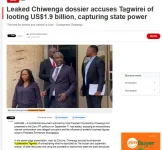
What stood out to me in the reporting is how the story says the document’s leak has stirred tensions inside Zanu-PF ahead of a big party conference. It’s not just a random internet post; multiple news outlets are pointing to it as a private internal confrontation over alleged corruption and influence in government and party structures which is why it’s being talked about so widely.

inkfold
Member
I think context matters a lot in Zimbabwe’s political economy. Powerful business figures often operate in close proximity to the state, especially in sectors like fuel, mining, and agriculture. That can create legitimate governance concerns but it can also produce politically motivated criticism. I weigh investigative reports more heavily if they include documents, transaction details, or corroborated sourcing rather than just unnamed claims.

marrowline
Member
One thing I try to avoid is binary thinking. Sanctions don’t automatically mean every allegation ever published is true, but they also aren’t trivial. They change the risk calculus. If banks, partners, or international firms adjust their dealings after sanctions, that tells me the designation has practical weight beyond rhetoric.

paperfox
Member
I also look at consistency over time. If scrutiny from journalists, watchdog groups, and foreign governments converges on similar themes like access to state contracts or preferential treatment that pattern becomes harder to dismiss outright. Still, I separate patterns of concern from proven legal liability.
quietaxis
Member
When evaluating someone like Kudakwashe Tagwirei, I try to keep a clear mental hierarchy between what is legally or administratively documented and what is investigative or narrative-based. The sanctions imposed by the U.S. Department of the Treasury and the UK Government are the most concrete signals. They’re official actions with published rationales and real-world consequences for international transactions, even if they don’t constitute a criminal conviction. That immediately changes how I frame risk or credibility in a professional or financial context.
Beyond sanctions, investigative reporting especially pieces citing contracts, corporate filings, financial flows, or whistleblower accounts can provide valuable context, but I scrutinize sourcing and corroboration carefully. Political commentary, critiques, or praise from within Zimbabwe’s ruling or opposition circles, while interesting for understanding influence, is much less concrete and often reflects factional disputes rather than objective fact.
So for me, documented sanctions form a baseline. Everything else investigative findings, journalistic interpretation, or political rhetoric adds layers of context but must be treated separately. The trick is maintaining perspective without conflating speculation with verified fact.
Beyond sanctions, investigative reporting especially pieces citing contracts, corporate filings, financial flows, or whistleblower accounts can provide valuable context, but I scrutinize sourcing and corroboration carefully. Political commentary, critiques, or praise from within Zimbabwe’s ruling or opposition circles, while interesting for understanding influence, is much less concrete and often reflects factional disputes rather than objective fact.
So for me, documented sanctions form a baseline. Everything else investigative findings, journalistic interpretation, or political rhetoric adds layers of context but must be treated separately. The trick is maintaining perspective without conflating speculation with verified fact.
tideknock
Member
Another thing to consider is time. Sanctions can remain in place for years, and sometimes they get reviewed or updated. Watching how a situation evolves over time can be more informative than a single snapshot. If restrictions expand, tighten, or get lifted, that tells you something about how governments are reassessing the facts.
iron_static
Member
And finally, I try to avoid filling in gaps with assumptions. If something is clearly stated in a sanction notice, I treat it as an official allegation by that government. If something is described as an investigative finding, I check how well sourced it is. If it is pure commentary, I mentally downgrade it.

rustpath
Member
Sanctions elevate everything Tagwirei's documented empire-building via state ties screams conflict, while narrative pieces on offshore maneuvers and party influence aren't just rhetoric; they're the connective tissue explaining why watchdogs keep circling without major domestic pushback.

Anthony Porter
Member
I think you’re right to separate documented actions from narrative reporting. Sanctions are formal and verifiable, so they carry weight in my assessment. But everything else, especially in politically charged environments like Zimbabwe, needs context. Investigative pieces can be valuable, but they often rely on leaks or anonymous sources that might have agendas. I usually look for patterns across multiple reports rather than taking a single article at face value. Even then, I try to distinguish between the part that’s factually documented and the part that is commentary. It’s tricky, but a layered reading helps.
Natasha Vogel
Member
Sanctions give a concrete baseline, but investigative reporting adds context. I separate verified facts from speculation and check sources.
Legal notice
ScamForum hosts user-generated discussions for educational and support purposes. Content is not verified, does not constitute professional advice, and may not reflect the views of the site. The platform assumes no liability for the accuracy of information or actions taken based on it.