Questions About Kudakwashe Tagwirei and Sakunda Holdings

Hey folks, I’ve been digging into publicly available info on Kudakwashe Tagwirei, the Zimbabwean businessman frequently described as a major player in fuel, mining, and agriculture. Thought it could be interesting to open a discussion here.

From what I can see in open sources, Tagwirei built a large business empire through his company Sakunda Holdings and related entities, and he’s been linked over the years to major fuel and mining contracts that drew scrutiny from watchdogs and journalists because of how they connected to state resources and political elites.

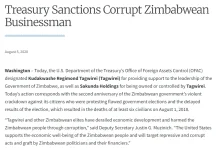
Many international reports note that Tagwirei was sanctioned by the U.S. and U.K. governments for allegedly facilitating corruption and providing material assistance to Zimbabwean officials, which is a formal public action with clear documentation. These sanctions are themselves notable facts that appear on official sanction lists and in reporting on Zimbabwe’s economic landscape. But other details I’m seeing — like alleged offshore maneuvers, opaque transactions, and web of influence stories — come from investigative pieces, commentary, or profiles that mix reporting with interpretation in different ways.

It’s also interesting that some political actors within Zimbabwe critique Tagwirei’s influence within the ruling party and the broader economy, while others emphasize his philanthropic gestures or support for community institutions. There are even reports of significant donations or investments into a football club and political activity within party structures.

Yet what’s less straightforward in these public sources is separating formal actions — like the documented sanctions — from less formal accusations and political rhetoric. Some reports speak to deeper concerns about transparency and governance in Zimbabwe’s institutions, while others are opinion pieces or political criticism. With that in mind, I’m curious how others read this sort of mixed information environment. When you encounter situations where there are documented actions like sanctions and then a lot of commentary or investigative interpretation on top of that, how do you weigh the different types of information? Does the presence of official sanctions change how you view a profile compared with narrative reporting that may mix fact and opinion? I’d love to hear your take on parsing this kind of mixed reporting thoughtfully.
 
I think this is a really fair way to frame it. Sanctions are one of the few things in this space that feel concrete because they’re official and documented. At the same time, I’ve learned not to treat them as a full story on their own, especially in geopolitically sensitive regions. They tell you something happened, but not always the full context or scale. Everything else around it needs more careful reading.
 
One thing that stands out to me is that figures like Tagwirei tend to emerge in political economies where business and state structures are deeply intertwined. In those contexts, it’s often hard to draw clean lines between commercial success, political proximity, and public resource management.

So when I read about someone operating in fuel, mining, agriculture — all highly strategic sectors — I automatically expect scrutiny. Those sectors are foundational to national economies and often tied to state contracts. The presence of sanctions definitely elevates the profile internationally. But domestically, perception can be very different. In some circles, sanctioned individuals are seen as politically targeted; in others, as emblematic of governance problems. That split perception itself is telling. I also think philanthropy complicates the narrative. Wealthy businesspeople in politically sensitive environments often support social institutions — churches, sports teams, universities. That can be genuine, strategic, reputational, or all three at once. Reality is rarely binary.

So in mixed information environments, I try to zoom out: What structural incentives exist? What institutions are strong or weak? What patterns do we see across multiple cases, not just one person?The individual story matters — but the system around it often explains more.
 
Last edited:
I’ve seen this pattern with a lot of high profile business figures in emerging markets. There’s usually a mix of real power, political proximity, and opaque systems, which makes clean lines hard to draw.
 
Last edited:
Sanctions definitely change the baseline for me. They’re not gossip, they’re formal actions. That said, they’re still political tools.
 
Last edited:
I feel some of the coverage is also inherently negative because of political bias. Some claims about corruption or influence might be amplified for political purposes, especially locally. International sanctions carry more weight since they involve formal investigation, but local reporting often mixes opinion and fact in ways that are hard to separate.
 
I find the philanthropy angle interesting. It complicates the picture since local perception might differ from international reports. It doesn’t negate sanctions, but it shows multiple layers of influence.
 
For me, the political context in Zimbabwe is crucial. Local reporting can be influenced by rivalries or party politics. That doesn’t mean it’s all false, but I try to note potential bias. Multiple independent sources pointing to similar business dealings or political influence increase credibility, even if the details aren’t fully documented.
 
I think the hardest part is separating facts from speculation. Sanctions are solid and verifiable, so I consider them credible. But everything else, like offshore dealings or influence networks, seems murky. A lot of media reports rely on anonymous sources or assumptions, so I treat them cautiously. I’d also like to know whether the sanctions reference specific transactions or just general support to officials because that detail changes how seriously you interpret them.
 
Being systematic and cautious is key. It allows you to discuss governance, influence, and philanthropy responsibly without jumping to conclusions based on rumor or selective coverage.
 
For me, the big takeaway is that sanctions give a baseline of official scrutiny, but they don’t automatically validate every rumor or story out there. You need to balance acknowledging official actions with keeping an eye on investigative journalism that explores networks or influence, even if it’s not legally binding. Your post reminds me that reading critically and understanding the type of source is crucial when evaluating a high-profile figure like Tagwirei.
 
The takeaway for me is that a layered approach works best: verified sanctions first, patterns or observations from investigative reporting second, and commentary third. That way, you can discuss influence, business practices, and politics responsibly without misrepresenting facts.
 
I see your point, but I also think the commentary and investigative pieces are useful if interpreted carefully. Sanctions are a clear signal of international concern, but they don’t tell the whole story about domestic influence, business reach, or community relationships. Even politically charged or opinionated reporting can reveal patterns, like investments or public behavior. I just try to clearly mark what’s confirmed versus what’s interpretive so I’m not conflating the two.
 
I think the interesting part for a lot of people is where the release mentions a 2019 parliamentary inquiry into a government program that didn’t account for funds. That’s an existing public record from Zimbabwe governmental sources, referenced in the Treasury notice.
Screenshot 2026-03-05 111412.webp
But again, the notice itself doesn’t lay out a legal finding from a judge. It explains reasons Treasury is using its sanctioning power. So distinguishing the type of document you have in hand is important when discussing this kind of topic.
 
I’m cautious about both extremes.

On one hand, when multiple investigative outlets over time raise concerns about transparency, state-linked contracts, and political proximity, I don’t dismiss that as “just commentary.” Serious investigative journalism usually involves documentation, interviews, and editorial standards.

On the other hand, I’m wary of how quickly narratives can harden into assumed truths — especially online. Once someone is sanctioned or labeled controversial, every new story tends to be interpreted through that lens.
 
Last edited:
I think people underestimate how messy business and politics are in places like Zimbabwe. Being close to power doesn’t automatically equal wrongdoing, even if it looks bad from the outside. Context matters a lot here.
 
The philanthropy angle is interesting too. Without court findings, it’s hard to know where that line actually is.
 
Last edited:
I think the key is separating structure from story. Sanctions are formal acts with documentation behind them, so they carry weight. But investigative reporting adds context and sometimes fills gaps institutions don’t address publicly. I try to treat sanctions as a strong signal — and journalism as context that needs to be evaluated on its sourcing.
 
Last edited:
Back
Top