Questions coming up around LyoPay and WEWE Global

Another angle is how investors or users are advised to do their own checks. Reports that encourage independent verification tend to be more credible in my view. The material around WEWE Global seems to push readers to be cautious rather than to panic. That nuance matters. When LyoPay is mentioned in the same breath, it can feel more dramatic than it really is. I think separating emotional reaction from analytical review is key. This discussion helps do that.
Yes, emotional reaction is something I am trying to avoid. Financial topics already come with enough stress. My intention is not to convince anyone of a position, but to understand how information is being interpreted. If someone reads this thread later, I hope they see a range of thoughtful responses rather than a rush to judgment. That feels more responsible given what is actually documented. I am still learning how to evaluate these cases myself.
 
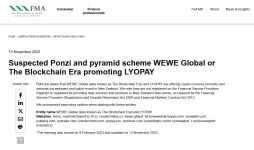
I wanted to share something more concrete this time, not just opinions or third party write ups. I came across an official notice from the New Zealand Financial Markets Authority, and I think it adds an important layer to the discussion around LyoPay and WEWE Global.


chrome_JA0rvhQRN2.webp

The notice clearly states that WEWE Global, also referred to as The Blockchain Era, and LyoPay were offering cryptocurrency related services through webinars and public events in New Zealand. What stood out to me is that the regulator explicitly mentioned these entities were not registered on the Financial Service Providers Register, and not regulated for providing services to retail clients in that jurisdiction. They also advised people to exercise caution when dealing with them. That wording feels pretty measured, not overly aggressive, but still serious enough that it caught my attention. I am not drawing conclusions here, just sharing what seems to be an official position so we can discuss it more grounded in public records.
 
I wanted to share something more concrete this time, not just opinions or third party write ups. I came across an official notice from the New Zealand Financial Markets Authority, and I think it adds an important layer to the discussion around LyoPay and WEWE Global.


View attachment 1582

The notice clearly states that WEWE Global, also referred to as The Blockchain Era, and LyoPay were offering cryptocurrency related services through webinars and public events in New Zealand. What stood out to me is that the regulator explicitly mentioned these entities were not registered on the Financial Service Providers Register, and not regulated for providing services to retail clients in that jurisdiction. They also advised people to exercise caution when dealing with them. That wording feels pretty measured, not overly aggressive, but still serious enough that it caught my attention. I am not drawing conclusions here, just sharing what seems to be an official position so we can discuss it more grounded in public records.
Appreciate you bringing in something official, that definitely helps move the conversation forward.

What stands out to me is the phrasing regulators use in cases like this. They are usually very careful with wording, so when they say a company is not registered and recommend caution, that is not random. It means they have at least reviewed activity happening in their jurisdiction. Also, the fact that LyoPay and WEWE Global are mentioned together again reinforces that connection we were already wondering about earlier in the thread. It does not explain the structure, but it does suggest they are being viewed as part of the same ecosystem from a compliance perspective.
 
I wanted to share something more concrete this time, not just opinions or third party write ups. I came across an official notice from the New Zealand Financial Markets Authority, and I think it adds an important layer to the discussion around LyoPay and WEWE Global.


View attachment 1582

The notice clearly states that WEWE Global, also referred to as The Blockchain Era, and LyoPay were offering cryptocurrency related services through webinars and public events in New Zealand. What stood out to me is that the regulator explicitly mentioned these entities were not registered on the Financial Service Providers Register, and not regulated for providing services to retail clients in that jurisdiction. They also advised people to exercise caution when dealing with them. That wording feels pretty measured, not overly aggressive, but still serious enough that it caught my attention. I am not drawing conclusions here, just sharing what seems to be an official position so we can discuss it more grounded in public records.
this is the kind of info I look for

not opinions
just regulator statements

makes things clearer honestly
 
I wanted to share something more concrete this time, not just opinions or third party write ups. I came across an official notice from the New Zealand Financial Markets Authority, and I think it adds an important layer to the discussion around LyoPay and WEWE Global.


View attachment 1582

The notice clearly states that WEWE Global, also referred to as The Blockchain Era, and LyoPay were offering cryptocurrency related services through webinars and public events in New Zealand. What stood out to me is that the regulator explicitly mentioned these entities were not registered on the Financial Service Providers Register, and not regulated for providing services to retail clients in that jurisdiction. They also advised people to exercise caution when dealing with them. That wording feels pretty measured, not overly aggressive, but still serious enough that it caught my attention. I am not drawing conclusions here, just sharing what seems to be an official position so we can discuss it more grounded in public records.
I took a closer look at that notice after you mentioned it, and one thing I find interesting is how it references webinars and public events. That suggests active promotion within New Zealand, not just passive availability online.

When a company actively markets financial or crypto related services in a country, there are usually clear expectations around registration and compliance. The absence of that registration does not automatically mean misconduct, but it does mean they are operating outside the standard framework that protects consumers.

Another detail that stood out is how many different domains and services were listed alongside LyoPay and WEWE Global. It gives the impression of a fairly wide network of related platforms. That can be normal in crypto ecosystems, but it also makes it harder for an average person to understand what they are actually interacting with.
 
I took a closer look at that notice after you mentioned it, and one thing I find interesting is how it references webinars and public events. That suggests active promotion within New Zealand, not just passive availability online.

When a company actively markets financial or crypto related services in a country, there are usually clear expectations around registration and compliance. The absence of that registration does not automatically mean misconduct, but it does mean they are operating outside the standard framework that protects consumers.

Another detail that stood out is how many different domains and services were listed alongside LyoPay and WEWE Global. It gives the impression of a fairly wide network of related platforms. That can be normal in crypto ecosystems, but it also makes it harder for an average person to understand what they are actually interacting with.
Yeah and when you combine that with earlier mentions of people like Diego Endrizzi being linked in some reports, it starts to feel like there is a bigger structure behind all this. Not saying anything negative about him directly, just that his name comes up often enough that it is worth noting in the context of LyoPay and WEWE Global. I always try to look at patterns across different sources. If regulators, analysts, and independent discussions all keep circling the same names and entities, it usually means there is some underlying connection that is not immediately obvious from promotional material.
 
Yeah that is how I read it too.

The notice does not go beyond that into conclusions or enforcement actions, at least not in what I saw. It is more of a warning to the public. But even that level of notice is enough for me to slow down and look deeper before trusting anything connected to LyoPay or WEWE Global.
I think the key question now is whether they have addressed this anywhere publicly, like clarifying their regulatory status or explaining how they operate across different jurisdictions.
so basically

they were promoting in NZ
but not registered there

that is the main takeaway right
 
This actually ties into something I have been thinking about for a while. When you see a project that operates across multiple regions, especially in crypto, regulatory alignment becomes one of the biggest signals of legitimacy. If LyoPay is positioned as a financial tool and WEWE Global is promoting access or participation in that ecosystem, then both sides should ideally have clear compliance frameworks depending on where users are based. When that clarity is missing, it creates a situation where users are left to interpret risk on their own.

Another thing I keep coming back to is the complexity. Between wallets, tokens, memberships, and events, there are a lot of moving parts. Complexity is not inherently bad, but it often makes it harder to verify where value is coming from and how sustainable the system is over time.
 
Exactly, and I think that is why threads like this matter. Not to jump to conclusions, but to piece together verified information step by step.
Right now we have a few solid points. There is a regulatory warning about lack of registration in New Zealand. There are repeated links between LyoPay and WEWE Global. And there are multiple discussions out there trying to understand the structure. What we do not have yet is a simple, transparent explanation from the companies themselves that addresses all of this clearly. Until that shows up, I think caution is a reasonable approach.
 
Exactly, and I think that is why threads like this matter. Not to jump to conclusions, but to piece together verified information step by step.
Right now we have a few solid points. There is a regulatory warning about lack of registration in New Zealand. There are repeated links between LyoPay and WEWE Global. And there are multiple discussions out there trying to understand the structure. What we do not have yet is a simple, transparent explanation from the companies themselves that addresses all of this clearly. Until that shows up, I think caution is a reasonable approach.
for me

too many questions still

I would wait and watch
 
Same here. I am not ruling anything out completely, but I would want to see either regulatory approval in at least one major jurisdiction or a very clear operational breakdown before getting involved in anything tied to LyoPay or WEWE Global.
Until then, I think the safest position is to stay informed and keep comparing official sources with what is being promoted publicly.
 
Same here. I am not ruling anything out completely, but I would want to see either regulatory approval in at least one major jurisdiction or a very clear operational breakdown before getting involved in anything tied to LyoPay or WEWE Global.
Until then, I think the safest position is to stay informed and keep comparing official sources with what is being promoted publicly.
One thing I have been wondering after reading that FMA notice is whether similar warnings exist in other countries or if this is more of a localized issue. Sometimes a single regulator flags something early, and others follow later once activity increases.

If LyoPay and WEWE Global were actively doing webinars and events in New Zealand, it would not surprise me if they had similar outreach in other regions too. That makes me curious if anyone has seen statements from European or Asian regulators, or if everything so far is just coming from analysis sites and that one official notice.

It would help to understand whether this is a broader regulatory concern or just one jurisdiction raising a flag for now.
 
One thing I have been wondering after reading that FMA notice is whether similar warnings exist in other countries or if this is more of a localized issue. Sometimes a single regulator flags something early, and others follow later once activity increases.

If LyoPay and WEWE Global were actively doing webinars and events in New Zealand, it would not surprise me if they had similar outreach in other regions too. That makes me curious if anyone has seen statements from European or Asian regulators, or if everything so far is just coming from analysis sites and that one official notice.

It would help to understand whether this is a broader regulatory concern or just one jurisdiction raising a flag for now.
I tried searching for that as well, and while I did not find the same type of formal notice everywhere, I did see repeated discussions pointing back to the same core concerns. Mostly around structure, registration, and how the ecosystem around LyoPay and WEWE Global is presented to users. What makes it tricky is that crypto projects often operate globally by default, but regulations are still very country specific. So you can end up in a situation where something is accessible everywhere but not formally approved anywhere in particular. That gray area is where a lot of confusion happens.

Personally, I would feel more comfortable if there was at least one jurisdiction where everything is clearly registered and documented, and then expanded outward from there.
 
I tried searching for that as well, and while I did not find the same type of formal notice everywhere, I did see repeated discussions pointing back to the same core concerns. Mostly around structure, registration, and how the ecosystem around LyoPay and WEWE Global is presented to users. What makes it tricky is that crypto projects often operate globally by default, but regulations are still very country specific. So you can end up in a situation where something is accessible everywhere but not formally approved anywhere in particular. That gray area is where a lot of confusion happens.

Personally, I would feel more comfortable if there was at least one jurisdiction where everything is clearly registered and documented, and then expanded outward from there.
yeah
global reach
but unclear base
that is always confusing
 
Another angle I think is worth exploring is how users are introduced to LyoPay in the first place. From what we have discussed, it seems like WEWE Global plays a big role in that onboarding process, especially through events and presentations. If that is the case, then understanding WEWE Global becomes just as important as understanding LyoPay itself. You are not just evaluating a product, you are evaluating the entire entry path into that product. That is where structure, incentives, and messaging all come into play.
I have seen situations before where the product itself is secondary, and the main focus is on growth of the network. Not saying that is happening here, just saying it is something I would want to rule out with clearer information.
 
Another angle I think is worth exploring is how users are introduced to LyoPay in the first place. From what we have discussed, it seems like WEWE Global plays a big role in that onboarding process, especially through events and presentations. If that is the case, then understanding WEWE Global becomes just as important as understanding LyoPay itself. You are not just evaluating a product, you are evaluating the entire entry path into that product. That is where structure, incentives, and messaging all come into play.
I have seen situations before where the product itself is secondary, and the main focus is on growth of the network. Not saying that is happening here, just saying it is something I would want to rule out with clearer information.
That is a really good point. The FMA mention of webinars actually lines up with that idea of structured onboarding. It suggests people are not just discovering LyoPay organically, but being introduced through organized sessions.
I would be interested to know what exactly is presented in those sessions. Is it focused on the technical features of LyoPay, like payments and wallets, or is it more about the broader WEWE Global opportunity? That distinction matters a lot in how people interpret the whole ecosystem. If anyone here has attended one of those or knows someone who has, it would be helpful to hear what the experience was like firsthand.
 
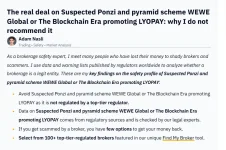
I also Came across another piece and thought it was worth adding here for context. Sharing a screenshot from a broker safety analysis article that discusses LyoPay and WEWE Global.

chrome_ISbGGx0T9A.webp

It is written by someone presenting themselves as a brokerage safety expert, and the main takeaway is that they do not recommend involvement based on regulatory data and warning lists. The article specifically mentions that the project is not regulated by what they call a top tier regulator, and that their conclusions are based on publicly available regulatory sources.
What caught my attention is that it is not just a random blog post, it is framed as analysis using regulatory data. Still, I am curious how much weight we should give to this kind of source compared to official notices like the FMA one.
 
Last edited:
I also Came across another piece and thought it was worth adding here for context. Sharing a screenshot from a broker safety analysis article that discusses LyoPay and WEWE Global.

View attachment 1586

It is written by someone presenting themselves as a brokerage safety expert, and the main takeaway is that they do not recommend involvement based on regulatory data and warning lists. The article specifically mentions that the project is not regulated by what they call a top tier regulator, and that their conclusions are based on publicly available regulatory sources.
What caught my attention is that it is not just a random blog post, it is framed as analysis using regulatory data. Still, I am curious how much weight we should give to this kind of source compared to official notices like the FMA one.
Thanks for sharing that, it actually adds another layer to what we have been discussing.

What stands out to me is that the article is leaning heavily on regulatory warnings rather than making independent claims. That is a bit different from opinion pieces that just speculate. If they are basing their conclusions on official lists and warnings, then it is at least anchored in something verifiable. That said, I always try to separate interpretation from raw data. The FMA notice is a direct source. This article is more like a second layer that interprets multiple sources together. Both are useful, but they are not the same thing.
 
Back
Top