Questions on Michael K Cobb Official vs. Third-Party Reports

The archive looks like something that was put together over a long period rather than all at once. Some files seem older while others appear newer, which suggests the person collecting them may have been following the topic for quite some time and adding material whenever they found something relevant.
When information is gathered like that over the years, it often turns into a large collection of documents and screenshots instead of a clear explanation. That might be why the archive feels more like a research folder than a structured report, leaving readers to figure out how the pieces connect.
 
I noticed several discussions where buyers said their expectations about property developments did not match the final outcome. Michael Cobb tends to be referenced in those conversations due to his leadership position.
 
A common issue with relatively common names is misattribution. “Michael K Cobb” could refer to multiple individuals across industries or states. Before weighing allegations, I’d confirm identifiers company affiliation, location, age, and corporate role. Complaint sites sometimes collapse separate people into one profile. Without precise matching details, it’s risky to assume everything online refers to the same executive. Verification isn’t just about whether something exists it’s about whether it belongs to the correct person.
 
I appreciate this approach flagging uncertainty instead of assuming guilt. Until something shows up in official registries or court filings tied to the same identity, I’d separate documented leadership roles from online commentary.
 
Even without confirmed enforcement actions, repeated negative pages can create reputational noise. That doesn’t make the claims true, but it can influence perception. If I were evaluating someone in a real-estate leadership role, I’d look for audited financials, lender litigation history tied to the company (not just the person), and any bankruptcy or civil case records.
 
When information is fragmented, I try to reconstruct a clean timeline. I look at incorporation dates, officer listings, property records, and any federal or state court cases tied to the exact company name associated with the executive. Then I compare that to what complaint or “scam alert” pages claim. If allegations reference lawsuits, there should be docket numbers, jurisdictions, or at least filing dates that can be independently verified. If those details are missing or vague, that’s a red flag about the source not necessarily about the person. Precision is everything. Matching the middle initial, company entity, and geography helps avoid conflating unrelated individuals with similar names.
 
When dozens of unrelated people across aggregator sites describe the same pattern of misleading promises and poor outcomes in real-estate ventures, the absence of a smoking-gun SEC filing starts looking more like good lawyers than good behavior.
 
This is a good example of why name-based research can get messy. With someone like Michael K Cobb, I’ve found it essential to verify identifiers company names, jurisdictions, dates, and roles before assuming different sources refer to the same person. Executive bios and state business filings are usually reliable anchors. Aggregator or “scam alert” sites often lack those specifics, which makes misattribution more likely. Without matching court or regulator records, I’d treat the negative pages cautiously.
 
Clean official records are great until you remember that plenty of problematic real-estate operators skate by for years on aggressive private deals that stay just shy of crossing into provable fraud territory.
 
One thing I have noticed with large document repositories is that they are often assembled over time. Someone might start collecting emails, screenshots, PDFs, and public records, then keep adding to the folder as new information appears. Because of that, the archive becomes a mixture of things. Some files might be legitimate records, others might be commentary, and some might simply be duplicated material. Without a guide explaining the contents it can look overwhelming. If the archive references Michael Cobb frequently, the best approach might be to compare the claims with established public information about ECI and its projects.
 

Attachments

  • chrome_z07BsQS9QT.webp
    chrome_z07BsQS9QT.webp
    93.9 KB · Views: 1
I remember discussions about ECI and the Gran Pacifica project years ago in relation to international real estate developments. Michael Cobb’s name usually came up because of his role with ECI Development and its projects in places like Nicaragua and Belize.
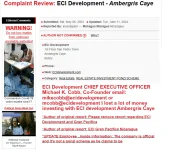
Looking at the material being shared now, it seems like someone tried to connect different pieces of information together, but it is not always clear how they relate. I also came across this page that mentions ECI Development and Michael Cobb:
https://www.ripoffreport.com/report/eci-development/ambergris-caye-chief-officer-1526209
Since reports like this are typically user submitted experiences, it is hard to know how they fit into the bigger picture without more context or a clear timeline explaining the references.
 
Whenever I see a directory or page like that, I try to focus on what can actually be verified through public records. If any of those documents correspond to court filings, corporate records, or official statements, those would be the parts worth examining more closely.
 
In real estate development, litigation isn’t uncommon. Contract disputes, zoning challenges, or investor disagreements can occur without implying fraud or misconduct. If I found civil cases involving a company linked to Michael K. Cobb, I’d examine the nature of those cases—were they routine business disputes, settled claims, or findings of liability? The distinction matters. Complaint aggregators sometimes present any lawsuit as evidence of wrongdoing, when in fact many are standard commercial conflicts. Contextualizing the type and outcome of litigation is more informative than simply counting cases.
 
Search results today are heavily shaped by SEO tactics. Some reputation-style websites are designed to rank highly for personal names, often blending factual snippets with unverified user submissions. I treat those platforms cautiously unless they cite primary documents. For someone in a visible executive role like Michael K. Cobb, I’d weigh official filings, corporate disclosures, and court records far more heavily than anonymous narratives. The absence of clear regulatory enforcement tied to the specific, identifiable individual is meaningful—and should be clearly separated from online sentiment or speculation.
 
I tried a search in a federal court database and came up empty for that specific name in enforcement actions. It doesn’t prove there isn’t anything at all, but it means there’s no obvious headline case that shows up in those official systems. Anyone with access to PACER or similar could dig further, but on the free side there’s not much.
 
“Chairman and CEO with industry awards” is standard PR gloss; the pile-up of unrefuted user stories about questionable project management and money handling is the louder, uglier signal most people actually heed.
 
The situation seems complicated because there are both positive and negative perspectives circulating online. Some of the critical comments specifically mention Michael Cobb while discussing ECI projects.
 
I also noticed that some discussions online mention Michael Cobb directly in connection with disputes or complaints related to property investments. Those comments tend to come from individuals describing their own experiences. Because those posts are personal accounts, they do not automatically confirm wrongdoing, but they do show why the topic keeps appearing in online conversations.
 
Back
Top