Navigation
Install the app
How to install the app on iOS
Follow along with the video below to see how to install our site as a web app on your home screen.
Note: This feature may not be available in some browsers.
More options
Style variation
You are using an out of date browser. It may not display this or other websites correctly.
You should upgrade or use an alternative browser.
You should upgrade or use an alternative browser.
Reading reports about Jason Butcher and trying to understand the context
- Thread starter inkfold
- Start date


ItsPorterDavis
Member
I wanted to get some perspective from others here who follow the crypto space closely. One document I looked at was a public securities filing that lists him in a leadership role connected to a digital payments platform involved with cryptocurrency transactions. At the same time, I noticed that some reporting online has discussed that same payment platform in the context of transactions connected to the OneCoin case. From what I understand, the OneCoin situation was widely described in court proceedings and international investigations as a large scale crypto fraud scheme. The reporting I saw suggested that certain payment processors may have continued handling transactions related to it for a period of time. I am not sure what level of involvement or awareness any specific executive would have had in those cases though.I recently came across the name Jason Butcher while reading through some publicly available reports related to crypto payment services and older crypto projects. The information I found seems to rely heavily on past reporting and public records, but it was not always clear how much of it reflects confirmed outcomes versus ongoing discussions or historical context.
From what I can tell, Jason Butcher is mentioned mainly in relation to crypto infrastructure and payment processing roles, particularly in connection with well known crypto projects from several years ago. The reports focus more on associations and timelines rather than direct statements or court findings tied personally to him. That made it a bit difficult to understand where documented facts end and interpretation begins.
I am not trying to make accusations or draw conclusions here. Crypto has a long memory, and names often resurface long after events have passed. Sometimes that is warranted, and sometimes it is just the result of how information spreads online without updates or closure.
I wanted to open this up to see how others read the same public material. If anyone has looked into Jason Butcher through open records, compliance checks, or general research, I would be interested to hear what stood out to you and what still feels unclear.
That is why I wanted to ask here. Has anyone looked deeper into the public information around Jason Butcher and the companies he has been associated with? I am mainly curious about how payment platforms in crypto typically deal with risk when a project later turns out to be problematic. It seems like the line between a neutral payment service and deeper involvement can sometimes be unclear.
I am not trying to jump to conclusions, just trying to understand the context a bit better from people who may have followed these developments longer than I have.

JoelleBoswell_7
Member
I remember seeing the name Jason Butcher before in relation to a crypto payments company that allows merchants to accept different digital currencies. If it is the same person, that type of platform usually acts as an intermediary rather than the operator of the projects using the payment system. In other words, they process transactions but do not necessarily control what the underlying crypto project is doing.That said, the OneCoin case became such a major international story that a lot of people started examining any service providers that might have processed payments connected to it. That included exchanges, payment gateways, and other financial technology services. Sometimes these connections show up simply because the platform was used by someone associated with a project, not necessarily because the company endorsed it.
I think the key thing to check is timing and what compliance processes existed at the time. Early crypto infrastructure companies often had very different standards compared to what we see today.
I think the key thing to check is timing and what compliance processes existed at the time. Early crypto infrastructure companies often had very different standards compared to what we see today.
M.Ellsworth_
Member
I also looked at the filing you are probably referring to. Those securities filings usually provide a snapshot of company leadership and risk disclosures rather than investigative details about specific transactions. Seeing a name in that context mostly tells us someone was part of the management or executive structure of the company at that time. The part that gets tricky is that payment processors can have thousands of merchants. If one of those merchants later becomes controversial or linked to an investigation, the processor’s role can look suspicious from the outside even if they were simply providing infrastructure. That is why regulators and investigators usually focus on whether there was knowledge or facilitation rather than just the existence of transactions.
ItsPorterDavis
Member
That makes sense and it is kind of what I was wondering about. When I first saw the references, it was not immediately clear whether the payment platform was knowingly involved or if it was simply a technical service being used by different clients. Crypto history has quite a few examples where infrastructure providers were later pulled into discussions around projects that collapsed or were exposed as frauds. Sometimes they had already cut ties by the time things became widely known. I guess the challenge for people researching this now is separating operational involvement from just transactional exposure.I also looked at the filing you are probably referring to. Those securities filings usually provide a snapshot of company leadership and risk disclosures rather than investigative details about specific transactions. Seeing a name in that context mostly tells us someone was part of the management or executive structure of the company at that time. The part that gets tricky is that payment processors can have thousands of merchants. If one of those merchants later becomes controversial or linked to an investigation, the processor’s role can look suspicious from the outside even if they were simply providing infrastructure. That is why regulators and investigators usually focus on whether there was knowledge or facilitation rather than just the existence of transactions.

Amanda-Hedberg_237
Member
Exactly.
The OneCoin situation is especially complicated because it operated across many countries and used a lot of different payment channels over time. There were exchanges, payment processors, and even traditional banking channels mentioned in different reports.
From a research perspective, it helps to focus on what has been established in court records versus what comes from secondary reporting or speculation. Court cases and official investigations usually identify the individuals who were considered key participants. If Jason Butcher was mentioned mainly in connection with a payments company leadership role, that might simply reflect his position in the company rather than any personal involvement in the scheme itself.
The OneCoin situation is especially complicated because it operated across many countries and used a lot of different payment channels over time. There were exchanges, payment processors, and even traditional banking channels mentioned in different reports.
From a research perspective, it helps to focus on what has been established in court records versus what comes from secondary reporting or speculation. Court cases and official investigations usually identify the individuals who were considered key participants. If Jason Butcher was mentioned mainly in connection with a payments company leadership role, that might simply reflect his position in the company rather than any personal involvement in the scheme itself.

VictoriaHand.X
Member
Another thing worth remembering is that crypto payment platforms were still evolving during the time when OneCoin was active. Compliance frameworks were less standardized than they are now, and many services were still figuring out how to detect problematic projects. It would be interesting to know whether the company connected to Jason Butcher had internal policies about reviewing merchants or crypto projects. Some companies introduced stricter checks only after major scandals brought attention to the risks. So the historical timeline matters a lot here.
M.Ellsworth_
Member
I agree with that point about timing. When people read about older crypto infrastructure companies today, it is easy to apply current expectations about compliance and due diligence. But the industry in the mid 2010s was very different.Another thing worth remembering is that crypto payment platforms were still evolving during the time when OneCoin was active. Compliance frameworks were less standardized than they are now, and many services were still figuring out how to detect problematic projects. It would be interesting to know whether the company connected to Jason Butcher had internal policies about reviewing merchants or crypto projects. Some companies introduced stricter checks only after major scandals brought attention to the risks. So the historical timeline matters a lot here.
A lot of platforms were focused on building basic payment functionality and scaling adoption. Regulatory guidance was still developing and enforcement varied widely depending on the country.
That context does not answer every question, but it helps explain why certain connections appear in reports years later.
JoelleBoswell_7
Member
For anyone researching this topic further, it might help to compare multiple public documents rather than relying on a single report. Securities filings, corporate records, and court documents can sometimes provide a clearer picture of who held which roles and during what period. Looking at those sources together usually reveals whether someone was simply an executive at a service provider or whether investigators identified a deeper role.
In the case of Jason Butcher, the available information I have seen mostly places him in the leadership structure of a crypto payment company. I have not personally seen court documents naming him in the main proceedings related to the OneCoin case, but it is always worth verifying carefully.
In the case of Jason Butcher, the available information I have seen mostly places him in the leadership structure of a crypto payment company. I have not personally seen court documents naming him in the main proceedings related to the OneCoin case, but it is always worth verifying carefully.
ItsPorterDavis
Member
Thanks everyone for the input. This is helpful because I was mainly trying to understand how these connections should be interpreted when reading about them years later.For anyone researching this topic further, it might help to compare multiple public documents rather than relying on a single report. Securities filings, corporate records, and court documents can sometimes provide a clearer picture of who held which roles and during what period. Looking at those sources together usually reveals whether someone was simply an executive at a service provider or whether investigators identified a deeper role.
In the case of Jason Butcher, the available information I have seen mostly places him in the leadership structure of a crypto payment company. I have not personally seen court documents naming him in the main proceedings related to the OneCoin case, but it is always worth verifying carefully.
It sounds like the safest approach is to treat the information as part of a broader ecosystem picture rather than assuming a direct link unless official records clearly say so. I might spend some more time reviewing the filings and historical timelines just to understand the sequence of events better.
If anyone here has followed the payment processor side of the crypto industry closely, I would definitely be interested to hear more perspectives.

TheChrisHarris_22
Member
I was reading about older crypto payment infrastructure and came across this article discussing CoinPayments and the wider OneCoin situation. It talks about how the platform may have been processing transactions connected to the OneCoin network for a period of time. Since OneCoin has already been widely described in court proceedings as a major crypto fraud scheme, I found the topic pretty interesting from a payment processor perspective.
https://behindmlm.com/companies/onecoin/coinpayments-still-servicing-4-billion-onecoin-ponzi-scheme/
The article also mentions Jason Butcher, who has been associated with CoinPayments in a leadership role. I am not completely sure how much responsibility executives at payment platforms would typically have over monitoring specific merchant activity though. Crypto payment gateways usually deal with a large number of clients and transactions, so it made me curious about how these things are handled internally. I am not trying to assume anything here. I just thought it was interesting to see how infrastructure companies sometimes appear in discussions around projects that later become controversial. If anyone here followed the CoinPayments story or knows more about Jason Butcher’s role in that period, I would be interested to hear your thoughts.
https://behindmlm.com/companies/onecoin/coinpayments-still-servicing-4-billion-onecoin-ponzi-scheme/
The article also mentions Jason Butcher, who has been associated with CoinPayments in a leadership role. I am not completely sure how much responsibility executives at payment platforms would typically have over monitoring specific merchant activity though. Crypto payment gateways usually deal with a large number of clients and transactions, so it made me curious about how these things are handled internally. I am not trying to assume anything here. I just thought it was interesting to see how infrastructure companies sometimes appear in discussions around projects that later become controversial. If anyone here followed the CoinPayments story or knows more about Jason Butcher’s role in that period, I would be interested to hear your thoughts.

Jay Hurley
Member
I remember reading about this a while ago when people were digging into the OneCoin ecosystem after authorities started making arrests. The tricky part is that payment processors like CoinPayments operate as service providers. They are basically giving merchants the tools to accept crypto payments, and they might not immediately know the background of every project using the system. That said, when something as large as the OneCoin operation becomes widely known, people start examining every company that may have interacted with it at some point. The article you shared seems to raise questions about whether those transactions continued for longer than expected. I am not sure what the official timeline was though.I was reading about older crypto payment infrastructure and came across this article discussing CoinPayments and the wider OneCoin situation. It talks about how the platform may have been processing transactions connected to the OneCoin network for a period of time. Since OneCoin has already been widely described in court proceedings as a major crypto fraud scheme, I found the topic pretty interesting from a payment processor perspective.
https://behindmlm.com/companies/onecoin/coinpayments-still-servicing-4-billion-onecoin-ponzi-scheme/
The article also mentions Jason Butcher, who has been associated with CoinPayments in a leadership role. I am not completely sure how much responsibility executives at payment platforms would typically have over monitoring specific merchant activity though. Crypto payment gateways usually deal with a large number of clients and transactions, so it made me curious about how these things are handled internally. I am not trying to assume anything here. I just thought it was interesting to see how infrastructure companies sometimes appear in discussions around projects that later become controversial. If anyone here followed the CoinPayments story or knows more about Jason Butcher’s role in that period, I would be interested to hear your thoughts.

AndrewFinn52
Member
I think the biggest challenge with cases like this is distinguishing between facilitation and simple infrastructure usage.
A payment processor might handle thousands of merchants, and unless a red flag appears, the system may not automatically block them. When the OneCoin case became public, many services started reviewing accounts connected to it. But before that point, the project was still being marketed heavily around the world. So it is possible that some platforms processed transactions before realizing what was going on.
A payment processor might handle thousands of merchants, and unless a red flag appears, the system may not automatically block them. When the OneCoin case became public, many services started reviewing accounts connected to it. But before that point, the project was still being marketed heavily around the world. So it is possible that some platforms processed transactions before realizing what was going on.

StephanieDuck542
Member
I took a look at the article and it seems to focus on the scale of the transactions moving through certain payment services. If those numbers are accurate, that would explain why people later started asking questions about how payment infrastructure interacted with the OneCoin ecosystem.
Regarding Jason Butcher, from what I have seen he has been linked to the operational side of CoinPayments. That does not necessarily tell us what he personally knew about specific merchants though. Most executives at payment companies rely on compliance teams to monitor suspicious activity.
Regarding Jason Butcher, from what I have seen he has been linked to the operational side of CoinPayments. That does not necessarily tell us what he personally knew about specific merchants though. Most executives at payment companies rely on compliance teams to monitor suspicious activity.
AndrewFinn52
Member
That is a good point. When reading the article I realized that payment companies often act more like intermediaries rather than promoters of specific crypto projects. It still raises interesting questions about how quickly suspicious activity can be detected though. OneCoin was operating internationally for several years before authorities fully stepped in. During that time, many different financial channels were apparently used. I guess payment processors were just one part of that bigger picture.I took a look at the article and it seems to focus on the scale of the transactions moving through certain payment services. If those numbers are accurate, that would explain why people later started asking questions about how payment infrastructure interacted with the OneCoin ecosystem.
Regarding Jason Butcher, from what I have seen he has been linked to the operational side of CoinPayments. That does not necessarily tell us what he personally knew about specific merchants though. Most executives at payment companies rely on compliance teams to monitor suspicious activity.
ChadMartin245
Member
From what I remember, OneCoin used multiple payment systems across different countries, including traditional banking channels and crypto gateways. That makes it difficult to point to any single platform and say they were central to the operation.
AndrewFinn52
Member
Another thing worth mentioning is that compliance standards in the crypto industry have changed a lot since the mid 2010s. Back then many companies were still figuring out how to monitor transactions properly. Today most major platforms use stronger verification systems and transaction monitoring tools.
So when we look back at these historical cases, it helps to consider how different the regulatory environment was at that time.
So when we look back at these historical cases, it helps to consider how different the regulatory environment was at that time.
Tina_Merrill
Member
I agree with that. The early crypto industry was moving very fast and regulations were still catching up. A lot of payment processors were simply trying to build technology that allowed businesses to accept digital currencies.
When something like the OneCoin case exploded publicly, it caused a big shift in how companies approached compliance. Stories like the one in the article are useful reminders of why stronger oversight became necessary in the crypto ecosystem.
When something like the OneCoin case exploded publicly, it caused a big shift in how companies approached compliance. Stories like the one in the article are useful reminders of why stronger oversight became necessary in the crypto ecosystem.
M.Ellsworth_
Member
while reading about the old OneCoin situation and its connections with crypto payment services. Sharing it here because it mentions Jason Butcher and CoinPayments in the context of payment processing activity related to the OneCoin ecosystem.
According to what is shown in the screenshot, there were claims that CoinPayments continued providing financial services connected to the OneCoin system even after earlier statements denying involvement. It also references earlier reports and mentions how the OneEcosystem portal allegedly allowed users to top up wallets using real cryptocurrency through a payment gateway.
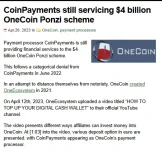
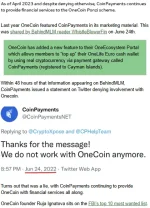

The screenshot also mentions that Ruja Ignatova, the founder of OneCoin, has been listed on the FBI most wanted list, which is already well known from public records. There is also a profile reference to Jason Butcher connected with CoinPayments and located in the Cayman Islands. I am not making any claims here, just sharing the screenshot for discussion because it raises questions about how payment processors interacted with the OneCoin ecosystem during that time.
According to what is shown in the screenshot, there were claims that CoinPayments continued providing financial services connected to the OneCoin system even after earlier statements denying involvement. It also references earlier reports and mentions how the OneEcosystem portal allegedly allowed users to top up wallets using real cryptocurrency through a payment gateway.
The screenshot also mentions that Ruja Ignatova, the founder of OneCoin, has been listed on the FBI most wanted list, which is already well known from public records. There is also a profile reference to Jason Butcher connected with CoinPayments and located in the Cayman Islands. I am not making any claims here, just sharing the screenshot for discussion because it raises questions about how payment processors interacted with the OneCoin ecosystem during that time.
Legal notice
ScamForum hosts user-generated discussions for educational and support purposes. Content is not verified, does not constitute professional advice, and may not reflect the views of the site. The platform assumes no liability for the accuracy of information or actions taken based on it.