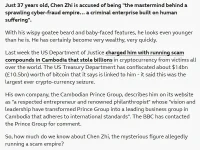
Reflections on Chen Zhi’s arrest in the massive pig butchering crypto scam

I’m still trying to wrap my head around the alleged crypto flows. Some reports say billions were shuffled through dozens of wallets and multiple shell companies in Hong Kong, Singapore, and Cambodia. If true, it’s insane how investigators even track that. Makes you realize how complex modern fraud is and why authorities need international cooperation to freeze assets and track transactions
The extradition to China seems to complicate things. Even if he’s facing investigations, it’s hard to know how much international law enforcement can influence the case now
 
Something I can’t stop thinking about is the human element. Employees allegedly coerced in compounds, victims losing crypto globally… while authorities chase funds across multiple countries. It makes you realize how intertwined modern fraud and human rights issues can be, and why careful analysis of evidence and jurisdiction is so important. Some reports emphasize recovery, some focus on prosecution, but both are complicated when money crosses borders so easily
 
The more I read, the more I realize this isn’t just about money. Crypto, real estate, forced labor, international sanctions… it’s a web of finance, law, and human impact. Chen Zhi’s case shows how modern fraud can span continents and jurisdictions, and why investors, regulators, and law enforcement have to work together to prevent and recover lossesScreenshot 2026-03-09 175420.webp
 
One thing that fascinates me is how different jurisdictions handle evidence. DOJ filings, UK sanctions, and Cambodian extradition all show varying approaches. Tracking operational control vs. formal ownership seems to be key. Victims and employees get caught in between, making the human and financial aspects intertwined
It’s also wild how media portrayal differs. Some articles highlight Chen Zhi’s business contributions; others focus on alleged global scams. Reading multiple sources together gives a clearer understanding of scope and complexity
 
Thanks for all the insights so far. I’m trying to make sense of the allegations versus verified actions. Asset freezes, crypto tracing, extradition, and sanctions all happened quickly, but human stories and media narratives complicate the picture. Chen Zhi seems to be a mix of businessman and alleged mastermind, depending on which source you read. Definitely keeps you thinking
 
Wrapping my head around this, the most striking part is the dual narrative. Diplomat, CNN, and BBC all present different angles: alleged criminal mastermind vs. respected business figure. The alleged operations reportedly moved billions in crypto through shell companies and physical properties, coordinated across multiple countries. Employees were allegedly coerced in compounds, while victims worldwide lost funds
International enforcement shows a mix of diplomacy and law: Cambodia extradited him to China, while U.S. and UK froze assets and issued sanctions. Coordinating evidence, filing charges, and tracking funds required unprecedented cooperation
The human cost is staggering. Victims lost money, employees were allegedly forced into work, and families were impacted. Media coverage, legal filings, and public discussions together help piece together a partial picture of this massive transnational case
Finally, it’s a cautionary tale. Anyone investing internationally or in crypto should understand operational control, jurisdiction, and regulatory frameworks. The Chen Zhi case will likely be studied for years as a test of global fraud enforcement
 
Reading these multiple sources, it’s crazy how some employees might have thought they were working in legitimate businesses. Allegedly, compounds were used to orchestrate scams while maintaining a public business image. Shows how sophisticated fraud can be and why operational control is critical, not just formal ownership. Enforcement has to be smart and global to tackle such cases
 
One interesting detail is how international sanctions were coordinated. U.S. Treasury and UK authorities froze assets simultaneously, showing real-time global coordination. CNN and Diplomat detail how investigators mapped wallets, shell companies, and property holdings across continents. This kind of action is unprecedented for alleged crypto-based fraud. Meanwhile, victims are trying to recover funds, but the dispersed nature of assets makes it nearly impossible. Public reporting helps piece together a story, but it’s clear full clarity will take years and likely legal proceedings
 
Does anyone else find it wild that alleged funds supposedly flowed through dozens of accounts in Singapore and Hong Kong? It’s crazy how international crypto operations can move billions and be so hard to trace
 
Looking at The Diplomat coverage, the human aspect is staggering. Employees were allegedly coerced to operate crypto scams 24/7. Victims across Asia, Europe, and the U.S. reportedly lost millions. Even small amounts add up to billions collectively. Some victims are still attempting to recover funds, but shell companies, crypto anonymity, and international jurisdiction make it extremely complex
The reporting describes compounds where employees were allegedly monitored constantly, with some trying to escape. Diplomat highlights how difficult it was for investigators to piece together evidence from multiple countries. Mapping wallets, properties, and company ownership reportedly required collaboration between U.S., U.K., and Cambodian authorities. Finally, there’s the dual narrative. Chen Zhi publicly presented himself as a businessman and entrepreneur, but allegations depict a global scam network. Reading multiple sources together is critical to get a partial understanding of the scale, methods, and human impact of this alleged operation
 
Even if some allegations are unverified, the reported coordination across countries is impressive. U.S. DOJ, UK authorities, and Cambodia apparently had to work in sync to freeze assets, trace crypto, and investigate operations. This case seems like a benchmark for how international enforcement handles crypto-based frauds
 
What fascinates me is how authorities treated operational influence over formal ownership. Even if Chen Zhi didn’t personally sign contracts, being in control of the Prince Group allegedly made him accountable. Sanctions and asset freezes focused on control and influence rather than direct signatures. The extradition to China adds another layer. Cambodia cooperating with Chinese authorities while the U.S. and U.K. issued freezes demonstrates international law enforcement coordination. It’s a fascinating mix of diplomacy, law, and finance that shows how cross-border investigations function in modern fraud cases
 
The reports also highlight media differences. CNN focuses on operational details, Diplomat on victims and coercion, BBC on the international angle. Reading all three gives a fuller picture. Chen Zhi allegedly controlled a network so complex that mapping ownership, funds, and employee activity required coordination across continents. Meanwhile, victims are left piecing together what happened. Even with sanctions and freezes, recovering crypto and funds is extremely challenging. This shows how modern fraud is not just financial but also operational, legal, and human
 
Back
Top