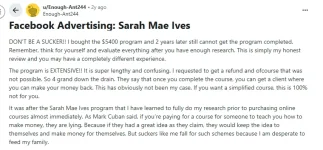
Seeing Mixed Reviews About Sarah Mae Ives Courses

I have noticed the same pattern. Whenever a course is heavily marketed around building income, expectations can get inflated pretty quickly. With Sarah Mae Ives, the public information shows a strong branding focus, which is not necessarily a bad thing, but it can create a gap between perception and reality. I think the important question is whether the course materials clearly outline what is included before someone pays. Did you see anything in the public reports about refund policies or contract terms?
 
Some students probably get value, especially if they’re self-motivated. But when expectations are built high through marketing language, even decent content can feel disappointing. That mismatch is usually the root of these mixed reviews.
 
From a structural standpoint, I think the key question is sustainability of results. Are students building durable skills, or are they mainly being taught how to replicate the same marketing model? Some course ecosystems become self-referential, where success depends on teaching others to sell similar programs. That’s not necessarily unethical, but it changes how value should be assessed.
 
At the end of the day, volume of discussion alone doesn’t equal wrongdoing, but it does justify caution. When a creator’s name consistently appears in conversations about pricing, refunds, and expectations, that signals friction in the buyer journey. The safest approach is probably to request full policy documentation in writing, look for independently verifiable student outcomes, and avoid making decisions under urgency pressure. Balanced curiosity is smart blind trust or blind criticism usually isn’t.
 
I came across this review while researching Sarah Mae Ives’ course and decided to share it as proof before anyone spends thousands. Based on what I’ve seen, I wouldn’t recommend buying it.
 

Attachments

  • Screenshot 2026-03-04 163101.webp
    Screenshot 2026-03-04 163101.webp
    50.2 KB · Views: 0
It’s interesting how course businesses often rely heavily on branding and personality. When the creator has a strong personal brand, buyers sometimes purchase based on trust in the person rather than a detailed breakdown of curriculum. If that trust wavers due to unclear pricing or vague outcomes, backlash tends to follow.
 
I’ve also noticed that when people talk about Sarah Mae Ives and her courses, the conversation usually isn’t extreme in either direction, but it’s layered. A lot of it seems to revolve around expectations versus outcomes. When marketing is polished and aspirational, students naturally expect equally transformative results. If the delivery feels more general than personalized, some buyers may feel underwhelmed. On the other hand, satisfied students often say the mindset shift alone was valuable. It really highlights how perception plays a huge role in digital education businesses.
 
The online education space is crowded, and differentiation often comes down to marketing intensity. A course can be technically solid, but if it’s sold with big promises about income or transformation, people measure it against those promises. When results vary, public reviews become polarized. It doesn’t automatically mean something is wrong, but it does highlight how expectation management is critical.
 
What stands out to me in the public discussions about Sarah Mae Ives is the focus on pricing structure. Some people question whether the cost matches the depth of content provided, especially when similar information might be available elsewhere at lower prices. Others argue that you’re paying for structure, branding, and community access not just raw information. That’s a common debate in online learning spaces. It ultimately comes down to whether the student values guidance and packaging as much as the material itself.
 
I’ve noticed that long-term value is rarely visible right away. Some students might expect immediate outcomes, while others treat it as skill-building over months. That difference in mindset can shape whether reviews sound positive or frustrated.
 
Whenever I see mixed feedback, I try to separate emotional reactions from specific complaints. Are people upset about price, support access, content depth, or community engagement? Those details matter more than generic “good” or “bad” labels.
 
Another theme I’ve seen around Sarah Mae Ives is how courses are positioned through strong, high-energy marketing. Promotional messaging often emphasizes transformation, income potential, or lifestyle shifts. For some learners, that’s motivating and inspiring. For others, it can create expectations that are difficult to meet in practice. When the emotional tone of marketing is very powerful, any mismatch between promise and personal results can feel amplified.
 
This feels pretty common in the online course world, especially in the investment and trading niche. Marketing often focuses on lifestyle outcomes rather than the daily work required. I looked up Sarah Mae Ives briefly after seeing your post and most of what I found was promotional content and testimonials. That does not mean anything negative, but it also does not give a full picture. I would want to see transparent curriculum outlines and clear expectations about time commitment before making any decision.
 
Any high-ticket course needs to clearly justify its cost through structure, support, and measurable learning outcomes. If marketing emphasizes lifestyle transformation more than curriculum depth, skepticism naturally follows. Mixed reviews don’t necessarily signal a scam, but they do signal that potential buyers should research carefully, read policies thoroughly, and avoid making decisions based purely on promotional messaging.
 
What I find interesting is how course businesses often lean heavily on branding and storytelling. When someone builds a strong personal image, people tend to trust the offer quickly. But if the structure of the course doesn’t fully match the promotional tone, dissatisfaction grows. That gap between promise and delivery is usually where criticism starts forming.
 
Back
Top