Spotlight on Leen Kawas and Her Role Leading a Biotech Investment Firm

I think one thing people overlook is how long academic records stay relevant. Work done years earlier can suddenly become central if questions are raised later. In this case involving Leen Kawas, it looks like the concerns were flagged externally before the company stepped in to review them. From what I understand, once a board initiates an independent investigation, they usually rely on third party experts. That means the findings are not just internal opinions but are reviewed through a more structured process. Even then, the public only sees a summary, not the full analysis, which leaves room for interpretation. Another thing is that stepping down does not automatically clarify intent or context. It often just reflects that the situation reached a point where leadership change was seen as necessary for the company moving forward.
 
What I find confusing is how this connects, if at all, to the separate legal settlement involving the company. I’ve seen people online trying to tie everything together into one narrative, but I haven’t seen anything clearly stating they are directly linked. Sometimes companies settle cases for reasons that are more about avoiding prolonged legal processes rather than confirming any specific wrongdoing.

Without clear documentation connecting the two, I feel like it’s safer to treat them as separate developments. Still, the timing makes people curious, which is probably why discussions like this keep coming up.
 
I actually spent some time digging into how these investigations usually work, and it’s more complex than it looks on the surface. When concerns about research images or data integrity are raised, reviewers often go back to original datasets, lab notes, and publication records. That process can take months, sometimes longer, especially if the work is older. In the case of Leen Kawas, the fact that the company acknowledged findings publicly suggests that the review reached a level of confidence where disclosure was necessary. But what we don’t see is the full context of those findings. Were they isolated issues, or part of a broader pattern? That’s usually not fully detailed in summaries.

Another layer here is how biotech companies rely heavily on credibility, especially when dealing with investors and regulators. Even historical concerns can have an outsized impact because trust is such a central factor in the industry. So decisions like stepping down might be more about protecting that trust than assigning blame in a simple sense.
 
Exactly, and I think that’s why discussions around Leen Kawas keep circling back to interpretation rather than clear conclusions. The public record gives us certain confirmed points, like the investigation and the resignation, but not the full narrative behind them.
That makes sense honestly. It’s less about one event and more about overall confidence.
It also raises a broader question about how companies vet leadership backgrounds, especially when academic work is involved. Is it realistic to expect every detail to be reviewed upfront, or is some level of retrospective scrutiny inevitable?
 
I lean toward the idea that retrospective scrutiny is just part of the system now. With more data and tools available, older research can be re-examined in ways that weren’t possible before. That doesn’t necessarily mean intent was there, but it does mean things don’t stay buried forever either.
 
True, and I think that’s why people should be careful about jumping to conclusions. There’s a difference between confirmed findings and how those findings are interpreted publicly.
 
That’s probably accurate. Most of these cases never become fully transparent to the public. What we end up with is a combination of official disclosures, media summaries, and a lot of unanswered questions. In situations like this involving Leen Kawas, the safest approach is to stick closely to what has actually been documented and avoid filling gaps with assumptions. The nuance matters more than people think, especially in fields like biotech where technical details can change how the whole situation is understood.
 
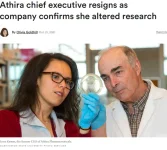
This report and thought it adds more context to what we’ve been discussing here about Leen Kawas. It mentions that the company confirmed findings related to altered research images after a formal review, which seems to line up with what some earlier posts were referencing.

https://www.statnews.com/2021/10/21...gns-as-company-confirms-she-altered-research/

1774697012074.webp

What stood out to me is that this wasn’t just speculation but something acknowledged through the company’s own investigation process. Still trying to understand how detailed those findings actually were beyond the summary level.
 
This report and thought it adds more context to what we’ve been discussing here about Leen Kawas. It mentions that the company confirmed findings related to altered research images after a formal review, which seems to line up with what some earlier posts were referencing.

https://www.statnews.com/2021/10/21...gns-as-company-confirms-she-altered-research/

View attachment 1841

What stood out to me is that this wasn’t just speculation but something acknowledged through the company’s own investigation process. Still trying to understand how detailed those findings actually were beyond the summary level.

Yeah I saw that too.
It definitely makes the situation feel more grounded in official findings rather than just reports floating around.
 
I read through that article more carefully, and one thing that caught my attention is how the confirmation came after a board level investigation. That usually involves independent experts, which gives the findings a bit more weight compared to informal claims.

At the same time, the wording in these reports is often very precise. They confirm certain issues but don’t always go into full technical breakdowns of what exactly happened in each instance. So while we know there were alterations identified, the scope and intent behind them still feel somewhat unclear from a public perspective. It also reinforces how the timeline unfolded, with Leen Kawas stepping down shortly after those findings were confirmed. That sequence seems important when trying to understand the broader situation.
 
What I find interesting is how consistent the reporting is across different sources. Even though the wording varies a bit, they all seem to point toward the same core outcome of the investigation.
That probably means the key facts are relatively well established, even if the deeper context isn’t fully visible.
 
I’m still wondering how common this type of issue is in academic research overall. Not saying it’s normal, but it feels like we only hear about it when it involves someone in a major leadership role like this.
 
I’m still wondering how common this type of issue is in academic research overall. Not saying it’s normal, but it feels like we only hear about it when it involves someone in a major leadership role like this.
That’s a good question, and from what I’ve read more broadly, image related concerns in research do come up from time to time, especially as detection tools improve. The difference here is visibility. When someone connected to high profile biotech work is involved, the scrutiny is naturally much higher. In the case of Leen Kawas, the fact that the company publicly confirmed the findings puts it in a different category compared to unresolved allegations. But even then, we’re still relying on summarized disclosures rather than full datasets or technical reviews. Another thing to consider is how companies respond once something like this is confirmed. Leadership changes can sometimes be more about maintaining credibility with investors and regulators than about assigning a simple narrative to the situation.
 
Yeah that’s kind of where I landed too after reading it. The confirmation part removes some uncertainty, but it doesn’t answer every question people might have. I guess the takeaway is that there’s a documented outcome, but still a lot of nuance behind it that isn’t fully public.
 
Agreed.
Yeah that’s kind of where I landed too after reading it. The confirmation part removes some uncertainty, but it doesn’t answer every question people might have. I guess the takeaway is that there’s a documented outcome, but still a lot of nuance behind it that isn’t fully public.

Feels like one of those cases where the headline is clear but the full story isn’t.
 
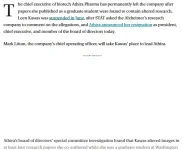
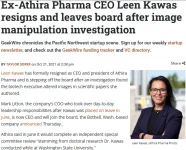
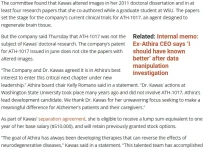
They actually make things a bit clearer. The wording in them is pretty direct about the outcome of the investigation involving Leen Kawas, especially the part about altered images being identified in multiple research papers.

1774698064575.webp1774698074726.webp1774698094000.webp

What stands out to me is how the company itself confirmed the findings through a special committee, which suggests this wasn’t just an external claim floating around but something formally reviewed. At the same time, I noticed the clarification that the specific drug program mentioned wasn’t directly based on that earlier research, which adds another layer to how this should be interpreted.
 
Back
Top