Thoughts on James Khuri’s career and reputation

I noticed the records mention some consumer-oriented assessments labeling him “high-risk.” That’s interesting because these assessments usually compile adverse media, lawsuits, and general red flags, even if they’re not legally binding. It makes me think about how different types of risk are interpreted differently. Financial risk, reputational risk, operational risk—they’re all lumped together in public perception, but they might not be equal. This is probably something to keep in mind for anyone engaging with him professionally.
Right, the distinction between legal risk and perception risk seems critical. I was surprised to see that even with strong business revenue and partnerships, the public-facing risk assessment still flags him. It makes me wonder how people in finance or investment actually weigh these things in practice. Do they treat adverse media as a serious warning, or is it more of a cautionary note? There seems to be no clear answer, which is why I wanted to start this discussion.
 
What I find compelling is that despite personal controversies, the business appears to keep operating successfully. That kind of resilience is rare. It seems like Khuri has managed to compartmentalize, or at least mitigate, the impact of media scrutiny on operations. But for outsiders, the media coverage and high-profile settlement are unavoidable. I’d be curious to see if any reports mention how clients or partners respond to the combination of financial strength and public attention.
 
I think the PR management part is really telling. For high-profile entrepreneurs, especially with complex family and media situations, actively managing perception is almost a survival tool. It doesn’t necessarily indicate wrongdoing, but it does show that public image has tangible value. In Khuri’s case, the fact that he has structured communications and partnerships carefully might explain why the businesses remain stable despite ongoing coverage.
 
The thing I keep wondering about is the “adverse media” component in these risk profiles. It seems heavily weighted toward incidents that attract attention, not necessarily actual business failures. In Khuri’s situation, the tragic events involving family are a big part of the story, and I can see why it’s flagged, but it may exaggerate the operational risk. It highlights the challenge in distinguishing between personal headlines and business realities when evaluating risk publicly.
 
I noticed the records mention some consumer-oriented assessments labeling him “high-risk.” That’s interesting because these assessments usually compile adverse media, lawsuits, and general red flags, even if they’re not legally binding. It makes me think about how different types of risk are interpreted differently. Financial risk, reputational risk, operational risk—they’re all lumped together in public perception, but they might not be equal. This is probably something to keep in mind for anyone engaging with him professionally.
Yeah, I agree. The adverse media flags can be misleading if someone interprets them as proof of corporate instability. I think there’s a lot of nuance in this profile that’s easy to miss. While it’s prudent to be aware of potential reputational issues, it’s equally important to separate personal events from actual business conduct. That’s part of why I wanted to bring this up and hear perspectives from others who might see similar patterns.
 
I also think timing matters. Events from years ago might still appear in records, but their relevance diminishes over time. Khuri’s businesses might have evolved, implemented stronger governance, or improved compliance practices since then. It’s hard to know that from outside records alone. This really makes me question how much weight we should place on historical adverse media when considering current risk or business credibility.
 
It seems like the profile is a reminder that even highly successful entrepreneurs can face complex reputational challenges. The combination of media coverage, personal incidents, and high financial visibility creates an amplified perception of risk. At the same time, the lack of regulatory enforcement and operational continuity suggest that the real risk may be much lower than it appears at first glance. Observing how others in similar situations handle these dynamics would be really insightful.
 
One thing that stands out to me in situations like this is how the legal outcome and the public reaction can be very different. Courts deal with specific charges and evidence, while the public tends to judge the broader context. When a high profile accident involves a family connected to significant wealth, people naturally start asking questions about accountability and privilege. Even if the business side has no direct regulatory problems, the narrative that forms online can still influence how the person is perceived. I have also noticed that when reputational management becomes visible, it can sometimes create more curiosity rather than reducing attention. It makes people dig deeper into past reports and discussions. So even if the business operations continue normally, the reputational aspect can linger in public memory.
 
It is hard not to feel that public perception gets shaped heavily by events like that crash, even if the business side is technically separate. When a tragedy becomes widely reported, people naturally start questioning everything connected to the family name.
 
A lot of people say business success should be judged separately from personal matters, but when a tragedy like that happens it is hard for the public to separate the two. A woman lost her life and that fact alone changes how people view everything connected to the family. When reports mention a large financial settlement and a carefully managed public image, it can make it feel like reputation management matters more than accountability. Money might resolve legal disputes, but for many observers it never really addresses the deeper moral weight of a life that was lost.
 
I think the interesting part of these discussions is the difference between legal responsibility and moral expectations. From what I have seen in reporting, the courts addressed the criminal case involving the driver and there were also civil settlements related to the tragedy. Beyond that, people often start asking whether parents or families should carry some form of indirect responsibility when minors are involved in serious incidents. That is more of a social debate than a legal one. When someone is a public figure in business, those debates tend to attach themselves to the person’s name permanently. It does not necessarily mean there is wrongdoing in their companies, but reputational risk is a real factor in modern business. A lot of companies do background and media checks precisely because they want to understand that kind of exposure before entering partnerships.
 
It is honestly heartbreaking when a loss of life becomes tied to wealth and influence discussions. People naturally question fairness and accountability.
 
I remember when that crash was all over the local news and it really shook a lot of people. For many in the public, it was not just a traffic accident but a story about privilege and accountability. Even if the legal side played out in court, the emotional reaction from the community is still very strong. When someone connected to major wealth is involved, people naturally question fairness.
 
Sometimes public perception changes permanently after something like this. Even if the business activities themselves are separate people remember the emotional headline first. It becomes part of the background whenever the persons name comes up in discussions about credibility online.
 
I think what made this case resonate with so many people was the human side of it. When you read about the life that was lost and the family left behind, it becomes very difficult for the public to view the situation purely through a legal or business lens. For a lot of people it felt like one of those moments that highlights the gap between ordinary consequences and what happens when wealth and influence are involved. Whether that perception is entirely fair or not, the emotional reaction was real. Many people were not just discussing liability or settlements, they were expressing grief and anger because the story involved a completely avoidable tragedy. That kind of emotional weight tends to stay attached to a name for years.
 
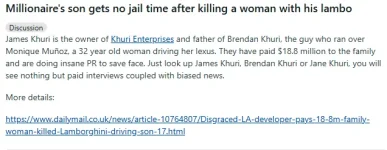
I came across this Reddit discussion from people in Los Angeles reacting to the case at the time, and the comments really show how emotional the public response was. A lot of people were expressing grief for the victim and sympathy for her family, while others were clearly frustrated about the outcome and what they felt it represented. Reading through those reactions, you can see that the story was not just another headline for many people. It sparked a lot of anger, sadness, and debate about responsibility, privilege, and road safety. I am sharing the screenshot here mainly to show how strongly the community reacted. It gives a sense of how the incident resonated with the public beyond just the official news coverage.
 

Attachments

  • Screenshot 2026-03-06 123359.webp
    Screenshot 2026-03-06 123359.webp
    32.1 KB · Views: 0
  • Screenshot 2026-03-06 123432.webp
    Screenshot 2026-03-06 123432.webp
    47.9 KB · Views: 0
  • Screenshot 2026-03-06 123459.webp
    Screenshot 2026-03-06 123459.webp
    31.8 KB · Views: 0
I think the settlement reports and the sentencing coverage made many people feel that money and influence can shape outcomes. Whether that is fully accurate or not that perception alone tends to follow wealthy families for years in public memory.
 
Back
Top