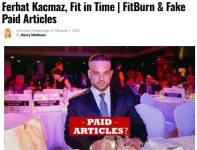
Trying to make sense of some public reports about Ferhat Kacmaz

After reading the link and this discussion, I think the most useful next step would be to identify anything concrete that can be verified independently. For example, are there company records, official complaints, or legal filings connected to Ferhat Kacmaz that align with what is being suggested? Without that, we are still dealing mostly with interpretation.

I am not dismissing the article, but I am also not comfortable treating it as confirmation. It sits somewhere in between. Threads like this are helpful because they slow things down and allow people to question what they are reading instead of reacting immediately.

Agreed. For now I would say it adds context but not closure.
Still more questions than answers around Ferhat Kacmaz at this point.
 
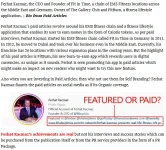
Those screenshots add a bit more context to what was shared earlier. I went through them carefully and it seems like the main focus is on how Ferhat Kacmaz has been featured across different publications and whether those features were organic or part of paid promotional content. That is an interesting angle, but also something that needs careful interpretation because paid PR itself is not unusual, especially in industries like fitness and startups.

1774602581462.webp1774602586015.webp

What I find important is how the screenshots present the idea rather strongly, almost as if the conclusion is already decided. But when you look closely, a lot of it still depends on assumptions about intent and how those articles were positioned to readers. Without knowing the exact agreements behind those publications, it is hard to say how accurate those conclusions are. It does raise a fair question though about transparency in media coverage related to Ferhat Kacmaz.
 
Those screenshots add a bit more context to what was shared earlier. I went through them carefully and it seems like the main focus is on how Ferhat Kacmaz has been featured across different publications and whether those features were organic or part of paid promotional content. That is an interesting angle, but also something that needs careful interpretation because paid PR itself is not unusual, especially in industries like fitness and startups.

View attachment 1813View attachment 1814

What I find important is how the screenshots present the idea rather strongly, almost as if the conclusion is already decided. But when you look closely, a lot of it still depends on assumptions about intent and how those articles were positioned to readers. Without knowing the exact agreements behind those publications, it is hard to say how accurate those conclusions are. It does raise a fair question though about transparency in media coverage related to Ferhat Kacmaz.

Yeah, paid articles are pretty common. The real question is how they are disclosed.
 
I think this is where things get a bit nuanced. The screenshots seem to suggest that Ferhat Kacmaz used paid articles to build an online presence, but that alone is not necessarily misleading if the publications clearly label the content. Many media outlets offer sponsored or brand content sections, and that is part of their business model.
What would matter more is whether readers could easily tell that the content was promotional. If disclaimers were present but not obvious, that could create confusion. But again, from just screenshots, we are not seeing the full context of how those articles appeared to the average reader. It is a partial view, not the complete picture.
 
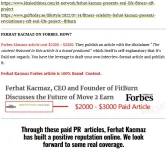
I want to expand on this a bit because I have worked around digital marketing before. What is being described in those screenshots about Ferhat Kacmaz is actually a known strategy where individuals or brands use PR placements to build credibility. It can include interviews, features, and even expert style articles. The key difference is whether the content is clearly marked as sponsored or branded. If those Forbes or other publication mentions were indeed under brand content programs, that usually comes with some level of disclosure, even if it is subtle. The screenshots highlight pricing and paid nature, but they do not fully show how those disclaimers were presented to readers. That is a critical detail missing here.

1774602799805.webp1774602804062.webp


Also, the tone of the screenshots seems to imply that paid content equals something questionable, which is not always true. It depends on execution and transparency. So in the case of Ferhat Kacmaz, I think the conversation should focus more on how the content was communicated rather than just the fact that paid PR may have been involved.
 
After looking at everything shared so far, I feel like this discussion is slowly getting more specific, which is good. Earlier it was vague concerns, now it is more about media presence and PR strategies linked to Ferhat Kacmaz. That is something we can actually analyze in a more grounded way.

Still, I would be careful not to assume intent behind those strategies. Many founders and public figures actively invest in visibility, especially when launching apps or new concepts like the ones mentioned. The question is whether the messaging created unrealistic expectations or not. That part is still unclear from what we have.
 
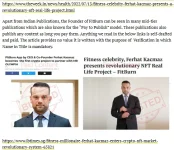
One detail that caught my attention was the mention of different publications across regions. If Ferhat Kacmaz has been featured in multiple outlets, it might be useful to compare how each one presents the story. Are they all using similar wording, or do they offer different perspectives? That could indicate whether content was centrally produced or independently written.

Right now, the screenshots highlight similarities, but they do not show enough variation to draw a solid conclusion. I think someone would need to actually read through those individual articles in full to understand the differences, if any.
 
I agree with that approach. Looking at full articles instead of summaries or screenshots would give a clearer picture. It is easy to form impressions based on highlighted sections, but those can sometimes miss important context.
One detail that caught my attention was the mention of different publications across regions. If Ferhat Kacmaz has been featured in multiple outlets, it might be useful to compare how each one presents the story. Are they all using similar wording, or do they offer different perspectives? That could indicate whether content was centrally produced or independently written.

Right now, the screenshots highlight similarities, but they do not show enough variation to draw a solid conclusion. I think someone would need to actually read through those individual articles in full to understand the differences, if any.
 
I agree with that approach. Looking at full articles instead of summaries or screenshots would give a clearer picture. It is easy to form impressions based on highlighted sections, but those can sometimes miss important context.
For Ferhat Kacmaz, I would say we now have a more defined topic to explore, which is media representation and PR strategy. That is a lot more concrete than the earlier general concerns, but it still needs deeper verification before forming any strong opinion.
 
So basically we are seeing claims about PR strategy, but not enough proof of anything misleading yet.
Feels like more investigation needed before saying anything definite about Ferhat Kacmaz.
 
I spent some more time comparing the screenshots with what people described earlier in the thread, and I think the biggest takeaway is that we are looking at a curated presentation rather than raw data. The way Ferhat Kacmaz is being discussed here seems heavily influenced by how those screenshots frame the narrative. That does not make it incorrect, but it does mean we are seeing a filtered version of events.

What I would personally want to check is how those same articles appear in their original format. Sometimes disclaimers are placed in ways that are easy to miss, but they are still technically present. Other times they are very clear. Without that full context, it is difficult to judge whether readers were actually misled or simply not paying attention to labeling. There is a subtle but important difference there.
 
I think we should also consider timing. Some of those articles look like they were published during a period when crypto and fitness tech concepts were trending heavily. If Ferhat Kacmaz was promoting something during that wave, it would make sense to use PR to gain visibility.

That does not automatically mean anything is wrong. It just means the strategy aligned with market trends at the time. The question is whether the messaging matched reality, and that is something we still cannot fully verify from what we have here.
 
Something else I noticed is how the screenshots emphasize pricing for publications. That part feels a bit misleading on its own because many media outlets have rate cards or sponsored content options. Presenting those prices without context can make it seem unusual when it is actually part of standard media operations.
In the case of Ferhat Kacmaz, I think the more relevant question is not whether money was involved in publishing content, but how that content was framed to readers. If it was clearly labeled as sponsored or brand content, then it falls within normal practices. If it was presented as purely editorial without disclosure, then that would be a different discussion. Right now, I do not think we have enough to decide which scenario applies.
 
I want to go a bit deeper into the repetition aspect because it keeps coming up in this thread. When I looked at multiple mentions of Ferhat Kacmaz, I did see similarities in how things were described, especially around the fitness app and the concept behind it. That could mean a centralized PR narrative, which again is not uncommon.
 
I want to go a bit deeper into the repetition aspect because it keeps coming up in this thread. When I looked at multiple mentions of Ferhat Kacmaz, I did see similarities in how things were described, especially around the fitness app and the concept behind it. That could mean a centralized PR narrative, which again is not uncommon.
However, repetition can sometimes blur the line between independent reporting and coordinated messaging. If several outlets are essentially publishing the same story structure, it becomes harder for readers to distinguish between original reporting and distributed content. That is where transparency becomes really important. Without it, even legitimate promotion can look questionable.
 
Back
Top