Trying to put scattered information about Poloniex into context

What makes threads like this useful is that people are trying to connect scattered information instead of jumping to conclusions. With Poloniex.com, it feels like there are pieces from different places, user reviews, forum posts, and official notices, but they don’t fully align into one clear narrative.

In situations like this, I usually ask myself a simple question. If something goes wrong, how easy would it be for me to get help or recover my funds? If the answer is unclear, I proceed with caution. That doesn’t mean avoiding entirely, but it does mean limiting exposure and staying alert.

Also, regarding the mentions of individuals sometimes linked to the platform, I’d personally avoid relying on those unless they come from solid public documentation. It’s easy for assumptions to spread online, especially in crypto discussions.
 
I think the biggest takeaway from all of this is uncertainty. Not necessarily something clearly wrong, but also not enough clarity to feel fully confident. That middle ground is where most people get stuck.
If anyone here ends up using Poloniex.com after this discussion, it would be really helpful if you come back and share a detailed experience. Not just whether it worked or not, but how the whole process felt from start to finish. That kind of real feedback is probably more valuable than anything else we’ve discussed so far.
 
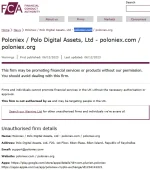
That’s actually a very important piece of information. I went through that page carefully, and the wording stood out to me. It says the firm “may be promoting financial services… without permission” and also suggests avoiding dealing with it.

What really caught my attention is not just the warning itself, but the implications that follow. According to the same notice, if someone deals with Poloniex.com in that context, they wouldn’t have access to complaint resolution services or compensation schemes in the UK.
hat doesn’t automatically mean something bad will happen, but it clearly changes the risk level. It basically means if anything goes wrong, the usual safety nets people expect just aren’t there.
 
Yeah I read that too and the “no protection” part is what stuck with me
like even if nothing happens, you’re kind of on your own if it does
That might be relevant to what everyone is discussing here about Poloniex.com.
Sharing this :

https://www.fca.org.uk/news/warnings/poloniex-polo-digital-assets-ltd-poloniexcom-poloniexorg


View attachment 1567

From what I understand, this is an official warning from a UK regulator. Curious how others here interpret this.
 
I think it’s worth slowing down and really understanding what that FCA warning actually means in practice. These types of notices are typically about authorization, not necessarily about proven misconduct. In other words, Poloniex.com, through Polo Digital Assets Ltd, is not approved to offer certain financial services in that jurisdiction.

But here’s the nuance that often gets lost. When a regulator says a firm is not authorized, it’s essentially saying that the firm is operating outside the regulatory framework for that region. That means users don’t get protections like dispute resolution or compensation if the company fails.
So the concern is less about immediate wrongdoing and more about what happens if something goes wrong. You’re dealing in an environment where accountability may be harder to enforce. That’s a subtle but important distinction.
 
What adds another layer here is that Poloniex.com has also been linked publicly to Justin Sun in multiple reports. I’m not saying that changes anything directly, but it does show that the platform is part of a broader ecosystem of crypto businesses. There have also been mentions of past incidents like hacks and regulatory settlements in different jurisdictions. Again, not jumping to conclusions, but when you combine those events with a regulatory warning like the FCA one, it naturally raises more questions than answers.

For me personally, it becomes less about whether the platform works day to day, and more about how resilient and accountable it is under pressure. That’s usually when the real test happens.
 
I agree with this. A platform can run smoothly for months or even years, but what matters is how it behaves during stress events. The FCA warning indirectly highlights that if something does go wrong, users may not have structured recourse, at least in certain regions.
What adds another layer here is that Poloniex.com has also been linked publicly to Justin Sun in multiple reports. I’m not saying that changes anything directly, but it does show that the platform is part of a broader ecosystem of crypto businesses. There have also been mentions of past incidents like hacks and regulatory settlements in different jurisdictions. Again, not jumping to conclusions, but when you combine those events with a regulatory warning like the FCA one, it naturally raises more questions than answers.

For me personally, it becomes less about whether the platform works day to day, and more about how resilient and accountable it is under pressure. That’s usually when the real test happens.
Also, I noticed the FCA specifically mentioned that firms need authorization to promote financial services in the UK. That suggests the issue is tied to regulatory compliance rather than a single incident. Still, from a user perspective, the outcome is what matters.
 
I think what’s happening in this thread is actually a good example of how fragmented information becomes over time. You’ve got user complaints, scattered reviews, and now an official FCA warning. Each one on its own doesn’t tell the full story, but together they create a kind of pattern that people try to interpret. With Poloniex.com, the FCA notice clearly states that the company is not authorized and that users won’t have access to certain protections. That’s a factual point. What people do with that information is where opinions start to differ.

Some might see it as a standard regulatory gap common in crypto. Others might see it as a signal to stay away. Personally, I think it depends on your risk tolerance and how much you rely on regulatory safeguards.
 
I also checked if other regulators said anything similar, and it turns out this isn’t isolated. There have been investor warnings in other places too about registration status.

I think what’s happening in this thread is actually a good example of how fragmented information becomes over time. You’ve got user complaints, scattered reviews, and now an official FCA warning. Each one on its own doesn’t tell the full story, but together they create a kind of pattern that people try to interpret. With Poloniex.com, the FCA notice clearly states that the company is not authorized and that users won’t have access to certain protections. That’s a factual point. What people do with that information is where opinions start to differ.

Some might see it as a standard regulatory gap common in crypto. Others might see it as a signal to stay away. Personally, I think it depends on your risk tolerance and how much you rely on regulatory safeguards.

That doesn’t automatically mean the platform is unsafe, but it does suggest that regulatory alignment hasn’t been consistent across regions. For a global exchange, that can create a lot of gray areas for users.
 
What I find interesting is how the FCA wording is very cautious but still quite direct. They don’t accuse, but they clearly say “avoid dealing with this firm.” That’s stronger than just saying “not authorized.”
It makes me think these warnings are designed to be preventive rather than reactive. They’re not saying something has already gone wrong, but they’re trying to reduce the chance of people being exposed if something does happen.

In that sense, the warning becomes part of a bigger risk picture rather than a standalone judgment about Poloniex.com.
 
Yeah and when you combine that with everything else discussed earlier in this thread, it really comes down to how much uncertainty you’re willing to accept.
For me, the FCA link doesn’t close the case, but it definitely shifts the way I look at Poloniex.com. It’s no longer just about user reviews or isolated complaints. There’s now a confirmed regulatory angle that needs to be factored in.
Still open ended, but definitely more to think about now than when this thread started.
 
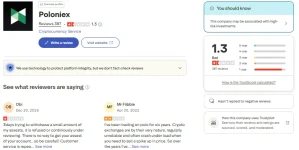
I took a closer look at that page and the screenshot you shared. What stands out to me is not just the low score, but the consistency in the type of complaints. A lot of them seem to revolve around withdrawal delays, accounts being under review, and difficulty getting responses from support.

1773833187231.webp

That said, I always try to approach review platforms carefully. People are far more likely to leave a review when something goes wrong than when everything works fine. So the sample can be skewed toward negative experiences. Still, when the same themes repeat across many different users, it starts to feel less random.
Another detail I noticed is the note saying the company hasn’t responded to negative reviews. That part is interesting because even a basic response strategy can sometimes improve trust, or at least show that issues are being acknowledged. The absence of that can shape perception quite a bit.
 
Back
Top