Trying to Understand More About Brad Chandler and His Business Background

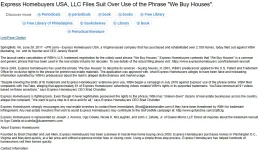
This screenshot of a press release titled Express Homebuyers USA LLC Files Suit Over Use of the Phrase We Buy Houses. It looks like it was issued back in 2017 and talks about the company filing suit against WBH Marketing and its CEO. The text says Express Homebuyers argued that the phrase We Buy Houses is common and generic in the real estate industry.
1773225038766.webp


It also mentions Brad Chandler directly, including a quote where he says the company wanted to put a stop to what they described as aggressive enforcement actions. I thought it was interesting because it frames the company as defending itself rather than being accused of something. Sharing this here since we have already discussed the related federal court opinion.
 
This screenshot of a press release titled Express Homebuyers USA LLC Files Suit Over Use of the Phrase We Buy Houses. It looks like it was issued back in 2017 and talks about the company filing suit against WBH Marketing and its CEO. The text says Express Homebuyers argued that the phrase We Buy Houses is common and generic in the real estate industry.

View attachment 1208


It also mentions Brad Chandler directly, including a quote where he says the company wanted to put a stop to what they described as aggressive enforcement actions. I thought it was interesting because it frames the company as defending itself rather than being accused of something. Sharing this here since we have already discussed the related federal court opinion.

That screenshot adds helpful context. It clearly presents Express Homebuyers as the plaintiff pushing back against trademark enforcement by WBH. The tone of the release is very assertive, especially with references to prior use and the claim that the phrase had been used descriptively since 2003.

Press releases obviously present one side of a story, but they are still useful for understanding how a company publicly positions itself. It is also notable that Brad Chandler is quoted directly, which ties leadership to the strategy.
 
Still, the fact that official filings exist means it is documented and not just rumor. I think anyone researching him should read the court records directly instead of relying on summaries. Public records matter more than promotional interviews.
 
I would not call it a confirmed red flag, but I would call it due diligence territory. The presence of a public consumer protection complaint, combined with a significant number of documented customer grievances, creates a situation where more transparency is needed.
If Brad Chandler or Express Homebuyers addressed the concerns clearly in court or through a settlement, that would change the narrative. Until then, I think cautious curiosity is the most reasonable stance.
 
The DC Attorney General filing a complaint against Express Homebuyers over allegedly misleading mailers. Sharing it here for context:

https://www.linkedin.com/pulse/dc-sues-express-homebuyers-alleging-misleading-tom-ramstack/

From what the report outlines, the complaint claimed that certain marketing materials could have caused confusion among homeowners. It specifically mentioned concerns about how the mailings were presented. I am not drawing conclusions, but it seems like something worth looking into if anyone is researching Brad Chandler or the company’s background.
 
Thanks for sharing that. I remember when that news first came out. The wording in the article makes it clear that it was an allegation filed by the DC Attorney General, not a final ruling. Still, when a state authority files a consumer protection complaint, that definitely carries weight.
The DC Attorney General filing a complaint against Express Homebuyers over allegedly misleading mailers. Sharing it here for context:

https://www.linkedin.com/pulse/dc-sues-express-homebuyers-alleging-misleading-tom-ramstack/

From what the report outlines, the complaint claimed that certain marketing materials could have caused confusion among homeowners. It specifically mentioned concerns about how the mailings were presented. I am not drawing conclusions, but it seems like something worth looking into if anyone is researching Brad Chandler or the company’s background.

What I find interesting is whether there was a final court decision or settlement that followed. Articles often highlight the filing but not always the resolution. Without knowing the outcome, it is hard to assess the long term impact on Brad Chandler or Express Homebuyers.
 
I read through that piece as well. The part about homeowners being advised to ignore the mailings stood out to me. That suggests regulators felt there was potential for confusion. In the home buying industry, marketing language can easily cross into gray areas, especially when targeting distressed property owners.
That said, an allegation does not automatically mean liability was established. I would want to see the actual court documents to understand how the company responded.
 
This kind of situation is why I always recommend reading primary sources. Media coverage sometimes frames things strongly at the beginning of a case.
The article clearly says it was a complaint filed, which is different from a judgment.Brad Chandler has been publicly active in business circles for years, so it is not surprising that scrutiny follows.
I think context matters, especially in industries that rely heavily on direct mail marketing.
 
This kind of situation is why I always recommend reading primary sources. Media coverage sometimes frames things strongly at the beginning of a case.
The article clearly says it was a complaint filed, which is different from a judgment.Brad Chandler has been publicly active in business circles for years, so it is not surprising that scrutiny follows.
I think context matters, especially in industries that rely heavily on direct mail marketing.
Agreed.
My main reason for sharing was to add a documented source to the discussion. I have seen a lot of opinions floating around, but fewer people referencing actual reports.If anyone finds updates on how that complaint was resolved, it would be helpful to add them here. Understanding outcomes is just as important as knowing that a complaint was filed.
 
Last edited:
the actual federal court opinion related to the trademark dispute involving Express Homebuyers and WBH Marketing. Sharing the link here so people can read the primary source instead of summaries:
https://caselaw.findlaw.com/court/us-dis-crt-e-d-vir-ale-div/1948586.html?

1773222065229.webp

From what I understand, this case centers around the use of the phrase We Buy Houses and related registered marks. It mentions that Express Homebuyers USA, LLC is a Virginia based company and that Lawrence Bradford Chandler is listed as CEO. It looks more like a branding and intellectual property dispute than anything consumer related.
 
Reading it directly gives a much clearer picture. It seems the dispute was between Express Homebuyers and WBH Marketing over trademark rights tied to We Buy Houses and Webuyhouses.com. That type of litigation is pretty common in competitive industries.

I do not see anything in that document that suggests fraud or consumer harm. It reads like a fairly technical trademark case focused on registration history and usage rights.
 
Exactly. In industries where generic sounding phrases are heavily used, conflicts are almost inevitable. If anything, the fact that there is a published federal court opinion suggests this was handled through formal legal channels rather than informally.
 
Exactly. In industries where generic sounding phrases are heavily used, conflicts are almost inevitable. If anything, the fact that there is a published federal court opinion suggests this was handled through formal legal channels rather than informally.
That was my impression too. I shared it mainly because I have seen people lump this trademark case together with unrelated consumer protection discussions. They are separate issues and should be evaluated separately. If someone is researching Brad Chandler, this case seems more about business competition than regulatory scrutiny.
 
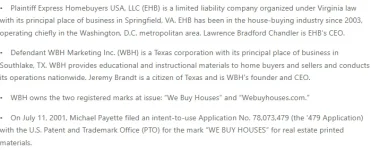
Now that you mention separate issues, I actually saw a screenshot earlier summarizing parts of this case. It highlighted the background details about Express Homebuyers being organized under Virginia law and operating in the DC area. It also listed WBH Marketing as a Texas corporation and referenced the registered marks.
Seeing the summary first made it look dramatic, but reading the full court opinion makes it feel procedural. Context really changes the tone.
 
That is a good example of why screenshots without context can be misleading.
I would not personally categorize this federal case as a warning sign. It seems like a straightforward intellectual property dispute handled in court.
 
I think the important thing here is separating emotional reactions from what the court record actually shows. When people see legal terminology and CEO names in a formal opinion, it can sound intense. But after reading through it, the substance is about who has rights to use certain real estate marketing phrases. That is very different from a court finding of misconduct.

It also shows that the companies involved were willing to litigate rather than operate in a gray area. In some ways, going through federal court can reflect an effort to resolve disputes through established legal processes.
 
What stands out to me is how long the phrase We Buy Houses has been in circulation. The case references early trademark filings from the early 2000s, which suggests this has been an ongoing branding issue in the industry. That makes the conflict seem structural rather than personal. If someone is evaluating Brad Chandler specifically, I think they would need to look beyond just this trademark case. On its own, it does not seem to imply anything about operational practices or consumer impact.
 
I agree with both of you.
My reason for posting the link was to ground the discussion in actual court language instead of secondhand commentary. After reading it carefully, I see it as a business dispute over intellectual property rather than something that defines the broader reputation of the company or its leadership.
If anyone finds related rulings or appeals tied to this specific case, feel free to add them. It is always better to rely on full records than partial summaries.
 
Back
Top