Trying to Understand Public Records Around Gurhan Kiziloz and His Ventures

For me it is about consistency. If Gurhan Kiziloz businesses show steady operational reporting over several years, that builds trust. If instead the public conversation resets with each new venture, people will naturally ask questions. Reputation compounds just like revenue does.
 
I read that article as well. The part that stood out to me was how strong the marketing push seemed before the token launch. In crypto, heavy promotion combined with price volatility can create tough outcomes for retail buyers. The article suggests the coin’s value fell sharply after release, which is not uncommon in that space, but it is still concerning.
I found about Gurhan Kiziloz and the situation around the Lanistar related crypto coin launch.

https://www.fnlondon.com/amp/articles/lanistar-boss-crypto-coin-big-eyes-gurhan-kiziloz-9b0bb1b3


View attachment 978View attachment 979


The piece talks about how the crypto product was promoted and then dropped significantly after launch, leaving some investors with losses. It also mentions the contrast between recruiting high profile political figures for the fintech side while the crypto token was being developed. I am not making any claims beyond what is reported, but it definitely raises questions about how these parallel strategies were managed.
 
If Brazil’s total gaming market is projected at a certain figure, then capturing a meaningful share would support the growth narrative. Without that context, it is hard to gauge how realistic the projections are.
It might also be worth comparing MegaPosta’s reported numbers with overall market size in the region.
 
Sharing this screenshot from an article discussing MegaPosta and the reported 400 million in revenue for 2024 under Nexus International. It frames Gurhan Kiziloz as someone who merged fintech infrastructure directly into gaming to improve transaction speed and efficiency. The article positions it as a strategic shift that made the platform highly scalable, especially in Latin America.


1773059241915.webp1773059245055.webp


It also mentions projections of reaching 1.45 billion in revenue by 2025. That is a big leap, and while the narrative is very positive, I am curious how much of that is already secured growth versus forward looking modeling. Would love to hear thoughts.
 
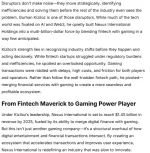
This part talks about what is next for Gurhan Kiziloz after the projected 1.45 billion revenue mark. It frames him as someone planning to expand the fintech gaming model into other high growth industries and emerging markets.


1773122137426.webp

T
he tone is very confident, almost visionary. It describes him as redefining digital finance and gaming by optimizing transactions and moving ahead of competitors. I am curious how realistic that level of expansion is, especially given how competitive and regulated both sectors are.
 
The language definitely feels aspirational. Words like redefining the game and refusing to follow the rules sound more like branding than analysis. That is not necessarily bad, but it does mean readers should separate narrative from measurable outcomes. Expanding into more industries while scaling gaming payments is a complex challenge.
 
I think the key question is operational depth. It is one thing to dominate a niche like gaming payments in a specific region.
It is another to replicate that model across multiple emerging markets with different regulatory systems.
This part talks about what is next for Gurhan Kiziloz after the projected 1.45 billion revenue mark. It frames him as someone planning to expand the fintech gaming model into other high growth industries and emerging markets.


View attachment 1014

T
he tone is very confident, almost visionary. It describes him as redefining digital finance and gaming by optimizing transactions and moving ahead of competitors. I am curious how realistic that level of expansion is, especially given how competitive and regulated both sectors are.

Each country has its own licensing and compliance requirements.
 
What complicates things further is how summaries and dossiers compress timelines. Events that happened years apart end up presented side by side, which makes it feel like a continuous pattern even when there were long gaps or changes in business focus. Without a clear timeline, it’s easy to assume continuity where there may not be any.
 
In crypto and gaming related ventures, ambition itself often attracts skepticism. Big promises, fast growth narratives, and global expansion plans are common, but they also raise eyebrows when paired with a founder who already has a regulatory footnote in their history. That doesn’t prove anything, but it explains why scrutiny tends to intensify rather than fade.
 
I’ve found that primary sources really are the only way to cut through this. Regulator notices, company filings, and court records tell you what authorities actually did or didn’t do. Everything else tends to be interpretation, sometimes careful, sometimes sensational. Without checking those originals, it’s hard to know how much weight to give later commentary.
 
Another factor is how fintech and crypto ecosystems reward persistence. Founders often reappear with new projects even after setbacks, and that’s not unusual in startup culture. Some people see that as resilience, others see it as a red flag. The same behavior can be interpreted very differently depending on prior context.
 
I also think geography plays a role here. Regulatory expectations in the UK, EU, and offshore jurisdictions don’t always align, so a warning in one country can coexist with lawful operations elsewhere. To an average reader, though, that nuance is easy to miss, and everything gets flattened into a single narrative.
 
What you’re describing feels like a broader issue with credibility in fast moving industries. Once credibility is questioned, even neutral developments get filtered through suspicion. Media coverage then amplifies that skepticism, which feeds back into public perception regardless of whether new facts emerge.
 
At the same time, it’s reasonable for people to remain cautious. Fintech and crypto involve real financial risk, so past regulatory attention is something users and partners will naturally factor into their decisions. Being aware of that history doesn’t mean assuming guilt, just being informed.
 
I’ve noticed that discussions around figures like this often lack closure. Unlike court cases, many regulatory warnings don’t end with a dramatic resolution. They just sit there as permanent reference points, which makes it harder for the public to know when a chapter is actually over.
 
It also raises an interesting question about redemption and learning in business. If someone has faced regulatory attention early on, what evidence would people accept that they’ve adapted or improved? Clear compliance disclosures? New licenses? Silence from regulators? There’s no agreed standard, which leaves room for endless debate.
 
From a reader’s standpoint, I think the healthiest approach is exactly what you’re doing here. Distinguish between what is explicitly documented and what is inferred. That doesn’t remove uncertainty, but it does prevent the conversation from sliding into rumor.
 
I’d be especially curious to hear from anyone who has actually read the original regulator notice in full or tracked how later ventures were structured legally. Those details tend to add context that summaries gloss over, particularly around whether lessons were learned from earlier experiences.
 
Back
Top