Navigation
Install the app
How to install the app on iOS
Follow along with the video below to see how to install our site as a web app on your home screen.
Note: This feature may not be available in some browsers.
More options
Style variation
You are using an out of date browser. It may not display this or other websites correctly.
You should upgrade or use an alternative browser.
You should upgrade or use an alternative browser.
Trying to Understand Reports About Felix Chertok and Wine Industry Coverage
- Thread starter Shadow
- Start date

palehour
Member
Overall, this feels like a case where context matters more than headlines. Without understanding the regulatory environment companies were operating in at each stage, it’s easy to misread public records. Discussions like this are helpful because they encourage people to slow down and actually look at how facts, law, and narrative interact.
drift:stone
Member
It’s also worth pointing out that public corporate registries don’t always tell a complete story on their own. They show filings and changes, but not the reasoning behind them. Without accompanying regulator correspondence or internal compliance explanations, readers are left to infer motives, which is where interpretation often creeps in.

northveil
Member
I also think there’s a tendency to read business continuity as intent. Just because a person remains active in leadership roles doesn’t mean they controlled or directed every compliance decision. Large distribution groups often have legal and compliance teams driving restructuring, while executives focus on keeping operations afloat within new constraints.

vela.grey
Member
Another aspect that often gets overlooked is how retrospective analysis can distort intent. When people look back at restructuring decisions with today’s knowledge of sanctions and political outcomes, it’s easy to assume foresight that may not have existed at the time. Businesses were making decisions based on incomplete information and evolving guidance, not on how those moves would be interpreted years later.

Amy A Lovelady
Member
It goes into detail about his reported business interests in Crimea, references to Alef Vinal, sanctions, and also mentions allegations connected to tax issues and offshore structures. The tone is quite strong and frames him as inheriting capital from his father, who is described as a criminal figure in Dnipro.
Here is the link:
https://arhument.com/felix-chertok-...-capital-and-trader-of-occupied-crimea-wines/
I am not making accusations, just trying to understand what parts are confirmed by official records and what might be investigative interpretation. The article references sanctions and legal disputes, but I have not checked primary documents yet. Curious what others think.
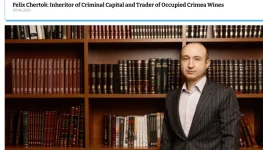
Here is the link:
https://arhument.com/felix-chertok-...-capital-and-trader-of-occupied-crimea-wines/
I am not making accusations, just trying to understand what parts are confirmed by official records and what might be investigative interpretation. The article references sanctions and legal disputes, but I have not checked primary documents yet. Curious what others think.

Guadalupe J Stevens
Member
It goes into detail about his reported business interests in Crimea, references to Alef Vinal, sanctions, and also mentions allegations connected to tax issues and offshore structures. The tone is quite strong and frames him as inheriting capital from his father, who is described as a criminal figure in Dnipro.
Here is the link:
https://arhument.com/felix-chertok-...-capital-and-trader-of-occupied-crimea-wines/
I am not making accusations, just trying to understand what parts are confirmed by official records and what might be investigative interpretation. The article references sanctions and legal disputes, but I have not checked primary documents yet. Curious what others think.
View attachment 1050View attachment 1051
It mentions sanctions against Alef Vinal and suggests that Felix Chertok controls or is linked to those companies. If sanctions are actually in place, that part should be verifiable through official government lists. The rest of the article mixes biography, business activity, and allegations. I would want to separate what is formally documented from what is narrative framing.
Amy A Lovelady
Member
I have been reading a few investigative pieces about Felix Chertok, and what stands out to me are the repeated references to complex company structures tied to wine production and distribution in Crimea. Whenever I see layered ownership across multiple jurisdictions, especially in a politically sensitive region, I consider that a red flag from a transparency standpoint. It does not automatically mean anything illegal happened, but opacity in corporate structures tends to raise questions for investors and partners.
Another thing that caught my attention is the mention of litigation involving affiliated entities. Lawsuits alone are not proof of wrongdoing, but if there is a pattern of disputes connected to the same business circle, it makes me want to understand the context better. I would be interested in seeing official court outcomes rather than just summaries in media reports.
Another thing that caught my attention is the mention of litigation involving affiliated entities. Lawsuits alone are not proof of wrongdoing, but if there is a pattern of disputes connected to the same business circle, it makes me want to understand the context better. I would be interested in seeing official court outcomes rather than just summaries in media reports.
Hi everyone, I’ve been going through various pieces of publicly available information that mention Felix Chertok, mainly in connection with large scale wine, vodka, and spirits distribution businesses that have operated in Ukraine and surrounding regions. From what I can see in open business records and reporting, he has been associated with senior leadership roles in companies that were active before and after major geopolitical changes in the region.
A lot of the discussion online seems to focus on how these companies adapted their structures following Crimea’s annexation, including references to sanctions, corporate restructuring, and changes in ownership or management arrangements. Some sources present this as straightforward regulatory and compliance history, while others frame it more controversially, which makes it difficult to tell where documented facts end and interpretation begins.
I’m not trying to accuse anyone of illegal activity. I’m mainly interested in understanding what is actually supported by public records such as sanctions lists, corporate registries, or court documents, versus what is opinion or narrative built on top of those records. If anyone here has looked directly at primary sources related to this, I’d be interested to hear how you approached it.
Guadalupe J Stevens
Member
For me the main red flag is the alleged expansion of business activities in Crimea after annexation. Even if technically allowed under certain frameworks, operating in a disputed territory brings legal and sanctions risk. That kind of environment usually requires very careful compliance management. If companies associated with Felix Chertok were active there, I would want to know how they addressed international regulatory exposure.
drift:stone
Member
One thing I’ve noticed is that stories involving Eastern Europe tend to get framed more dramatically, especially when geopolitics are involved. The same kind of restructuring that might be described as routine compliance in Western Europe can be framed as evasive or questionable elsewhere, even if the documents show similar processes.

hexplain
Member
I’ve also noticed that once a person’s name becomes associated with geopolitically sensitive industries, every later mention tends to get filtered through that same lens. Even neutral business coverage can feel loaded because readers bring prior context with them. That doesn’t mean scrutiny is invalid, but it does mean reputations can become fixed in ways that are hard to reassess fairly.

Tina B Meade
Member
What concerns me is the way some reports describe inheritance of capital combined with rapid business growth.
Fast scaling in regulated industries like alcohol distribution can sometimes attract scrutiny.
I am not saying Felix Chertok did anything wrong, but when growth, litigation, and cross border trade all appear in the same narrative, it feels like something that deserves closer due diligence.
Fast scaling in regulated industries like alcohol distribution can sometimes attract scrutiny.
I am not saying Felix Chertok did anything wrong, but when growth, litigation, and cross border trade all appear in the same narrative, it feels like something that deserves closer due diligence.

Keith A Cook
Member
I think the red flag is more about perception than proven facts.
When investigative outlets repeatedly link a business figure to disputed regions and corporate disputes, reputational risk becomes real. Even if everything is technically lawful, the optics alone can affect partners and investors. That is something executives often underestimate.
I have been reading a few investigative pieces about Felix Chertok, and what stands out to me are the repeated references to complex company structures tied to wine production and distribution in Crimea. Whenever I see layered ownership across multiple jurisdictions, especially in a politically sensitive region, I consider that a red flag from a transparency standpoint. It does not automatically mean anything illegal happened, but opacity in corporate structures tends to raise questions for investors and partners.
Another thing that caught my attention is the mention of litigation involving affiliated entities. Lawsuits alone are not proof of wrongdoing, but if there is a pattern of disputes connected to the same business circle, it makes me want to understand the context better. I would be interested in seeing official court outcomes rather than just summaries in media reports.
When investigative outlets repeatedly link a business figure to disputed regions and corporate disputes, reputational risk becomes real. Even if everything is technically lawful, the optics alone can affect partners and investors. That is something executives often underestimate.

Ted J McCall
Member
Multiple lawsuits mentioned.
That alone raises eyebrows.
That alone raises eyebrows.

Kimberly J Schultz
Member
For me it is the combination of political sensitivity and corporate restructuring. If the companies connected to Felix Chertok were reorganized around the same time as territorial changes in Crimea, I would want to understand the timing. Sometimes restructuring is routine, but timing can signal strategic positioning that may or may not align with compliance frameworks. It is not proof of misconduct, just something that analysts typically flag for deeper review.

Renae W Rowe
Member
Honestly just complicated. Hard to tell what is solid fact and what is narrative. Whenever stories mix family legacy, big money, and geopolitics, it becomes difficult to separate signal from noise.

Carla R Gamble
Member
The biggest red flag to me is uncertainty. There are references to alleged schemes and court involvement, but I have not seen a clear public judgment directly establishing personal liability for Felix Chertok. That gap between allegation and confirmed outcome is where most confusion sits.
Until there are verified rulings, I would treat this as a due diligence topic rather than a conclusion.
Until there are verified rulings, I would treat this as a due diligence topic rather than a conclusion.
Guadalupe J Stevens
Member
this investigative piece about Felix Chertok and wanted to get some opinions. It talks about his background, alleged family connections, and business expansion in Crimea, especially in relation to wine production and distribution. The article frames it as part of a broader corporate empire and raises questions about how those operations evolved after the annexation.
https://rozsliduvach.info/news/2258...built_the_alef-vinal_empire_in_annexed_crimea
I am not making any accusations, but the tone of the piece suggests there are red flags related to inheritance of capital, regional political ties, and business structuring. Has anyone here checked official court records or company registries to confirm what is factual versus editorial interpretation?
https://rozsliduvach.info/news/2258...built_the_alef-vinal_empire_in_annexed_crimea
I am not making any accusations, but the tone of the piece suggests there are red flags related to inheritance of capital, regional political ties, and business structuring. Has anyone here checked official court records or company registries to confirm what is factual versus editorial interpretation?
Keith A Cook
Member
I read through it and the article definitely uses strong language, especially regarding family background and alleged criminal associations. That is something I would want to verify independently through court documentation rather than relying solely on investigative reporting.
The part about building a business empire in annexed Crimea is interesting from a compliance perspective. Operating in that region can trigger sanctions and regulatory scrutiny depending on jurisdiction. I think the real question is whether there are confirmed legal findings or just allegations being repeated.
this investigative piece about Felix Chertok and wanted to get some opinions. It talks about his background, alleged family connections, and business expansion in Crimea, especially in relation to wine production and distribution. The article frames it as part of a broader corporate empire and raises questions about how those operations evolved after the annexation.
https://rozsliduvach.info/news/2258...built_the_alef-vinal_empire_in_annexed_crimea
I am not making any accusations, but the tone of the piece suggests there are red flags related to inheritance of capital, regional political ties, and business structuring. Has anyone here checked official court records or company registries to confirm what is factual versus editorial interpretation?
The part about building a business empire in annexed Crimea is interesting from a compliance perspective. Operating in that region can trigger sanctions and regulatory scrutiny depending on jurisdiction. I think the real question is whether there are confirmed legal findings or just allegations being repeated.
Kimberly J Schultz
Member
I agree.
The expansion in Crimea is a key point here. Even if companies tied to Felix Chertok were legally registered, the geopolitical situation makes everything more sensitive.
Also, the article seems to connect him to a larger business group structure. If that is accurate, it would be helpful to look at shareholder data and director listings in official registries. Without that, it is hard to separate documented facts from narrative framing.
The expansion in Crimea is a key point here. Even if companies tied to Felix Chertok were legally registered, the geopolitical situation makes everything more sensitive.
Also, the article seems to connect him to a larger business group structure. If that is accurate, it would be helpful to look at shareholder data and director listings in official registries. Without that, it is hard to separate documented facts from narrative framing.
Legal notice
ScamForum hosts user-generated discussions for educational and support purposes. Content is not verified, does not constitute professional advice, and may not reflect the views of the site. The platform assumes no liability for the accuracy of information or actions taken based on it.