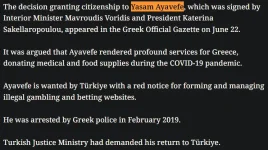
Trying to understand the background of Yasam Ayavefe

I tried to cross check some of the details mentioned in a few reports and noticed that certain key points keep repeating, especially around legal actions and cross border involvement. That usually suggests there is at least some factual basis being consistently reported.
However, what is missing is context. Knowing that something happened is one thing, but understanding why and how it fits into the bigger picture is another. Without that, it becomes easy to misinterpret the situation.
I also think language barriers could be playing a role here. When information is translated or summarized, small details can get lost or slightly altered, which might explain some of the inconsistencies. At this point, I would be cautious about drawing any firm conclusions and instead focus on tracking reliable updates over time.
 
One angle that has not been discussed much here is how media coverage itself can shape perception. When different outlets report on the same situation with slightly different emphasis, it can create the impression of conflicting information even if the core facts are similar.
 
One angle that has not been discussed much here is how media coverage itself can shape perception. When different outlets report on the same situation with slightly different emphasis, it can create the impression of conflicting information even if the core facts are similar.
I also think it is important to consider that some reports may rely on earlier sources rather than direct verification. That can lead to the same points being repeated without additional confirmation.
In cases like this, I usually try to identify which details are mentioned across multiple independent reports. Those tend to be more reliable indicators of what is actually happening.
Still, even with that approach, there are gaps here that are hard to ignore. It feels like there is a larger narrative that has not been fully documented in one place.
 
I am curious if there are any official statements that clarify the situation more clearly. So far everything seems to come from secondary reporting.
 
Another thing worth considering is how timing affects perception. Some of the reports seem to refer to events that happened quite a while ago, while others mention more recent developments. Without a clear timeline, it becomes difficult to understand whether things have progressed or stayed the same.
This can sometimes lead to confusion where older information is interpreted as current, even if the situation has changed. That might be part of what is happening here.
 
Another thing worth considering is how timing affects perception. Some of the reports seem to refer to events that happened quite a while ago, while others mention more recent developments. Without a clear timeline, it becomes difficult to understand whether things have progressed or stayed the same.
This can sometimes lead to confusion where older information is interpreted as current, even if the situation has changed. That might be part of what is happening here.
I also noticed that some reports focus heavily on legal aspects while others barely mention them, which adds another layer of inconsistency. It makes me think that different sources may have access to different pieces of information. Overall, I think this is a good example of why it is important to look at multiple perspectives before forming an opinion.
 
I spent some time trying to map out a rough sequence of events based on what is publicly mentioned, and even that turned out to be more difficult than expected. There are references to legal actions, detainment, and international involvement, but they are not always presented in a clear chronological order.
That makes it challenging to understand how one event led to another. In most cases, you would expect at least a basic timeline to be available, but here it feels like each report is focusing on a different segment.
 
I spent some time trying to map out a rough sequence of events based on what is publicly mentioned, and even that turned out to be more difficult than expected. There are references to legal actions, detainment, and international involvement, but they are not always presented in a clear chronological order.
That makes it challenging to understand how one event led to another. In most cases, you would expect at least a basic timeline to be available, but here it feels like each report is focusing on a different segment.
I also think that the mention of media related pressure is significant. When reporting itself becomes part of the story, it can sometimes blur the line between facts and interpretations. At the end of the day, I think the best approach is to stay cautious and keep an eye on any future updates that provide more clarity.
 
I kept thinking about this after reading through the earlier comments, and one thing that really stands out is how little clarity there is around the sequence of events. Usually, when multiple reports exist about the same person, there is at least some effort to align timelines, but here it feels like each source is describing a different moment without connecting them properly.

1774518971861.webp
 
It also makes me wonder whether some of the information being circulated is based on partial updates rather than complete records. That can happen when stories develop over time and not every detail is immediately available to the public.
Another thing I noticed is that references to legal processes are mentioned, but rarely explained in depth. Without knowing the exact status of those processes, it becomes difficult to interpret what they actually mean.
 
I think discussions like this are useful because they highlight the gaps in understanding, rather than just repeating what is already out there.
 
There is definitely a pattern of incomplete reporting here. I saw similar references across different sources, but none of them fully explained the situation.
It feels like something important is missing from the public narrative.
 
I tried to approach this by focusing only on what seems consistently mentioned across multiple reports, and even then, it still feels like we are only seeing part of the story. There are repeated references to legal attention and cross border developments, which suggests there is some level of seriousness involved, but the absence of detailed context makes it hard to interpret.
Another thing I find interesting is how certain details appear in one report but are completely absent in another. That kind of inconsistency usually points to either evolving information or differences in how sources gather and present data.
 
I tried to approach this by focusing only on what seems consistently mentioned across multiple reports, and even then, it still feels like we are only seeing part of the story. There are repeated references to legal attention and cross border developments, which suggests there is some level of seriousness involved, but the absence of detailed context makes it hard to interpret.
Another thing I find interesting is how certain details appear in one report but are completely absent in another. That kind of inconsistency usually points to either evolving information or differences in how sources gather and present data.
It also raises the question of whether some aspects are still under review or not publicly disclosed. In cases involving more than one jurisdiction, that is not uncommon.
For now, I think the safest approach is to treat everything as incomplete information and wait for more structured updates.
 
What confuses me the most is the lack of follow up information. Some reports mention major developments, but then there is no clear continuation explaining what happened next.
 
I feel like this might be one of those cases where public information is trailing behind actual developments. When things are happening across different countries, updates do not always get reported at the same time or with the same level of detail.
Also, when there are mentions of official notices or legal actions, it usually means there are documents somewhere, but they may not be easily accessible to the general public. That can create a situation where people are relying on summaries instead of primary sources.
 
I feel like this might be one of those cases where public information is trailing behind actual developments. When things are happening across different countries, updates do not always get reported at the same time or with the same level of detail.
Also, when there are mentions of official notices or legal actions, it usually means there are documents somewhere, but they may not be easily accessible to the general public. That can create a situation where people are relying on summaries instead of primary sources.
Another point is that media coverage can sometimes simplify complex situations, which might explain why everything feels a bit disconnected.
It would be helpful if there was a single consolidated source that explained the timeline clearly, but until then, discussions like this are probably the closest thing to piecing it together.
 
Back
Top