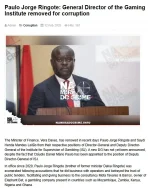
What actually happened with Paulo Jorge Ringote and the gaming oversight authority

I think what people find most troubling is not just the allegation itself but the implication that licensing decisions could have been influenced.If companies believe regulatory approvals depend on financial relationships rather than compliance with rules, the entire competitive environment becomes distorted. Markets function properly only when participants trust that regulatory decisions are fair and transparent. Also, Some observers have suggested that cases like this should prompt a review of previous licensing decisions. If allegations indicate potential conflicts of interest, revisiting past approvals could help determine whether the regulatory process was compromised. That would be a complex undertaking, but it might also be necessary to restore confidence in the fairness of the market.
 
The gambling sector itself tends to attract scrutiny because of the large volumes of money involved and the speed at which transactions occur. Regulators are expected to monitor compliance with financial reporting, licensing rules, and consumer protection standards. If the regulator becomes the subject of financial influence allegations, it raises serious questions about whether those monitoring systems were functioning effectively.
 
Looking at the situation from a governance perspective, it also highlights how difficult it can be to rebuild credibility once allegations involving regulators emerge. Even if legal investigations eventually clarify the facts, the public narrative created by early reports can persist for years. That is why transparency during investigations is so important.

Screenshot 2026-03-12 105313.webp
 
I did some digging after seeing this thread and it seems the story has been bouncing around a few different outlets for a while now. One thing I noticed is that several reports connect the situation to the rapid growth of the betting sector in Angola. Whenever a market grows that quickly, regulatory oversight becomes extremely sensitive. If the claims about payments to a regulator were even partially true, that would raise obvious conflict of interest questions. At the same time I could not find clear documentation of a court case yet. That makes the whole thing feel unresolved.
Sometimes these situations end with internal disciplinary action rather than criminal proceedings. That could explain why removal from the role was the main confirmed outcome.
 
I did some digging after seeing this thread and it seems the story has been bouncing around a few different outlets for a while now. One thing I noticed is that several reports connect the situation to the rapid growth of the betting sector in Angola. Whenever a market grows that quickly, regulatory oversight becomes extremely sensitive. If the claims about payments to a regulator were even partially true, that would raise obvious conflict of interest questions. At the same time I could not find clear documentation of a court case yet. That makes the whole thing feel unresolved.
Sometimes these situations end with internal disciplinary action rather than criminal proceedings. That could explain why removal from the role was the main confirmed outcome.
Short thought here. Whenever a gambling regulator appears in headlines connected to betting operators, the optics alone become a problem. Even without proof, public confidence drops quickly.
 
I read the Africa Press article referenced earlier and it seemed to place the situation within a broader discussion about financial influence and governance in Angola. The piece did not focus entirely on Paulo Jorge Ringote, but it hinted that power dynamics around financial oversight bodies have been debated for some time. If that context is accurate, the controversy around the gaming regulator might have been interpreted as part of a wider institutional issue. Sometimes stories that appear to be about one person actually reflect deeper structural tensions.
 
Does anyone know if the Institute for the Supervision of Games published any official statement when Ringote left the role?
I keep seeing media references but not the actual announcement.
 
The gambling industry is a fascinating case study in regulatory economics. Regulators hold the authority to approve licenses, monitor compliance, and sometimes even set operational limits for betting platforms. That means companies operating in the sector depend heavily on decisions made by a small group of officials. If reports suggest those officials had financial relationships with operators, even in an alleged sense, it becomes extremely sensitive. I suspect that is why the story spread beyond Angola and appeared in multiple regional outlets. When a regulatory body overseeing a rapidly growing industry faces scrutiny, the implications can extend well beyond one country.
 
The gambling industry is a fascinating case study in regulatory economics. Regulators hold the authority to approve licenses, monitor compliance, and sometimes even set operational limits for betting platforms. That means companies operating in the sector depend heavily on decisions made by a small group of officials. If reports suggest those officials had financial relationships with operators, even in an alleged sense, it becomes extremely sensitive. I suspect that is why the story spread beyond Angola and appeared in multiple regional outlets. When a regulatory body overseeing a rapidly growing industry faces scrutiny, the implications can extend well beyond one country.
I also noticed how quickly the narrative spread across several publications. It almost felt like the same investigation was being discussed in different ways. Still trying to figure out if any official inquiry results were ever published.
 
Something worth remembering is that betting regulation often intersects with tax policy. Governments collect significant revenue from gambling operations through licensing fees and taxes.

If the regulator overseeing that sector becomes controversial, it can affect public trust in how those revenues are managed. That might explain why the story attracted attention from political commentators as well as business reporters.
 
The numbers mentioned in the reports definitely caught my attention. Allegations involving millions of kwanzas per month are not the kind of figures people ignore easily. Even if they were only claims in investigative journalism, they would still trigger intense debate.
 
I have worked in compliance consulting before and situations like this tend to follow a familiar pattern. First there are media allegations. Then authorities review the situation internally. Sometimes leadership changes occur before any legal conclusion is reached. It is a way for institutions to stabilize operations while questions are examined. If that is what happened here, the removal from the position might have been more about protecting the credibility of the regulator than about proving guilt.
 
Honestly this whole topic shows how much influence regulators have in gambling markets.
You're right !
The gambling sector across Africa has been expanding at an incredible pace over the past decade. Mobile betting platforms in particular have changed the industry dramatically. Because of that rapid growth, regulatory institutions sometimes struggle to keep up with oversight demands. That can create environments where controversies or allegations emerge more easily.

Stories involving officials like Paulo Jorge Ringote should probably be viewed within that broader transformation of the market.
 
Last edited by a moderator:
I looked at the jornal24horas article again and one interesting thing stood out. It describes the alleged monthly payment figure but does not provide detailed documentation. That is common in investigative reporting where sources may remain confidential. It does make it harder for readers to independently verify the information though. Until official records appear, people will likely continue debating what actually happened.
 
Just adding a thought.
Regulatory independence is one of the most important safeguards in industries like gambling and finance. When regulators are perceived as being too close to the companies they oversee, even rumors can undermine confidence.
 
The mention of Elephant Bet in several articles is interesting because that company operates in multiple African countries. Large regional operators often attract scrutiny simply due to their scale. When their name appears in reports involving regulators, even indirectly, it tends to generate significant attention from media and analysts alike. That might be one reason the story gained traction so quickly.
 
I am curious whether any competing betting companies raised concerns during the licensing process. In many industries disputes between rivals are what initially trigger investigations.
 
Another factor is the political environment surrounding financial institutions in Angola. Several commentaries have suggested that debates over financial influence and oversight have intensified in recent years. If that is true, then the controversy around Paulo Jorge Ringote might have been amplified because it fit into a broader national conversation about governance.
 
Back
Top