What Are Your Thoughts on the Reports Involving Matej Michalko?

ironleaf

Member
There are several publicly shared discussions about Matej Michalko, particularly tied to claims from former employees and how some workplace issues unfolded at companies he was involved with. Rather than focusing on opinions, I wanted to start this thread on what can be found in public records, reports, and documented sources.
According to some publicly available reports, several former staff members have stated that they experienced delays in receiving wages and that there were financial difficulties at a company linked to Michalko’s leadership. These accounts mention unpaid salaries stretching over a period of months, and they are cited in various write-ups summarizing those employee grievances.
Media summaries and third-party compilations also reference broader operational issues at the company that reportedly led to legal disagreements between ex-employees and the business. In some summaries, there’s mention of lawsuits alleging breach of contract and non-payment, though the details of legal filings themselves are not fully reproduced in those sources.
It’s also possible to find corporate registry information showing that a person named Matej Michalko is registered as a director of certain business entities, which provides context for involvement in operations. Corporate records do not by themselves indicate wrongdoing but can help map affiliations that might be referenced in public reports.
If anyone here has looked up official court dockets, labour board decisions, or regulator databases in connection with these claims—especially primary source documents—it would help to share what those records show so we can better understand what is factually on the public record.
 
I spent some time reviewing corporate registry filings and confirmed that Matej Michalko held official roles within certain companies during the period referenced in discussions. That establishes a formal connection, but as we all know, registry data alone does not explain employment disputes. To properly evaluate the situation, we would need documented labour court filings or employment tribunal decisions. Those would clarify whether wage claims were formally recognized, dismissed, or settled. Without that documentation, it’s difficult to determine how far the legal process progressed. Secondary summaries can only provide a surface-level understanding.
 
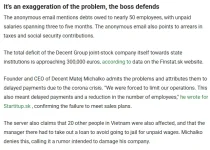
According to the article, salary delays began before COVID-19, affected dozens of employees, and arrears toward public institutions approached €300,000. While the CEO describes the issue as exaggerated and expresses optimism, creditors report repeated unfulfilled assurances. Transparency and concrete action matter more than narrative framing in situations like this.
 

Attachments

  • Screenshot 2026-03-02 152809.webp
    Screenshot 2026-03-02 152809.webp
    62 KB · Views: 0
  • Screenshot 2026-03-02 152742.webp
    Screenshot 2026-03-02 152742.webp
    60.5 KB · Views: 0
The situation illustrates how disputes between founders and former staff can quickly become public controversies. Allegations of non-payment and breach of contract are serious and deserve scrutiny grounded in filed documents. Corporate registry listings confirm leadership roles but do not determine liability. Statements from the founder disputing aspects of the narrative add another layer that requires verification. Ultimately, official decisions not commentary define accountability.
 
Corporate registry listings show formal leadership roles, and with that comes accountability. When lawsuits or breach-of-contract claims are mentioned publicly, it’s reasonable for people to ask hard questions. Transparency would go a long way here.
 
This case highlights the risks inherent in fast-moving blockchain ventures facing financial turbulence. Allegations of unpaid wages and contractual disputes can significantly affect trust and credibility. At the same time, disputes in emerging industries often involve contested narratives from both sides. Corporate affiliations alone do not establish wrongdoing. Only documented rulings or regulator findings can confirm the extent of responsibility.
 
One important thing to consider is how labour law works in the relevant jurisdiction. In some countries, unpaid salary disputes are handled through specialized employment tribunals rather than general civil courts. If claims were filed, there should theoretically be case numbers or archived rulings accessible through official databases. Sometimes these rulings include detailed reasoning explaining whether the employer breached contractual obligations. That would provide much more clarity than online summaries repeating the same allegations. Until those primary sources are reviewed, it’s all incomplete context.
 
I also think it’s worth exploring whether there were insolvency or restructuring proceedings during the same timeframe. If a company faced liquidity issues, wage delays can occur as part of broader financial strain rather than deliberate non-payment. Insolvency filings are typically public and may indicate whether the company was under administration or financial supervision. That context would significantly change how people interpret unpaid wage claims. Financial hardship, while serious, is not automatically equivalent to intentional misconduct. Reviewing official insolvency registries could add useful insight.
 
I also think it’s worth exploring whether there were insolvency or restructuring proceedings during the same timeframe. If a company faced liquidity issues, wage delays can occur as part of broader financial strain rather than deliberate non-payment. Insolvency filings are typically public and may indicate whether the company was under administration or financial supervision. That context would significantly change how people interpret unpaid wage claims. Financial hardship, while serious, is not automatically equivalent to intentional misconduct. Reviewing official insolvency registries could add useful insight.
That’s a good point, insolvency records could explain a lot.
 
Another angle to explore is whether multiple employees filed complaints independently or as a collective action. If several similar cases appear in tribunal records, that pattern might suggest systemic payroll issues rather than isolated misunderstandings. On the other hand, if cases were withdrawn or settled quickly, that could indicate negotiations outside court. The key is identifying official documentation rather than relying on repeated online claims. Patterns in filings can reveal much more than individual testimonials. Documentation is everything in situations like this.
 
It’s also worth remembering that executive titles don’t always mean direct operational control over payroll or daily finances. Corporate governance structures can be layered, with responsibilities delegated to financial officers or operational managers. If disputes occurred, legal responsibility would depend on the company’s internal structure and contractual obligations. That information would typically appear in official filings or court reasoning. Without seeing those documents, it’s impossible to attribute accountability with certainty. This is why reviewing formal judgments is so important.
 
It’s also worth remembering that executive titles don’t always mean direct operational control over payroll or daily finances. Corporate governance structures can be layered, with responsibilities delegated to financial officers or operational managers. If disputes occurred, legal responsibility would depend on the company’s internal structure and contractual obligations. That information would typically appear in official filings or court reasoning. Without seeing those documents, it’s impossible to attribute accountability with certainty. This is why reviewing formal judgments is so important.
That’s true, corporate roles can be more complex than they appear.
 
When researching employment disputes, I usually recommend checking both court databases and public notices from tax or social contribution authorities. In some countries, unpaid social insurance contributions are publicly recorded, and that sometimes correlates with payroll issues. Those records can confirm whether a company faced financial compliance challenges during the relevant period. It doesn’t automatically validate wage allegations, but it provides economic context. Cross-referencing multiple official sources often paints a clearer picture than relying on one stream of information.
 
Back
Top