What Do Public Records Actually Show About Zion Rokah’s Past

What I find interesting is how secondary sites reframe government language. A short wanted notice becomes a dramatic narrative once it is copied elsewhere. Important qualifiers get lost, like the difference between an indictment and a conviction. Over time, repetition gives those summaries an air of authority they may not deserve. Going back to the original public record is really the only way to reset the discussion. Even then, it leaves unanswered questions.
Exactly, the repetition effect seems to amplify certainty where none exists. That is why I wanted to keep this thread grounded in what is actually documented. If someone can point to a court judgment, plea agreement, or dismissal order, that would change the conversation entirely. Until then, all we have is an indictment notice frozen in time. It is interesting how often those get treated as final conclusions online. This kind of thread can at least slow that down a bit.
 
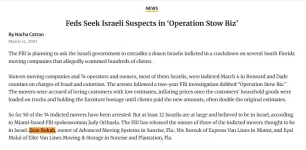
I went through that article someone dropped earlier and it actually gives more context than the official documents alone.

This one here explains part of it in simpler terms :

chrome_yg9JKSE1MA.webp

From what I understand, the case tied to Zion Rokah was part of a larger federal investigation into moving company practices back in the early 2000s. The reports mention dozens of indictments and describe a pattern where customers were quoted low prices and then faced much higher charges after their belongings were already loaded. What still confuses me is whether Zion Rokah’s role was central or just one of many names listed in that wider operation.
 
I went through that article someone dropped earlier and it actually gives more context than the official documents alone.

This one here explains part of it in simpler terms :

View attachment 1793

From what I understand, the case tied to Zion Rokah was part of a larger federal investigation into moving company practices back in the early 2000s. The reports mention dozens of indictments and describe a pattern where customers were quoted low prices and then faced much higher charges after their belongings were already loaded. What still confuses me is whether Zion Rokah’s role was central or just one of many names listed in that wider operation.
Yeah I read that too and honestly it feels like one of those big multi-person cases where it is hard to isolate one individual. Also noticed that a lot of these people were apparently outside the US when things escalated.

Makes it harder to track outcomes I guess.
 
Yeah I read that too and honestly it feels like one of those big multi-person cases where it is hard to isolate one individual. Also noticed that a lot of these people were apparently outside the US when things escalated.

Makes it harder to track outcomes I guess.
Same here, I dug a bit deeper into the enforcement side of it. The official documents linked earlier suggest that Zion Rokah was listed among individuals sought in connection with that broader investigation. But those summaries are very procedural, they don’t really explain what happened afterward or whether the case progressed for each person.

What stood out to me is how large the operation was. It was not just one company or one complaint, it seems like investigators were looking at a network of businesses that may have been operating in similar ways. That kind of structure usually takes years to unravel, and even then the outcomes can vary a lot depending on jurisdiction and cooperation between countries.

I think the biggest challenge here is separating what is documented as an allegation or investigation from what was actually proven in court. Without full case records, it is easy to misinterpret the significance of a name like Zion Rokah just appearing in those documents.
 
I am not fully convinced people should read too much into the “wanted” listings either.
Those pages sometimes stay up forever. Does not always mean active pursuit.
 
I see both sides here. On one hand, the article and the official summaries clearly show there was a serious investigation involving multiple agencies, which gives some weight to the situation. On the other hand, the information is very fragmented when you try to follow a single individual like Zion Rokah through the whole story.
One thing I noticed is that these kinds of operations often resulted in some people being prosecuted while others were never extradited or formally tried in the same jurisdiction. That could explain why certain names remain in public records without clear resolution. It does not necessarily tell us what happened after the initial investigation phase. I also think context matters a lot. Early 2000s enforcement around moving scams was a big focus area, and there were a lot of complaints at the time. So seeing a name tied to that era does not automatically mean anything recent, even if the listing is still visible today.
 
I see both sides here. On one hand, the article and the official summaries clearly show there was a serious investigation involving multiple agencies, which gives some weight to the situation. On the other hand, the information is very fragmented when you try to follow a single individual like Zion Rokah through the whole story.
One thing I noticed is that these kinds of operations often resulted in some people being prosecuted while others were never extradited or formally tried in the same jurisdiction. That could explain why certain names remain in public records without clear resolution. It does not necessarily tell us what happened after the initial investigation phase. I also think context matters a lot. Early 2000s enforcement around moving scams was a big focus area, and there were a lot of complaints at the time. So seeing a name tied to that era does not automatically mean anything recent, even if the listing is still visible today.
That’s exactly what I was wondering about, the timeline is really unclear.

Feels like we’re looking at a snapshot from 20 years ago that never got updated.
 
That’s exactly what I was wondering about, the timeline is really unclear.

Feels like we’re looking at a snapshot from 20 years ago that never got updated.
Yeah and another thing is media coverage versus official filings. The article gives a narrative that is easier to follow, but it is still summarizing what authorities were saying at the time.

Official records, like indictments or wanted notices, are more rigid and don’t tell you the full story unless you track down the actual court proceedings. In cases like this, multiple defendants can have completely different outcomes, some might resolve their cases while others remain unresolved for years.

When it comes to Zion Rokah specifically, I have not seen a clear public record that ties everything together from investigation to final outcome. That gap is probably why this thread even exists.
 
Also worth noting that a lot of those moving scam cases had similar patterns.
Low quote then higher charge later.
That part seems consistent across reports.
 
From what I have read, it was quite widespread at one point, especially in certain regions. The investigation mentioned in connection with Zion Rokah appears to have been one of the larger coordinated efforts to address it.

What makes it tricky is that these operations often involve multiple layers, like different company names, shared personnel, and shifting ownership structures. So even if someone is named in one part of the investigation, their exact role might not be obvious unless you have detailed case files. I think the safest approach here is to treat the available information as partial. We know there was an investigation, we know certain individuals including Zion Rokah were listed in connection with it, but we do not have a full picture of what happened afterward in every case.
 
From what I have read, it was quite widespread at one point, especially in certain regions. The investigation mentioned in connection with Zion Rokah appears to have been one of the larger coordinated efforts to address it.

What makes it tricky is that these operations often involve multiple layers, like different company names, shared personnel, and shifting ownership structures. So even if someone is named in one part of the investigation, their exact role might not be obvious unless you have detailed case files. I think the safest approach here is to treat the available information as partial. We know there was an investigation, we know certain individuals including Zion Rokah were listed in connection with it, but we do not have a full picture of what happened afterward in every case.
Yeah that makes sense.
Feels like a lot of missing pieces still.
 
Agreed, and honestly this is a good example of why reading raw enforcement documents without context can be confusing. They are not written for general understanding, they are written for legal and procedural purposes. If anyone really wanted to go deeper, they would probably need to look at archived court records or legal databases to see if Zion Rokah appears in any finalized cases. That would give a clearer idea of whether the matter was resolved, dismissed, or still open in some form.

Until then, all we really have are the investigation details and the fact that the name appears in those public records.
 
And probably a reminder to be careful when interpreting partial information.
Names like Zion Rokah can show up in serious contexts, but without full records, it is hard to draw firm conclusions either way.
 
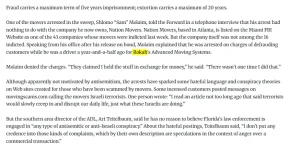
I actually went back to that article again and grabbed a screenshot of one section because I think people are missing how specific it gets about roles and timelines.

It talks about someone named Shlomo Molaim who said his arrest was tied to when he worked as a driver for Rokah’s Advanced Moving Systems, not his later company. He also denied the accusations and said there was not a single instance of holding goods for money.

To me this part is important because it shows how messy these cases can be, like people connected through past employment rather than current businesses

chrome_GGpijugae6.webp
 
I actually went back to that article again and grabbed a screenshot of one section because I think people are missing how specific it gets about roles and timelines.

It talks about someone named Shlomo Molaim who said his arrest was tied to when he worked as a driver for Rokah’s Advanced Moving Systems, not his later company. He also denied the accusations and said there was not a single instance of holding goods for money.

To me this part is important because it shows how messy these cases can be, like people connected through past employment rather than current businesses

View attachment 1794
That’s a really interesting detail.

It kind of shows how one investigation can pull in people from different time periods and roles.
Not everything is as straightforward as it first looks.
 
Yeah that section adds a lot of nuance that is missing from the official summaries. The mention of Rokah’s Advanced Moving Systems suggests that Zion Rokah’s name is tied to a specific company during that time frame, rather than just being a random listing in a large case. What stands out to me is that Molaim is clearly pushing back on the allegations, which reminds us that these reports often include claims and responses side by side. It is not a final judgment, it is more like a snapshot of what investigators believed and what individuals said in response.

Also, the distinction between companies being listed and companies actually being indicted is really important. That part gets overlooked easily, but it changes how you interpret the scale of involvement.
 
Yeah that section adds a lot of nuance that is missing from the official summaries. The mention of Rokah’s Advanced Moving Systems suggests that Zion Rokah’s name is tied to a specific company during that time frame, rather than just being a random listing in a large case. What stands out to me is that Molaim is clearly pushing back on the allegations, which reminds us that these reports often include claims and responses side by side. It is not a final judgment, it is more like a snapshot of what investigators believed and what individuals said in response.

Also, the distinction between companies being listed and companies actually being indicted is really important. That part gets overlooked easily, but it changes how you interpret the scale of involvement.
Exactly, listed versus indicted is a big difference.
People tend to blur that line when reading quickly.
 
I think that excerpt also highlights how complicated it is to map responsibility in these types of operations. Someone working as a driver for a company connected to Zion Rokah does not necessarily mean the same level of involvement as ownership or management, but it still brings their name into the investigation. The fact that Molaim said his arrest was tied to past work rather than his current company shows how investigators were looking backward over a period of time. That could explain why so many different names and businesses appear in the same case, even if they were not all operating together at the exact same moment. It also reinforces the idea that we are mostly seeing allegations and responses, not conclusions. Without full court outcomes, it is difficult to know how those claims were ultimately resolved.
 
Back
Top