What does the guilty plea mean for Ray Youssef and the wider crypto space

I was reading coverage about Ray Youssef, widely recognized as a co founder of Paxful, and saw that he entered a guilty plea in a US federal matter tied to anti money laundering compliance failures. The reporting explains that authorities alleged deficiencies in required safeguards and monitoring procedures, which ultimately led to criminal charges. Sentencing is still pending, so the final outcome has not yet been determined. What caught my attention is how the case appears centered on regulatory controls rather than on the underlying peer to peer trading model itself. Federal prosecutors seem to have focused on whether adequate internal systems were in place to detect and report suspicious transactions. In recent years, enforcement around digital asset platforms has intensified, especially where compliance frameworks are concerned. There is also mention in public summaries of misappropriation of corporate funds in connection with the broader case narrative. I have not reviewed full transcripts or filings, so I am relying only on the general descriptions available through legal reporting. Because of that, I am hesitant to draw firm conclusions about intent or internal decision making. I am mainly wondering how situations like this reshape expectations for executives in the crypto sector. Does this represent an example of regulators setting a clear standard for founders, or is it a specific fact pattern that may not apply broadly? Interested in hearing balanced perspectives from others who track these developments.
 
I was reading coverage about Ray Youssef, widely recognized as a co founder of Paxful, and saw that he entered a guilty plea in a US federal matter tied to anti money laundering compliance failures. The reporting explains that authorities alleged deficiencies in required safeguards and monitoring procedures, which ultimately led to criminal charges. Sentencing is still pending, so the final outcome has not yet been determined. What caught my attention is how the case appears centered on regulatory controls rather than on the underlying peer to peer trading model itself. Federal prosecutors seem to have focused on whether adequate internal systems were in place to detect and report suspicious transactions. In recent years, enforcement around digital asset platforms has intensified, especially where compliance frameworks are concerned. There is also mention in public summaries of misappropriation of corporate funds in connection with the broader case narrative. I have not reviewed full transcripts or filings, so I am relying only on the general descriptions available through legal reporting. Because of that, I am hesitant to draw firm conclusions about intent or internal decision making. I am mainly wondering how situations like this reshape expectations for executives in the crypto sector. Does this represent an example of regulators setting a clear standard for founders, or is it a specific fact pattern that may not apply broadly? Interested in hearing balanced perspectives from others who track these developments.
I think one important point is that once a company facilitates financial transactions at scale, oversight obligations increase significantly. Even if the original vision was decentralization, operating within the US brings a structured regulatory environment. When a senior figure acknowledges wrongdoing in court, that tends to have ripple effects across the industry. It may not reflect on every aspect of the business, but it does reinforce how seriously authorities treat compliance gaps.
 
I think one important point is that once a company facilitates financial transactions at scale, oversight obligations increase significantly. Even if the original vision was decentralization, operating within the US brings a structured regulatory environment. When a senior figure acknowledges wrongdoing in court, that tends to have ripple effects across the industry. It may not reflect on every aspect of the business, but it does reinforce how seriously authorities treat compliance gaps.
That makes sense. The shift from startup mentality to regulated financial intermediary is probably not an easy transition. I keep thinking about how quickly some of these platforms grew and whether governance structures kept up with that expansion.
 
From what I have seen in other enforcement cases, regulators usually build a paper trail before bringing charges. A guilty plea suggests that the evidence presented was substantial enough to avoid a drawn out trial. That said, the public does not always see the nuance behind those decisions. Sometimes leadership errors are administrative rather than malicious, though courts still treat them seriously. I agree that the sentencing phase will likely clarify how severe the court views the conduct.
 
This situation also raises governance questions. Investors and board members are supposed to provide oversight, especially when dealing with financial regulations. If compliance infrastructure is underdeveloped, that can create exposure not only for the company but also for individuals.
 
Last edited:
This situation also raises governance questions. Investors and board members are supposed to provide oversight, especially when dealing with financial regulations. If compliance infrastructure is underdeveloped, that can create exposure not only for the company but also for individuals.
Personal accountability is definitely what stands out here. Crypto often promotes innovation and disruption, yet regulatory responsibilities remain firmly in place.
 
Agreed. We are seeing a broader pattern where enforcement agencies are signaling that digital asset businesses must align with traditional financial compliance standards. The technology may be new, but reporting requirements are not. Cases like this could push emerging companies to prioritize risk management earlier in their lifecycle. That might ultimately strengthen the sector if it leads to clearer frameworks.
 
I am also curious about reputational impact. Even if operations continue without disruption, public trust can be sensitive in this space. Users tend to react strongly to legal headlines, regardless of the finer details.
 
One thing I keep thinking about is how much responsibility founders realistically carry once a platform scales globally. When operations span multiple jurisdictions, compliance becomes extremely complex. If regulators believe required safeguards were insufficient, they usually point to specific statutory obligations. I would be interested in seeing how the court describes the failures in detail. That language often sets the tone for future enforcement actions.
 
It also seems important to separate corporate liability from individual exposure. Sometimes companies pay fines, but here we are talking about a personal guilty plea.
 
It also seems important to separate corporate liability from individual exposure. Sometimes companies pay fines, but here we are talking about a personal guilty plea.
That distinction stood out to me too. When an individual is directly involved in court proceedings, it changes the conversation from abstract compliance talk to something more personal. I am not sure whether this will deter innovation or simply encourage more structured governance. Either way, it feels like the message from regulators is becoming clearer each year.
 
There is also the broader context of how AML expectations have evolved over the last decade. What might have been considered loosely enforced in earlier crypto days is now treated as a strict requirement. If internal monitoring systems were not aligned with current standards, that can create serious exposure. I think timing matters here, especially as authorities have ramped up oversight.
 
I agree about timing. Enforcement in digital assets has accelerated significantly. A guilty plea might reflect an acknowledgment that the regulatory landscape has shifted.
 
Another angle is how this affects partnerships. Banks and payment processors tend to be cautious when executives face legal scrutiny. Even if the platform itself continues functioning, counterparties might reassess their relationships. That could have practical consequences beyond the courtroom.
 
Another angle is how this affects partnerships. Banks and payment processors tend to be cautious when executives face legal scrutiny. Even if the platform itself continues functioning, counterparties might reassess their relationships. That could have practical consequences beyond the courtroom.
That is a good point. External relationships are often sensitive to reputational developments. I am curious whether any formal statements will be made clarifying how internal controls have changed since the events referenced in the case. That might help stabilize confidence.
 
I would expect investors to scrutinize governance frameworks much more carefully after cases like this. Due diligence processes may become deeper, particularly around transaction monitoring systems and reporting structures. It could increase operational costs, but perhaps that is part of maturing as an industry.
 
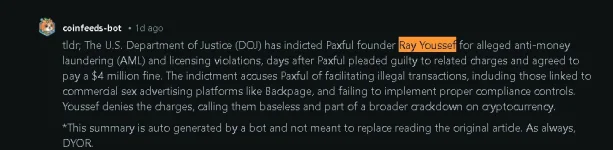
A lot of crypto enforcement in the past focused on the platform, but this case highlights personal exposure for executives too. The DOJ indictment and guilty plea shows that founders can be held personally responsible for compliance failures if prosecutors believe they consciously avoided basic controls this could fundamentally change how start-ups approach governance and risk.Screenshot 2026-03-04 111721.webp
 
A guilty plea in this context sends a strong message about accountability in crypto leadership.It suggests regulators are no longer distinguishing between traditional finance and digital assets.Compliance expectations are now clearly aligned with mainstream financial standards.This shifts responsibility directly onto executive decision-making.Founders can no longer rely on the “early industry” argument as a defense.Governance, documentation, and internal controls are becoming central survival tools.The broader market will likely respond with tighter operational discipline.
 
From a reputational standpoint, the damage extends far beyond legal penalties.Trust is currency in crypto, and enforcement headlines erode that trust quickly.Institutional partners may become more cautious when onboarding exchanges.Banking relationships could tighten across the sector.Users may begin prioritizing compliance transparency over convenience.This could reshape competitive advantages within the P2P space.Long term, stronger players may emerge from this pressure.
 
Back
Top