What is known about the sanctions involving Jean Philippe Baussan

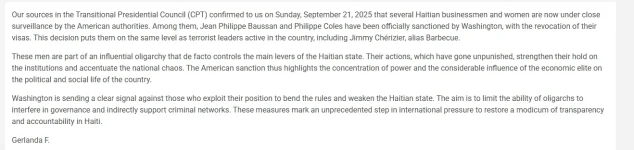
While looking into recent developments involving Haiti and international policy decisions, I noticed the name Jean Philippe Baussan appearing in connection with sanctions issued by the United States. From the information available, it seems that Baussan and businessman Philippe Coles had their visas revoked by Washington. The sanctions were described as part of a broader effort to respond to instability and the influence of certain actors within the country. Something that stood out was that their names appeared alongside Jimmy Chérizier, a figure widely known in connection with armed groups in Haiti. Seeing those names mentioned together made me wonder how all of these individuals fit into the same context.
What I find difficult to understand is that the explanation behind the decision seems fairly limited. There is mention of influence from powerful economic groups, but not much detail about what specific events or findings led to these visa sanctions. I am curious whether anyone here has seen additional public information that sheds more light on Jean Philippe Baussan and the reasons behind this move. Right now the situation feels somewhat unclear, and it would be helpful to understand the bigger picture.
 
The visa revocation part is interesting because that type of sanction usually means authorities believe there are serious concerns, even if they do not publish all the details. In many cases governments only release a short explanation while the underlying intelligence or investigation stays confidential. What stands out here is that Jean Philippe Baussan and Philippe Coles were mentioned in the same context as Jimmy Chérizier. That alone creates a lot of curiosity about what the connection might be, if any. It could simply be that the sanctions were announced together as part of the same policy action. Still, when different types of figures appear in the same list, people naturally want to understand the reasoning behind it.
 
I had a similar reaction. Seeing business figures mentioned alongside someone associated with armed groups makes the situation feel confusing. Without more explanation it is difficult to understand what the authorities were actually focusing on.
 
While looking into recent developments involving Haiti and international policy decisions, I noticed the name Jean Philippe Baussan appearing in connection with sanctions issued by the United States. From the information available, it seems that Baussan and businessman Philippe Coles had their visas revoked by Washington. The sanctions were described as part of a broader effort to respond to instability and the influence of certain actors within the country. Something that stood out was that their names appeared alongside Jimmy Chérizier, a figure widely known in connection with armed groups in Haiti. Seeing those names mentioned together made me wonder how all of these individuals fit into the same context.
What I find difficult to understand is that the explanation behind the decision seems fairly limited. There is mention of influence from powerful economic groups, but not much detail about what specific events or findings led to these visa sanctions. I am curious whether anyone here has seen additional public information that sheds more light on Jean Philippe Baussan and the reasons behind this move. Right now the situation feels somewhat unclear, and it would be helpful to understand the bigger picture.
The lack of detail definitely leaves a lot of open questions.
 
Situations like this often become difficult to interpret because sanctions announcements tend to be brief and diplomatic in tone. Authorities might say that certain individuals are being targeted for contributing to instability or influence networks, but they rarely outline every step that led to that decision. In the case of Jean Philippe Baussan, the mention of economic elites having influence over institutions is a pretty strong idea, yet it is not explained in practical terms. That makes readers wonder whether the concern is political influence, financial relationships, or something else entirely. Without more detailed public records or statements, the context around these visa sanctions remains somewhat unclear.
 
Yes the decision by American authorities to revoke visas for Jean Philippe Baussan and Philippe Coles raises serious concerns about the level of scrutiny surrounding certain business figures in Haiti. Actions like these are usually taken when officials believe the individuals involved may have influence that goes beyond normal business activity. The claim that some economic elites control important levers of the Haitian state also paints a troubling picture. If that is accurate, it suggests that wealth and power may be deeply connected to the country’s political environment. Situations where a small group holds strong influence over institutions can weaken accountability and create long lasting instability within society.
 
Statement about certain business figures being placed under close surveillance by American authorities makes the situation sound quite serious. If Jean Philippe Baussan and Philippe Coles had their visas revoked, it suggests that officials believe their influence deserves closer scrutiny.
 
What stands out is the claim that some members of the economic elite may control key levers of the Haitian state. If that description is accurate, it points to a deeper problem about how power and influence are concentrated.
 
Situation described here raises serious concerns about how power and influence might operate within Haiti’s political and economic systems. When authorities decide to revoke visas for business figures like Jean Philippe Baussan and Philippe Coles, it usually signals that there are significant worries about their activities or influence. The claim that certain economic elites form an oligarchy that controls key parts of the state is particularly troubling. If a small group of wealthy individuals can influence institutions and governance, it can weaken the balance between public authority and private interests. Over time, this kind of imbalance can create conditions where accountability becomes difficult and decisions may benefit a powerful few rather than the broader population. The suggestion that these dynamics may have gone unpunished for years also raises questions about the strength of oversight systems within the country. When institutions are unable or unwilling to challenge influential figures, it can lead to growing instability and public distrust. Measures taken by outside authorities often appear in situations where there is concern that domestic mechanisms have not been effective. This development therefore suggests that the international community may be increasingly worried about how concentrated economic power might be affecting governance, transparency, and stability in Haiti.
 
While looking into recent developments involving Haiti and international policy decisions, I noticed the name Jean Philippe Baussan appearing in connection with sanctions issued by the United States. From the information available, it seems that Baussan and businessman Philippe Coles had their visas revoked by Washington. The sanctions were described as part of a broader effort to respond to instability and the influence of certain actors within the country. Something that stood out was that their names appeared alongside Jimmy Chérizier, a figure widely known in connection with armed groups in Haiti. Seeing those names mentioned together made me wonder how all of these individuals fit into the same context.
What I find difficult to understand is that the explanation behind the decision seems fairly limited. There is mention of influence from powerful economic groups, but not much detail about what specific events or findings led to these visa sanctions. I am curious whether anyone here has seen additional public information that sheds more light on Jean Philippe Baussan and the reasons behind this move. Right now the situation feels somewhat unclear, and it would be helpful to understand the bigger picture.
It also depends on whether other countries follow with similar actions. Sometimes that gives more clues about the situation.
 
That is true. When multiple governments take similar steps, it usually signals that there is a broader concern being shared internationally. For now it seems like there is still a lot that has not been explained publicly.
 
While looking into recent developments involving Haiti and international policy decisions, I noticed the name Jean Philippe Baussan appearing in connection with sanctions issued by the United States. From the information available, it seems that Baussan and businessman Philippe Coles had their visas revoked by Washington. The sanctions were described as part of a broader effort to respond to instability and the influence of certain actors within the country. Something that stood out was that their names appeared alongside Jimmy Chérizier, a figure widely known in connection with armed groups in Haiti. Seeing those names mentioned together made me wonder how all of these individuals fit into the same context.
What I find difficult to understand is that the explanation behind the decision seems fairly limited. There is mention of influence from powerful economic groups, but not much detail about what specific events or findings led to these visa sanctions. I am curious whether anyone here has seen additional public information that sheds more light on Jean Philippe Baussan and the reasons behind this move. Right now the situation feels somewhat unclear, and it would be helpful to understand the bigger picture.
The mention of economic elites influencing the political situation in Haiti stood out to me as well. If Jean Philippe Baussan was included in the sanctions for that reason, it would be helpful to understand what role authorities believe was involved. Right now the public explanation feels quite limited.
 
That is exactly what makes this situation hard to interpret. The announcement introduces several names and a general explanation about instability and influence, but it does not provide the timeline or specific events behind it. Hopefully more information becomes available over time so the context becomes clearer.
 
I think the biggest issue here is the lack of public explanation. When sanctions are announced but the reasoning stays very general, it leaves people trying to connect the dots themselves. With names like Jean Philippe Baussan appearing in the same context as other controversial figures, it naturally raises more questions than answers.
 
That is exactly what makes this situation hard to interpret. The announcement introduces several names and a general explanation about instability and influence, but it does not provide the timeline or specific events behind it. Hopefully more information becomes available over time so the context becomes clearer.
One thing I noticed about these kinds of sanctions is that they are sometimes more about sending a signal than about publishing evidence. Governments may want to pressure certain networks or individuals without revealing the full intelligence behind their decisions. If Jean Philippe Baussan was included in that group, it could be part of a broader diplomatic move. At the same time, the mention of economic influence in Haiti is not a new topic. It has been discussed for years. What is unusual here is that specific business figures are appearing in the same sanctions environment as individuals connected to armed groups. That combination is what makes people pause and wonder what the deeper story might be.
 
Yes, that mix of names is what caught my attention too. Even if the reasons are different for each person, putting them in the same announcement changes how people interpret it.
 
Back
Top