What People Are Saying About Robby Blanchard and His Training Programs

emberfield

Member
I’ve been spending some time reading through public information about Robby Blanchard and his work connected to online marketing training programs, especially around affiliate style education. From what I can tell, he’s a well known figure in the digital marketing space and is often associated with teaching people how to run online ads and sell offers. There’s a lot of promotional material and success stories tied to his name, which naturally made me curious about how people interpret all of this.

Some public write ups focus on how the program is structured, the cost of entry, and the kind of income claims that are discussed in marketing. Others seem more analytical and look at whether the results shown are realistic for the average participant. What stood out to me is that most of the information is based on reviews, marketing breakdowns, and public commentary rather than court cases or regulatory actions.

I didn’t come across any confirmed legal judgments saying anything was illegal, which is important to point out. At the same time, there does seem to be debate around expectations versus outcomes, especially for newcomers who may not have prior experience with paid advertising or affiliate marketing. That feels like a gray area rather than something clearly good or bad.
 
I’ve seen his name come up a lot in affiliate marketing circles. From what I can tell, he’s very good at marketing himself and the system. That doesn’t automatically mean anything negative, but it does mean people should read carefully.
 
I’ve been spending some time reading through public information about Robby Blanchard and his work connected to online marketing training programs, especially around affiliate style education. From what I can tell, he’s a well known figure in the digital marketing space and is often associated with teaching people how to run online ads and sell offers. There’s a lot of promotional material and success stories tied to his name, which naturally made me curious about how people interpret all of this.

Some public write ups focus on how the program is structured, the cost of entry, and the kind of income claims that are discussed in marketing. Others seem more analytical and look at whether the results shown are realistic for the average participant. What stood out to me is that most of the information is based on reviews, marketing breakdowns, and public commentary rather than court cases or regulatory actions.

I didn’t come across any confirmed legal judgments saying anything was illegal, which is important to point out. At the same time, there does seem to be debate around expectations versus outcomes, especially for newcomers who may not have prior experience with paid advertising or affiliate marketing. That feels like a gray area rather than something clearly good or bad.
Same here. Most of the concerns I’ve read are about cost and expectations, not about anything illegal. That’s pretty common with online courses, especially ones that focus on paid ads.
 
That’s the impression I got too. It feels more like a question of fit and transparency than fraud. Still, it’s hard for beginners to judge.
 
I think a lot of people underestimate how much ad spend and testing is involved. When results are shown publicly, they usually don’t include failed campaigns or losses. That can skew perception. Exactly. Affiliate marketing can work, but it’s not passive like some promotions imply. If someone joins thinking it’s push button income, disappointment is almost guaranteed.
 
I’ve reviewed similar programs before. Usually the content itself is real, but success depends heavily on budget, skills, and time. That part doesn’t always get emphasized enough.
 
Another observation is how marketing rarely shows losses. Beginners may not realize that ad campaigns often fail or break even. Public commentary highlights this gap, and it seems like a big factor in how people perceive the program versus actual outcomes.
 
https://www.trustpilot.com/review/robbyblanchard.com
I noticed that the target has a low overall rating, with most feedback being one‑star. Many users report difficult refund experiences, misleading promises, and extra upsells that feel deceptive. The training content is often described as basic and not worth the cost, with poor support and unexpected additional expenses. These experiences show widespread customer frustration, disappointment, and unmet expectations with the programs offered.
 
I also noticed discussions about cost transparency. Public info suggests pricing is clear upfront, which is positive. Still, combined with high marketing claims, it might create unrealistic expectations for beginners. The key seems to be that the training itself is documented and structured, but achieving advertised results is highly dependent on individual skill and persistence. Most debate in forums revolves around this rather than legality.
 
Same here. Most of the concerns I’ve read are about cost and expectations, not about anything illegal. That’s pretty common with online courses, especially ones that focus on paid ads.
That’s a good way to put it. The system might be legitimate, but outcomes vary wildly depending on the person.
 
One thing I look for is whether there are refunds and clear terms. From public info, it seems those exist, which is at least a sign of structure. It doesn’t guarantee satisfaction, but it matters. I agree. If there were serious legal issues, they’d likely show up in public records by now. Instead, most discussion seems opinion based. I think people also forget that marketers often showcase top performers. That’s not unique to Robby Blanchard. It’s basically an industry standard, for better or worse.
 
I’ve reviewed similar programs before. Usually the content itself is real, but success depends heavily on budget, skills, and time. That part doesn’t always get emphasized enough.
True, and that’s what makes researching tricky. You have to mentally adjust for the fact that success stories are curated. What I’d like to know is how many average users break even versus lose money on ads. That data is rarely public. Without it, everything feels incomplete.
 
https://sidehustlesdatabase.com/commission-hero-review/
I researched the Commission Hero review on Side Hustles Database and found several notable concerns. The article points out that the course’s initial price is high, and many buyers end up spending much more on tools and Facebook ads than expected, pushing the total cost far above the advertised amount. It also highlights a strict refund policy that makes it hard to get money back, and the program’s heavy reliance on Facebook ads can be risky and challenging for beginners.
 
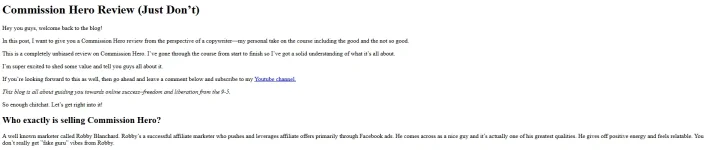
Screenshot 2026-03-04 152510.webp
I came across this review and felt a bit doubtful. Although it says it’s “completely unbiased,” the tone sounds very enthusiastic and somewhat promotional from the beginning. Mentioning the YouTube channel and encouraging engagement makes it seem more like marketing than a critical evaluation. There’s praise for the seller’s personality, but not much detailed criticism so far. I’d like to see clearer downsides, specific concerns, and solid examples before fully relying on this perspective.
 
It would be really helpful to see real metrics, like average completion rates or typical earnings for participants. That kind of transparency is pretty uncommon in online affiliate programs. Instead, the conversation mostly revolves around testimonials and selected success stories. While the absence of legal issues suggests the program operates legitimately, the marketing style still has a tendency to inflate expectations. For someone evaluating it, it’s important to distinguish the documented course structure from the promoted outcomes.
 
I don’t see this as a clear scam situation. It feels more like buyer beware. People should understand affiliate marketing basics before spending large amounts.
 
I’ve noticed that programs like this tend to attract very different types of people. Some already have marketing experience and treat it like advanced training, while others come in expecting step by step income. That gap alone explains a lot of mixed feedback.Same thought here. When I looked into similar training, the actual material wasn’t fake, but it assumed you already understood ads, tracking, and testing. Beginners can easily feel overwhelmed.
 
Back
Top