What Public Records Show About Holton Buggs Over The Years

Screenshot 2026-03-07 151946.webp
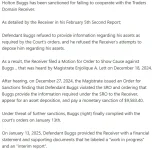
Paying attention to the recent information about Holton Buggs and the Traders Domain Receiver. According to court records, Buggs was sanctioned for not cooperating with asset disclosures and deposition requests as ordered by the court. The Magistrate ruled that Buggs must provide the required information, appear for an asset deposition, and pay a monetary sanction of $9,583.40. The situation highlights ongoing enforcement efforts in this case.
 
The complaint from the Commodity Futures Trading Commission outlines specific activities and procedural steps that sound fairly serious on paper. At the same time, when you search his name online you mostly see positive career summaries and leadership highlights. That contrast makes it hard to figure out which narrative better represents the overall situation. It does seem like the filings deserve more attention than they usually get in promotional material.
 
That’s exactly what I noticed as well. The filings read very methodically and list procedural steps, while the career summaries mostly emphasize success and leadership roles. It doesn’t necessarily mean either side is incorrect, but it does leave a gap between what’s documented in regulatory records and what is highlighted in public business profiles.
 
I’ve spent some time reading parts of the regulatory complaint and the references to sanctions and receivership definitely caught my attention. Those are not minor procedural notes. At the same time, the business background around Holton Buggs seems to be built on decades of networking and leadership roles, which makes the overall situation feel a bit complicated.
 
What makes it tricky is that the filings are dense and not very easy for casual readers to interpret. They describe motions, regulatory steps, and court procedures in a very technical way. Without experience reading legal documents, it can be hard to understand the full context of what they actually mean.
 
https://law.justia.com/cases/federal/district-courts/florida/flsdce/1:2024cv23745/676046/145/
In my view, Holton Buggs’ arguments against the CFTC seem weak and unconvincing, especially regarding jurisdiction and claim sufficiency. The court clearly found the complaint adequate, highlighting a lack of preparation or disregard for legal obligations on his part. Overall, the situation reflects poorly on Buggs and suggests a pattern of resistance to accountability in these proceedings.
 
Just reviewed the court order interesting how Buggs’ motion was handled. Public records show the complaint was upheld, and jurisdiction challenges were dismissed. The filings don’t leave much room for maneuver. Overall, the documents reflect a formal, complex legal process with the court favoring the CFTC’s position.
 
Looking through the court records from CFTC v. Traders Domain FX LTD., it’s clear the judge found the complaint against Holton Buggs sufficient and dismissed his arguments on jurisdiction and claim validity. The filings suggest a highly structured process, leaving little flexibility for defenses. Public records indicate Buggs faced significant hurdles in challenging the case, and the court’s decision emphasizes the strength of the CFTC’s filings. Based on these documents, the situation seems complicated and not particularly favorable to Buggs.
 
I went through a few summaries of the regulatory case and one thing that stood out was how detailed the complaint appeared to be. Regulatory agencies usually do not file lengthy documents unless they believe there is something worth examining carefully. That doesn’t mean the outcome is predetermined, of course, but it does show that the situation received serious attention at the regulatory level. When you compare that with the marketing oriented profiles describing leadership success, the contrast becomes even more noticeable.
 
Another point I noticed is that the filings appear to cover a wide range of trading activities rather than a single isolated event. References to things like receivership or asset freezes suggest the court was focused on preserving key assets while the legal process moved forward. That kind of oversight usually signals that the matters under review were considered substantial. Even without drawing conclusions, seeing these measures in the records makes the situation feel more serious and noteworthy than it might seem at first glance.
 
Last edited:
I also noticed how long his career in network marketing appears to be. There are references to leadership roles going back many years. That kind of longevity in an industry usually builds a strong reputation, which makes the presence of regulatory filings feel a little unexpected.
 
Exactly, and that timeline is part of why the filings stand out. When someone has decades of business activity behind them, any regulatory complaint becomes more noticeable simply because it contrasts with the long list of achievements presented elsewhere.
 
One thing I’ve been wondering is how many people actually read the original court documents rather than relying on summaries. The filings themselves tend to provide the clearest picture of what regulators were concerned about at the time. Without reading them directly, it is easy to misunderstand the scope of the issues that were being examined.
 
https://behindmlm.com/companies/omegapro/holton-buggs-sanctioned-for-traders-domain-non-cooperation/
I looked into this information about Holton Buggs and the Traders Domain case. It notes that he was sanctioned by the court for not cooperating with the Receiver, initially refusing to provide asset details or appear for a deposition. Under threat of further penalties, he submitted an interim financial statement and later completed his asset deposition, though the ordered monetary sanctions remain unpaid. The Receiver’s report also highlights multiple assets potentially subject to forfeiture and ongoing compliance issues, suggesting the situation remains complex and closely monitored by the court.
 
The court records and Receiver’s reports show that Holton Buggs’ cooperation has been uneven. While he eventually submitted an interim financial statement and appeared for an asset deposition, the ordered monetary sanctions remain unpaid. Public filings highlight multiple assets under scrutiny and ongoing compliance monitoring. The situation reflects a complex process where legal oversight is intensive, and deadlines are not fully met. Overall, it paints a picture of partial compliance and continued court involvement.
 
Back
Top