What Public Records Show About Holton Buggs Over The Years

Based on public filings, Buggs submitted an interim financial statement under pressure and later completed his asset deposition, but the sanctions remain unpaid. The Receiver is closely tracking multiple assets, showing the process is detailed and ongoing, with cooperation appearing incomplete and the case still actively managed by the court.
 
The filings indicate that Holton Buggs eventually complied with the required asset reporting, but the ordered monetary sanctions remain unpaid. Public records show that court oversight is ongoing, reflecting continued monitoring of his compliance. Overall, the situation illustrates partial cooperation within a complex legal process, with the Receiver and the court actively ensuring adherence to prior orders.
 
That’s why I think reviewing original filings is important. They provide documented information about what regulators or courts were addressing at a particular time. Promotional material and business biographies can still offer context about someone’s career, but they usually don’t mention legal developments. Looking at both sources together probably gives the most balanced understanding of what is actually recorded in the public domain.
 
Screenshot 2026-03-07 152206.webp
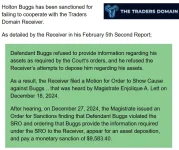
I got information that Holton Buggs was sanctioned for failing to cooperate with the Traders Domain Receiver by not providing required asset information or appearing for deposition as ordered by the court. Following a motion and hearing before Magistrate Enjolique A. Lett, Buggs was ordered to comply, pay a monetary sanction, and appear for an asset deposition. Under threat of further penalties, Buggs eventually provided a financial statement and supporting documents on January 13, 2025, describing them as a “work in progress” and “interim report,” complying with the court’s requirements.
 
It’s interesting to see how the filings describe Holton Buggs’ compliance timeline. The fact that a court issued sanctions and then received a follow-up financial report shows that there were procedural hurdles to meet. Even though he eventually provided the documents, the filings suggest that the process wasn’t straightforward and raises questions about how information was managed.
 
It highlights how courts sometimes have to balance enforcing compliance with allowing time for documentation, and it definitely adds nuance to understanding what actually happened versus the impression you might get from a simple summary.
 
Back
Top