What Should Traders Know Before Choosing IC Markets

q7Vortex

Member
I’ve been looking into IC Markets recently to understand what public records and official filings actually show. From what I can see, IC Markets operates in multiple jurisdictions and holds regulatory licences in some of them, but there are also complaints and ongoing legal matters out there. I want to ground this discussion only in documented information rather than speculation.
According to multiple sources, IC Markets is regulated in Australia by the Australian Securities and Investments Commission (ASIC), in Cyprus by CySEC, in the Seychelles, and in the Bahamas. Each of these entities has different levels of oversight and investor protections, and understanding which entity a trader is under can affect their experience.
On public forums and complaint platforms, traders share a variety of experiences. Some report delays or complications with withdrawals and account verification requests, while others say they have traded and withdrawn funds without issue. These user posts provide context about customer experiences, but they are separate from regulator findings or legal actions.
There are also mentions of legal proceedings, including class action lawsuits in Australia related to CFD products and disclosures, and regulatory fines by CySEC for certain compliance failures. None of these automatically indicate fraud, but they are part of the public record.
Has anyone here looked up specific regulator databases or court dockets to confirm licence status, enforcement actions, or formal legal outcomes? I’d like to hear about what you found from verified sources so we can piece together a balanced view.
 
From what I’ve seen, the key issue is which legal entity someone signs up under. That detail changes everything. Different jurisdictions mean different regulatory rules and protections.
 
One thing people often miss is how multi-entity brokers operate. IC Markets isn’t just one single company in one country. There are different branches under different regulators, and each regulator has its own standards. For example, leverage caps, compensation schemes, and reporting obligations can vary widely. So when someone shares a negative or positive experience, it’s important to ask which entity they were registered with. Without that context, comparisons become confusing.
 
One thing people often miss is how multi-entity brokers operate. IC Markets isn’t just one single company in one country. There are different branches under different regulators, and each regulator has its own standards. For example, leverage caps, compensation schemes, and reporting obligations can vary widely. So when someone shares a negative or positive experience, it’s important to ask which entity they were registered with. Without that context, comparisons become confusing.
That’s exactly what I’m trying to untangle. The brand name is the same, but the regulatory umbrella might not be.
 
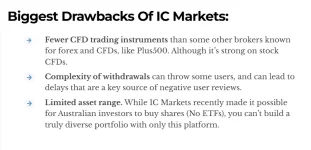
I’ve read mixed feedback about withdrawals. Some traders say payouts were smooth and quick, while others mention delays or extra document requests. It’s hard to tell whether those delays are compliance related or operational. Verification checks are stricter these days across the industry.
 
To be fair, compliance requirements globally have tightened a lot in recent years. Brokers now have to monitor transactions more closely, especially large withdrawals or unusual activity. That can trigger additional documentation requests. From a trader’s perspective, that feels inconvenient. From a regulatory perspective, it’s often mandatory. The tricky part is distinguishing between legitimate compliance and unnecessary obstacles. That’s where patterns in complaints matter more than isolated stories.
 
To be fair, compliance requirements globally have tightened a lot in recent years. Brokers now have to monitor transactions more closely, especially large withdrawals or unusual activity. That can trigger additional documentation requests. From a trader’s perspective, that feels inconvenient. From a regulatory perspective, it’s often mandatory. The tricky part is distinguishing between legitimate compliance and unnecessary obstacles. That’s where patterns in complaints matter more than isolated stories.
That makes sense. One complaint alone doesn’t necessarily show a bigger issue.
 
I have also noticed that the structure can be a bit hard to follow. When a broker operates under multiple licenses in different regions, it usually means clients are onboarded under whichever entity applies to their location. That can create very different conditions in terms of leverage, dispute resolution, and compensation schemes. It does not automatically signal a problem, but it does mean people should double check which entity is holding their account. I think a lot of confusion comes from users assuming they are covered by one regulator when they might actually be under another.
 
From what I have read in publicly available material, some entities are under well known regulators, while others are registered in offshore financial centers. That is not unusual in the forex industry. Many global brokers do this to serve clients in regions where stricter regulators would not allow certain leverage levels. The key issue for me is transparency. If the broker clearly states which entity you are signing with and what protections apply, then at least the client can make an informed decision. The problem is when marketing language feels unified but the legal structure is more fragmented.
 
chrome_b3pUZRYMOM.webp

I have traded with Ic Markets in the past, although I am not currently active there. My experience personally was smooth in terms of execution and withdrawals, but I was onboarded under a regulated entity. I did notice that online complaints often do not specify which branch the person was dealing with. That makes it hard to evaluate patterns. I think it is important not to generalize without knowing those details. At the same time, people sharing concerns should not be dismissed either.
 
Last edited by a moderator:
Another angle worth looking at is how long IC Markets has been operating. Longevity under regulatory oversight usually means they’ve passed multiple audits and reporting cycles. That doesn’t mean perfection, but it does suggest ongoing supervision. If there were serious structural problems, regulators would likely have stepped in more aggressively. Checking enforcement history gives better clarity than social media threads.
 
Something else to keep in mind is that CFDs and forex are inherently high-risk instruments. A lot of traders lose money due to leverage and volatility, and that frustration can sometimes be directed at the broker. It’s not always misconduct, sometimes it’s market mechanics. That said, execution quality and transparency still matter a lot. So the discussion should separate trading losses from genuine compliance concerns. Mixing the two creates confusion.
 
Something else to keep in mind is that CFDs and forex are inherently high-risk instruments. A lot of traders lose money due to leverage and volatility, and that frustration can sometimes be directed at the broker. It’s not always misconduct, sometimes it’s market mechanics. That said, execution quality and transparency still matter a lot. So the discussion should separate trading losses from genuine compliance concerns. Mixing the two creates confusion.
That distinction is really important. I see how emotions could blur the lines.
 
I’ve noticed many debates focus on slippage and spreads during high volatility. That’s not necessarily a red flag by itself because liquidity conditions change rapidly in news events. The question is whether disclosures clearly explain those risks beforehand.
 
There’s also the issue of clone websites. Large brokers often become targets for impersonators who copy branding and even licence numbers. When people say they were scammed, sometimes they weren’t even dealing with the real regulated entity. That complicates online discussions because the brand name gets blamed regardless. Verifying the official domain and matching it with regulator listings is crucial. It sounds basic, but many overlook that step.
 
Back
Top