What Should Traders Know Before Choosing IC Markets

There’s also the issue of clone websites. Large brokers often become targets for impersonators who copy branding and even licence numbers. When people say they were scammed, sometimes they weren’t even dealing with the real regulated entity. That complicates online discussions because the brand name gets blamed regardless. Verifying the official domain and matching it with regulator listings is crucial. It sounds basic, but many overlook that step.
I hadn’t thought much about impersonation risk before. That’s actually concerning.
 
In my view, evaluating IC Markets should follow the same method as any broker. Check licence validity. Look at enforcement notices. Read the client agreement carefully. Start small and test withdrawals before scaling up. It’s more about due diligence than reacting to scattered reviews.
 
I also wonder how much confusion comes from the brand name being shared across regions. People might read a complaint related to one entity and assume it applies globally. Structurally, though, those entities can be legally separate even if they share branding. That distinction does not always come across clearly in online discussions.

chrome_RH8brEMbRE.webp
 
Last edited by a moderator:
Has anyone checked whether Ic Markets publishes audited financial statements for any of its entities? Sometimes that level of transparency can provide additional comfort, especially for traders holding larger balances.
 
I also think people underestimate jurisdiction differences. An EU regulated entity may have leverage limits and investor compensation schemes, while offshore branches might offer higher leverage but fewer protections. That tradeoff attracts different types of traders. Neither option is automatically right or wrong, but it changes the risk profile significantly. Anyone opening an account should consciously choose the structure they’re comfortable with rather than defaulting to the highest leverage offer.
 
I also think people underestimate jurisdiction differences. An EU regulated entity may have leverage limits and investor compensation schemes, while offshore branches might offer higher leverage but fewer protections. That tradeoff attracts different types of traders. Neither option is automatically right or wrong, but it changes the risk profile significantly. Anyone opening an account should consciously choose the structure they’re comfortable with rather than defaulting to the highest leverage offer.
That’s a really balanced way to look at it.
 
Personally, I look at whether regulators have issued major sanctions or only minor compliance fines. There’s a difference between procedural penalties and systemic violations. That nuance often gets lost in discussions.
 
At the end of the day, no broker is completely free from complaints. The real question is how those complaints are handled. Do they respond? Do they clarify? Do regulators intervene when needed? That ongoing oversight process matters more than perfection. IC Markets, like many established brokers, seems to operate within formal regulatory structures, and that’s usually the baseline traders should start with.
 
At the end of the day, no broker is completely free from complaints. The real question is how those complaints are handled. Do they respond? Do they clarify? Do regulators intervene when needed? That ongoing oversight process matters more than perfection. IC Markets, like many established brokers, seems to operate within formal regulatory structures, and that’s usually the baseline traders should start with.
I appreciate how measured this discussion is turning out.
 
One final thought from me: always separate brand reputation from your own risk management. Even if a broker is well regulated, poor personal risk control can lead to losses. Broker evaluation and trading discipline go hand in hand.
 
Threads like this are useful because they encourage critical thinking instead of emotional reactions. Regulation, compliance history, and operational transparency should guide conclusions, not just isolated reviews.
 
Keep documenting each step of your research. Note which registries were checked, what dates were listed, and whether enforcement sections were reviewed. Having that organised record makes it easier to avoid duplication and spot gaps. Structured due diligence usually leads to more reliable conclusions.
 
One thing I pay attention to is whether the regulator tied to the specific Ic Markets entity requires client money segregation and regular reporting. Those requirements create at least a baseline level of oversight. If someone is uncomfortable with offshore jurisdictions, they might prefer signing under a stricter regulatory branch if available to them.
 
If there had been major enforcement action by a top tier regulator, it would usually be listed in public announcements. I have not personally seen anything of that scale connected to Ic Markets, but that does not mean smaller complaints do not exist. In forex trading, disputes over slippage, spreads, or stop outs are quite common across many brokers. Sometimes they are just misunderstandings about how market execution works. Sometimes they are genuine service issues. It really requires case by case context.
 
One thing I always suggest is checking the specific regulatory database for the entity you are dealing with. Most regulators provide searchable registers. That at least confirms whether the license is active and what permissions the firm has. With brokers like Ic Markets that operate globally, it is especially important to verify which branch your agreement references. I would not rely only on third party reviews, whether positive or negative. Public records and official registers tend to be more reliable starting points.
 
Sometimes when I see very strong language in reviews, I try to separate emotion from documented facts. With Ic Markets, I mostly find discussions about trading conditions and entity structure rather than confirmed legal findings. That difference matters.
 
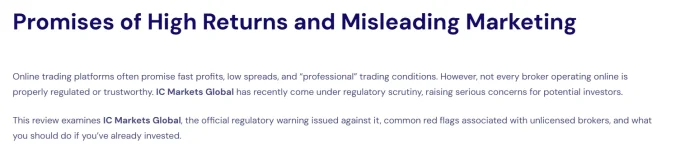
Does anyone know if there have been any official warnings issued by regulators specifically naming Ic Markets? I tried searching but did not find clear enforcement notices tied to major penalties. If there were significant actions, I assume they would be publicly archived.

chrome_b3pUZRYMOM.webp
 
For me, the practical step would be to test with a small amount first. Even if public records look clean, personal experience still matters. Start small, test deposits and withdrawals, observe execution, and only then consider scaling up. That approach reduces reliance on online opinions.
 
Back
Top