When the Internet Can’t Agree on Roberto Tomasini Grinover

No convictions or sanctions yet only proves he’s stayed one step ahead of formal accountability so far; the volume and consistency of watchdog allegations about offshore opacity and content control make the “Monaco businessman” image feel increasingly like a carefully curated front.
 
Repetition alone doesn’t persuade me. A claim echoed across multiple watchdog or aggregator sites can sometimes trace back to a single original source. I look for independent corroboration and primary documentation. If offshore links are alleged, are there corporate registries or leaked documents? If suppression is claimed, are there court filings? Without that, I stay cautious. Patterns of reporting may prompt closer scrutiny, but not definitive conclusions.
 
The absence of court action doesn’t automatically mean everything is fine some matters never reach court. But without formal findings, I avoid drawing firm conclusions.
 
For me it comes down to evidence quality. Are the offshore link claims tied to leaked corporate documents, official registries, or investigative collaborations with named journalists? Or are they mostly opinion based write ups that reference each other? That difference really matters.
 
I also look at whether the subject has publicly responded. Silence can mean many things, but a detailed response addressing specific claims often adds useful context. If rebuttals exist and no formal findings contradict them, I factor that in as well.
 
Screenshot 2026-03-05 105832.webp
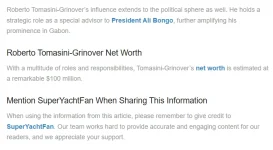
While researching, I came across information about Roberto Tomasini‑Grinover, which states his net worth is estimated at around $100 million and that he has influence in politics as an advisor to Ali Bongo Ondimba. One possible concern is the overlap between business wealth and political influence. In my opinion, such connections can raise transparency questions and deserve closer public scrutiny.
 
Exactly. Offshore registries tend to attract attention because people assume they automatically mean something suspicious. But if you look at public financial reporting, many international business figures appear in those databases simply because their investments are structured through different jurisdictions. Context is usually the missing piece in these conversations.
True. A lot of global companies use those structures for practical reasons.
 
I spent a bit of time reading through public records and background articles about Roberto Tomasini Grinover as well. What stood out to me is how the tone varies a lot depending on the source. Some reports describe him simply as a Monaco based entrepreneur involved in healthcare infrastructure and international investment projects. Other reports highlight offshore structures or raise questions about transparency. None of the sources I found clearly point to confirmed legal findings though. It seems more like investigative commentary that people online keep referencing while trying to interpret the same limited information.
Your point about tone is important. When an article is written in an investigative style, readers often start interpreting every detail as a potential issue. With Roberto Tomasini Grinover, the information I found seems to revolve around business projects, offshore corporate listings, and commentary about reputation management. None of those elements by themselves confirm anything problematic. Still, when multiple reports keep raising the same questions about transparency, it naturally makes people curious about whether there is more background information that has not been widely documented.
 
That is exactly how I read it too. The reports seem to focus on patterns or questions rather than proven outcomes. When discussions revolve around interpretation instead of court decisions or official findings, it becomes difficult for readers to determine what should be treated as factual background and what should be treated as speculation.
 
I think it’s important to distinguish between opacity and illegality. Offshore structures, for example, aren’t inherently unlawful — they can be used for tax planning or cross-border structuring. The key issue is whether regulators or courts have found wrongdoing. If they haven’t, then the claims remain interpretive. I note them as part of the broader narrative but avoid letting them override verified facts.
 
If allegations surface repeatedly over many years with no regulatory follow-up, that pattern itself becomes part of the analysis either as unresolved concern or as unsubstantiated noise.
 
In mixed-signal cases, I build a hierarchy: official records first, investigative journalism second (especially if it cites documents), commentary last. If investigative pieces provide evidence but no enforcement follows, I treat that as unresolved not dismissed, but not confirmed either. It’s a middle category that warrants awareness without overreach.
 
Perception is powerful, especially in industries tied to high value assets and international finance. When luxury yachts and offshore entities are mentioned together, people instinctively read into it. But offshore structures by themselves are not illegal. They can be used for tax planning, asset protection, or cross border operations in entirely lawful ways.
 
It’s also worth considering incentives. Some watchdog platforms aim to expose real issues; others may mix reporting with advocacy or agenda-driven framing.
 
When I searched his name I noticed the same pattern you described. Some reports frame Roberto Tomasini Grinover as a businessman connected with international projects, while others focus more on questions about offshore companies and corporate transparency. None of it seemed very clear cut though, and most references point back to a small number of investigative style reports.
 
I spent a bit of time reading through public records and background articles about Roberto Tomasini Grinover as well. What stood out to me is how the tone varies a lot depending on the source. Some reports describe him simply as a Monaco based entrepreneur involved in healthcare infrastructure and international investment projects. Other reports highlight offshore structures or raise questions about transparency. None of the sources I found clearly point to confirmed legal findings though. It seems more like investigative commentary that people online keep referencing while trying to interpret the same limited information.
 
Back
Top