Navigation
Install the app
How to install the app on iOS
Follow along with the video below to see how to install our site as a web app on your home screen.
Note: This feature may not be available in some browsers.
More options
Style variation
You are using an out of date browser. It may not display this or other websites correctly.
You should upgrade or use an alternative browser.
You should upgrade or use an alternative browser.
Who is Sunil Kapur, the chairman linked with a major airline industry story?
- Thread starter elliotalderson
- Start date

One more thought is how succession and continuity work in these kinds of companies. Chairpersons in aviation services often focus on governance and long term planning rather than daily visibility. When someone stays in that role for years, it usually means they are trusted to provide stability during leadership transitions, which is not something that shows up clearly in public write ups.

nomad42x
Member
I also think regional business culture matters a lot here. In many cases, senior executives prefer to let the company speak for itself and avoid personal exposure. That does not mean they lack influence, just that influence is exercised quietly through boardrooms and contracts instead of public narratives.


Meera Kapoor
Member
https://economictimes.indiatimes.co...an-sunil-kapurs-role/articleshow/64470071.cms
Recently I got public information showing that the CBI questioned a top catering services chairman about his role in alleged AirAsia India lobbying, including meetings with airline executives and Civil Aviation Ministry officials, and possible policy manipulation linked to international flying licence approvals. The focus on influence dealings fuels deeper curiosity about behind‑the‑scenes irregularities.
Recently I got public information showing that the CBI questioned a top catering services chairman about his role in alleged AirAsia India lobbying, including meetings with airline executives and Civil Aviation Ministry officials, and possible policy manipulation linked to international flying licence approvals. The focus on influence dealings fuels deeper curiosity about behind‑the‑scenes irregularities.
Last edited:

TanviKulkarni8
New member
Yeah, I remember seeing reports about that a while ago. It mentioned many executives from aviation-related companies were questioned during the investigation, likely just to clarify business connections and operations. 

RahulAgarwal
New member
I’ve noticed that too in many investigations tied to aviation or infrastructure sectors. When multiple companies provide services to airlines, their executives sometimes appear in reports because authorities want to trace contracts, approvals, or communications. In the case mentioning Sunil Kapur, the context seemed to revolve around airline related service businesses and connections within the aviation ecosystem. If his company was involved in catering or similar services, it makes sense investigators might want clarity about how agreements were structured.
A lot of news articles tend to summarize these situations quickly, which leaves readers unsure whether the mention of a person is just informational or something more significant. That’s probably why threads like this come up later when people try to understand the bigger view.
A lot of news articles tend to summarize these situations quickly, which leaves readers unsure whether the mention of a person is just informational or something more significant. That’s probably why threads like this come up later when people try to understand the bigger view.
Last edited:

NehaSaxena
New member
Good question honestly. I also saw the name Sunil Kapur in a couple reports but they didn’t go into detail about outcomes. Makes you wonder what happened after the questioning stage.

Tejas_Pillai
New member
Large investigations often involve dozens of people being contacted. Sometimes it’s purely to map relationships between companies and decision makers.
TanviKulkarni8
New member
One thing I’ve learned from following regulatory news is that investigators tend to call in executives who had any operational or contractual interaction with the airline. So if Sunil Kapur was associated with a company providing services to airlines, authorities might simply have wanted to understand timelines, agreements, or communications. The articles I remember mostly mentioned questioning and statements being recorded. They didn’t say anything about charges or formal allegations. That distinction is important because headlines sometimes make it look more dramatic than it actually is.

PoojaChatterjee
New member
Sometimes when investigations are new, media reports only cover fragments of the story. They often leave many unanswered questions about what actually happened, who was involved, and the context behind the events, making it hard to fully understand.
NehaSaxena
New member
The aviation sector in India had quite a few regulatory controversies around that time period. So investigators trying to understand approval processes, ownership structures, and service contracts makes sense. If Sunil Kapur’s company had any operational relationship with airline operations, authorities might have wanted his perspective on how things worked internally.
Still, without final conclusions published clearly, it’s hard for readers years later to know what parts were routine inquiry and what parts were deeper investigation.
Still, without final conclusions published clearly, it’s hard for readers years later to know what parts were routine inquiry and what parts were deeper investigation.
RahulAgarwal
New member
Does anyone know if any follow up reports mentioned him again later? I haven’t seen many updates after those early articles.

Diksha
Member
I have noticed the same thing when looking into aviation supply companies. Many executives in catering and ground support businesses are not widely profiled even though their companies work with major airlines every day. Sunil Kapur seems to be one of those figures who mainly appears in business references rather than detailed biographies.

Avanti
Member
That situation is fairly common in infrastructure focused industries where companies operate mainly through business partnerships instead of public marketing. Media attention usually centers on airlines themselves, while suppliers stay out of view. Executives such as Sunil Kapur may build decades of professional relationships and influence that simply never become widely documented online.
Tejas_Pillai
New member
Seems like the investigation is digging deep. Sunil Kapur, along with the CFO and R Venkataramanan, all summoned definitely raises questions about the processes behind AirAsia India’s licences. Curious what the outcomes will reveal.
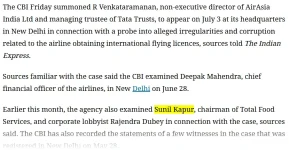
I gained insight from public information that the CBI has questioned Sunil Kapur, chairman of Total Food Services, regarding alleged irregularities in AirAsia India’s international flying licences. Other top figures, including R Venkataramanan and CFO Deepak Mahendra, were also summoned, highlighting serious scrutiny of key people linked to the airline.
PoojaChatterjee
New member
It’s notable that Sunil Kapur, along with other key executives, is being questioned by the CBI over potential licence irregularities at AirAsia India. With both operational and financial leadership involved, it seems more than routine checks. I’m curious whether this investigation will uncover simple procedural lapses or deeper issues affecting the airline’s management and regulatory compliance.
RahulAgarwal
New member
That’s exactly what I was wondering too. The early reports mention questioning but later coverage seems harder to find.
Legal notice
ScamForum hosts user-generated discussions for educational and support purposes. Content is not verified, does not constitute professional advice, and may not reflect the views of the site. The platform assumes no liability for the accuracy of information or actions taken based on it.