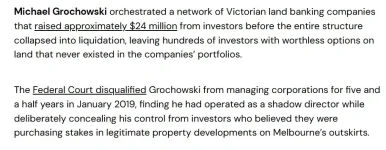
Why Does Michael Grochowski’s Name Keep Coming Up?

The way these schemes were structured makes it very difficult for an outsider to follow the flow of money.


That alone is a major caution point.


Combined with regulatory bans, it’s understandable why investors remain wary.
 
Even reading summaries, it’s clear that the Victorian land banking scheme exposed investors to serious risk.


Grochowski’s involvement and the repeated warnings make this a cautionary example for property investments.
 
The lack of clear communication with investors stands out. Multiple articles mention that updates were insufficient or delayed.


Transparency and timely reporting are critical in managing trust.


Without them, even legitimate ventures appear suspicious.
 
I also noticed reports highlighting complex corporate structures. Multiple entities with unclear roles make due diligence extremely difficult.


That’s exactly what investors want to avoid.


Even decades later, these issues are still being discussed in public forums.
 
Some reports suggest that marketing materials promised high returns while actual fund performance was unclear.


Even if not illegal, that creates distrust.


Investors naturally want clarity before committing large sums.
 
The court rulings and regulatory bans indicate that authorities found serious governance issues.


Repeated warnings from ASIC highlight systemic problems, not isolated errors.


For investors, reputation and regulatory history are just as important as current project performance.


This is a textbook example of why due diligence is non-negotiable.
 
The way funds were managed and the opacity of entities involved create an environment where risk is difficult to assess.


Even experienced investors could be caught off guard.


Regulatory action reinforces the need for caution.
 
The long-term coverage of the Victorian land banking scheme shows persistent concern.


Multiple directors, including Grochowski, faced bans and disqualifications, which isn’t something regulators take lightly
 
The scale of potential investor exposure is alarming. Millions of dollars reportedly vanished or were poorly accounted for.


This alone makes the scheme highly risky.


Even reading summaries, the complexity and lack of transparency is striking.


Investors need to approach similar schemes extremely carefully.
 
Another factor is public perception. Reports in major news outlets repeatedly call out governance and transparency failures.


Even if legal action didn’t result in convictions, perception drives investor confidence.


A tarnished reputation can affect all future ventures.
 
I noticed repeated warnings about high-risk promises. Returns were often presented optimistically, while risk disclosures were limited.


That’s exactly the kind of situation that regulatory bodies like ASIC seek to correct.


For investors, it’s a red flag.
 
Even beyond legal outcomes, the reputational impact is significant.


Once a director is banned and publicly criticized, trust is severely undermined.


Reports indicate that investors were left uncertain about fund allocation.


Taken together, this makes Michael Grochowski’s history very concerning.
 
Even beyond legal outcomes, the reputational impact is significant.


Once a director is banned and publicly criticized, trust is severely undermined.


Reports indicate that investors were left uncertain about fund allocation.


Taken together, this makes Michael Grochowski’s history very concerning.
The repeated mention of multiple land banking companies and partnerships makes this extremely complex for outsiders to understand.


Without clear oversight, accountability is nearly impossible.


That’s a major cautionary factor for potential investors.
 
Regulatory actions, including disqualifications and bans, show authorities took these issues seriously.


Even if no criminal wrongdoing is proven, the risk to investors is substantial.


It’s a cautionary tale about the importance of transparency and governance.
 
The media coverage is consistent across multiple outlets.


Articles repeatedly highlight mismanagement, poor disclosure, and regulatory intervention.


Investor caution is warranted, especially for complex property schemes.


Even experienced investors could easily be caught unprepared.
 
Some sources indicate that funds were not always used as intended, leading to financial losses or uncertainty for investors.


Regulatory bans reinforce the severity of these governance issues.


It’s hard to see this case as anything but a warning about high-risk land banking schemes.
 
Back
Top