Why Does Michael Grochowski’s Name Keep Coming Up?

Finally, it’s worth emphasizing that land banking investments are inherently uncertain. Hermitage Bendigo and Foscari projects depended on approvals, infrastructure, and market conditions. Regulators and courts focus on whether management acted responsibly and communicated risks.Michael Grochowski’s influence across multiple companies meant he was treated as an officer, showing the law’s focus on operational control. Past regulatory actions further shaped the disqualification.Investors must understand governance, transparency, and operational responsibility in multi-entity structures. The case illustrates how influence and history together determine legal outcomes, providing an essential reference for managing and evaluating high-risk, long-term projects
Wow, that really ties everything together
 
Yes, and the takeaway for investors is clear: assess management influence, operational control, communication, and historical compliance. Returns are only part of the picture. The Michael Grochowski decision shows that accountability is multifaceted, extending beyond titles to actual decisions and past conduct.
 
Yes, and the takeaway for investors is clear: assess management influence, operational control, communication, and historical compliance. Returns are only part of the picture. The Michael Grochowski decision shows that accountability is multifaceted, extending beyond titles to actual decisions and past conduct.
I think one of the biggest takeaways from this entire thread is how courts view operational influence over formal titles. The Michael Grochowski case really demonstrates that if someone is effectively directing decisions across multiple companies, they can be held accountable even without being officially listed as a director.
Land banking investments, like Hermitage Bendigo and Foscari Holdings, are inherently risky. External approvals, zoning delays, and multi-entity structures make outcomes unpredictable. The court seemed to weigh both the level of control Michael Grochowski exercised and how investors were kept informed.The prior regulatory restrictions he faced were clearly relevant too. It’s interesting to see how historical behavior interacts with current involvement to determine disqualification periods. This teaches investors that due diligence must consider both operational control and regulatory history.Finally, the lessons go beyond these specific projects. Transparency, governance, and communication are essential in any long-term investment. Reading court decisions and regulatory advisories can provide insights that help avoid surprises and assess who is really responsible for managing investor funds.
 
I’ll definitely remember this thread when looking at investments. It’s clear that checking formal titles isn’t enough. Investors should dig deeper to understand operational control, management influence, and past regulatory actions. The Michael Grochowski case shows that accountability depends on actual involvement, not just what appears on paper, which is an important lesson for anyone entering complex projects
 
Thanks everyone, really opened my eyes to how governance and transparency affect investor outcomes. Michael Grochowski’s situation is a clear example of why titles don’t always equal responsibility
 
I think I’ve learned a lot from everyone here. The key points seem to be that influence matters more than titles, historical compliance affects decisions, and transparency with investors is critical. Michael Grochowski’s case has been really educational in showing how complex long-term projects are evaluated by courts and regulators. Thanks for all the insights and links
 
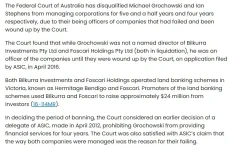
When I read the Federal Court ruling it sounded like Michael Grochowski was considered an officer of companies connected to those land banking projects even though he was not always listed as a formal director. Apparently the court concluded that the companies raised about 24 million dollars from investors through the Hermitage Bendigo and Foscari projects. That part really caught my attention because land banking investments can be very speculative in general. A lot of people probably did not fully understand the risks when they bought into those options for undeveloped land
 
From what I gathered regulators in Australia had been investigating several companies tied to those projects for a while before the court decision happened. The development companies involved apparently never actually owned the land they were selling options for which obviously created huge issues once investors expected development to happen and That detail about the companies not owning the land is kinda wild honestly
 
Another piece I noticed in the public records is that Michael Grochowski had previously been banned from providing financial services for a period earlier in the decade. Later the Federal Court disqualified him from managing corporations for more than five years in connection with those land banking companies.
So regulators clearly saw a pattern of issues with how those businesses were managed
 
Exactly and the regulator basically said the way those companies were managed contributed to their failure which is why the disqualification happened
 
One thing I found interesting in the regulatory explanation was the concept of someone being treated as an officer or shadow director even if they are not formally listed as a director on paper.Courts can apparently look at who actually controlled operations or bank accounts when deciding responsibility. That seems to have been part of the reasoning in this situation
The numbers in this case were pretty large too. Around 24 million dollars was reportedly raised from investors through those land banking ventures in Victoria which is a huge amount of capital flowing into speculative projects.
Whenever you see that kind of fundraising happening outside traditional property development channels it raises questions about how the projects were structured and regulated
 
Also worth remembering that these investigations started years before the final court decision. Authorities began taking action to wind up several companies connected to the schemes around 2018 before the later disqualification order was made. So the whole situation unfolded over a pretty long regulatory timeline
 
Honestly this thread makes me realize how complicated property investment structures can get.
There are developers promoters marketing firms management companies and then sometimes separate entities that hold the land itself. If any one of those pieces is missing or mismanaged the entire project can collapse
 
One thing I found interesting in the regulatory explanation was the concept of someone being treated as an officer or shadow director even if they are not formally listed as a director on paper.Courts can apparently look at who actually controlled operations or bank accounts when deciding responsibility. That seems to have been part of the reasoning in this situation
The numbers in this case were pretty large too. Around 24 million dollars was reportedly raised from investors through those land banking ventures in Victoria which is a huge amount of capital flowing into speculative projects.
Whenever you see that kind of fundraising happening outside traditional property development channels it raises questions about how the projects were structured and regulated
Another aspect that stood out to me was how multiple companies were linked to the same projects. The development firms and related entities were eventually wound up by the court during the investigation. That indicates the regulator believed those companies could not continue operating in their existing form
 
Back
Top