Wondering How Charles Zhang’s Profile Matches Public Rankings

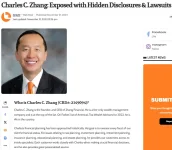
I recently read through some material discussing Charles Zhang and his advisory business, and I thought it might be helpful to talk it through here. From what I can see in regulatory databases and professional biographies, he holds several credentials and has been highlighted in well known industry rankings over the years. On paper, it looks like a long established career with consistent recognition within wealth management circles.
At the same time, when I searched for independent client commentary, I did not find much that felt detailed or firsthand. That could simply reflect the type of clientele he serves, especially if privacy is a priority. Still, it made me pause because in many other professions there tends to be at least some trace of broader feedback floating around online.
I also noticed that official filings do not appear to show disciplinary findings or formal enforcement matters tied to him or his firm. That is certainly relevant, but I am unsure how much weight to assign to the absence of regulatory action versus the presence of industry awards. It feels like two different types of information that do not necessarily answer the same questions.
I am not drawing any firm conclusions here. I am more interested in how others interpret publicly documented data when evaluating someone in the financial advisory space. What signals matter most to you when the record is technically clean but public commentary is limited?
 
I recently read through some material discussing Charles Zhang and his advisory business, and I thought it might be helpful to talk it through here. From what I can see in regulatory databases and professional biographies, he holds several credentials and has been highlighted in well known industry rankings over the years. On paper, it looks like a long established career with consistent recognition within wealth management circles.
At the same time, when I searched for independent client commentary, I did not find much that felt detailed or firsthand. That could simply reflect the type of clientele he serves, especially if privacy is a priority. Still, it made me pause because in many other professions there tends to be at least some trace of broader feedback floating around online.
I also noticed that official filings do not appear to show disciplinary findings or formal enforcement matters tied to him or his firm. That is certainly relevant, but I am unsure how much weight to assign to the absence of regulatory action versus the presence of industry awards. It feels like two different types of information that do not necessarily answer the same questions.
I am not drawing any firm conclusions here. I am more interested in how others interpret publicly documented data when evaluating someone in the financial advisory space. What signals matter most to you when the record is technically clean but public commentary is limited?
I think you are asking a fair question. A spotless regulatory history is important, but it does not automatically translate into a full picture of someone’s approach or client experience. In finance especially, a lot of relationships are private and long term, so outside visibility can be limited. If there were court judgments or sanctions, that would obviously be a different story. Without that, it becomes more about due diligence than suspicion.
 
I think you are asking a fair question. A spotless regulatory history is important, but it does not automatically translate into a full picture of someone’s approach or client experience. In finance especially, a lot of relationships are private and long term, so outside visibility can be limited. If there were court judgments or sanctions, that would obviously be a different story. Without that, it becomes more about due diligence than suspicion.
That is kind of where my head is at too. I do not see documented enforcement actions, so there is nothing concrete pointing to misconduct.
 
Rankings in magazines often rely on metrics like assets under management or growth rates. Those criteria say something about business scale, but not necessarily about client satisfaction or advisory philosophy. I usually suggest looking at the firm’s disclosure documents carefully, especially fee structures and potential conflicts. That gives more practical insight than award placements.
 
Another angle is to check whether there have been civil cases filed in state courts, not just regulatory databases. Sometimes disputes show up there first. That said, I did a quick search and did not find anything obvious. In situations like this, the lack of adverse filings is meaningful, even if it does not answer every question.
 
Honestly, the biggest red flag for me is ambiguity.

When public write ups raise questions but do not clearly explain outcomes, it leaves readers guessing. That uncertainty alone can create reputational risk.
If I were researching Charles Zhang for due diligence, I would pull the official court dockets and see how each case ended. Dismissed cases are very different from judgments. Until that is clarified, I would keep it in the category of unresolved concerns rather than confirmed issues.
 
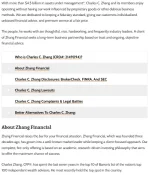
After reading the piece about Charles C. Zhang and the references to hidden disclosures and lawsuits, I feel a bit conflicted. On one hand, he is described as a highly ranked financial advisor with significant assets under management. On the other hand, the article frames certain legal matters and disclosures in a way that raises questions.
1772787733459.webp1772787738098.webp

I think the key issue is transparency. If there were disclosures on regulatory platforms like BrokerCheck, FINRA, or SEC filings, then technically that information was public. The real question is whether clients were fully aware of those matters when making decisions. Without reviewing the actual regulatory entries, it is hard to know how serious they were.
 
What stands out to me is the contrast between the glowing professional profile and the section highlighting lawsuits. That contrast creates tension. It does not prove wrongdoing, but it does make you want to verify details independently.

I would want to check whether the lawsuits mentioned were customer disputes, employment related, or business conflicts. Those are very different categories. The context matters more than the headline language.
 
Another angle is to check whether there have been civil cases filed in state courts, not just regulatory databases. Sometimes disputes show up there first. That said, I did a quick search and did not find anything obvious. In situations like this, the lack of adverse filings is meaningful, even if it does not answer every question.
That is helpful. I had not looked deeply into state level dockets, mostly just federal and regulatory sources
 
Exactly. Think of it as assembling pieces of a puzzle. Credentials, years in practice, disclosures, and any public litigation all contribute context. None of them alone tells the full story. If someone were considering working with him, direct conversations about investment philosophy and risk management would probably be the next logical step.
 
I also think expectations matter. Some advisory firms intentionally keep a low public profile to protect client privacy.
 
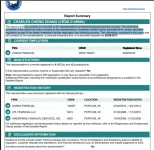
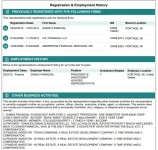
I am sharing two screenshots from the official regulatory report for Charles Cheng Zhang, CRD 2149094. According to the summary section shown here, under Disclosure Information it says “No” to reportable events. The registration history shows prior associations with Ameriprise Financial Services, LPL Financial LLC, and Zhang Financial, and current employment listed as Zhang Financial since 2012.
1772789829332.webp1772789832744.webp
The other screenshot lists outside business activities, including rental properties and passive investor roles in real estate entities. I am posting this because earlier documents and articles suggested disclosure concerns, but this regulatory snapshot seems to indicate no active disclosure events. Am I reading this correctly?
 
I spent some time reading through publicly available disclosure documents for Charles Zhang and what stood out to me was how structured and formal everything appears. The filings outline services, compensation models, and advisory approach in fairly standard language for the industry. Nothing immediately jumped out as unusual or alarming. That said, those forms are often written in broad compliance driven terms, so they tend to be conservative and carefully phrased. I think it is smart that you are not equating a clean disclosure with automatic trust, but at the same time, it is meaningful that there are no listed sanctions or enforcement outcomes.
 
One thing I always look at with advisors is longevity. From what is publicly documented, he seems to have been active for quite a while. Sustained presence in a heavily regulated field can be a signal in itself, especially when there are no obvious regulatory findings. That does not mean someone is perfect, but surviving multiple market cycles without formal disciplinary records suggests some level of operational stability.
 
One thing I always look at with advisors is longevity. From what is publicly documented, he seems to have been active for quite a while. Sustained presence in a heavily regulated field can be a signal in itself, especially when there are no obvious regulatory findings. That does not mean someone is perfect, but surviving multiple market cycles without formal disciplinary records suggests some level of operational stability.
That is interesting about longevity. I had not thought about market cycles as a factor.
 
I approach these situations by separating three categories. First is regulatory history, which appears clear based on available databases. Second is reputation within the professional community, which seems supported by rankings and recognitions. Third is client level experience, which is usually the hardest to evaluate from outside. In your case, the first two appear documented, while the third remains somewhat opaque. That does not imply wrongdoing, just limited transparency from a public perspective.
 
You mentioned that the absence of commentary felt noticeable. In wealth management, especially at higher asset levels, clients often value discretion. That can translate into very little public chatter. It is quite different from consumer finance products where reviews are everywhere. I would not interpret quietness as negative on its own, but I understand why it leaves you wanting more context.
 
Another thought is to examine the firm’s investment philosophy as described in official materials. Sometimes advisors publish white papers or educational content. If that material is consistent and coherent over time, it can reflect seriousness and depth.
 
Another thought is to examine the firm’s investment philosophy as described in official materials. Sometimes advisors publish white papers or educational content. If that material is consistent and coherent over time, it can reflect seriousness and depth.
That is a good suggestion. I might look at archived versions of their materials to see how messaging evolved. Consistency over time could say something about stability.
 
Back
Top