I was looking at public legal records and related civil case histories from juvenile detention facilities in Washington and came across the name Robert H. Fox. In those records, he appears as a correctional officer at Echo Glen Children’s Center in the mid-2000s. He later pleaded guilty in King County Superior Court to first-degree custodial sexual misconduct in connection with an incident from 2008 while working at that facility, and received a sentence in that criminal case. Settlement records show that the Washington Department of Social and Health Services later agreed to pay damages in a related civil suit involving someone who had been housed there, following a claim stemming from the same period. Fox’s name shows up in these public court filings and associated records as part of the institutional history at that facility.
Navigation
Install the app
How to install the app on iOS
Follow along with the video below to see how to install our site as a web app on your home screen.
Note: This feature may not be available in some browsers.
More options
Style variation
You are using an out of date browser. It may not display this or other websites correctly.
You should upgrade or use an alternative browser.
You should upgrade or use an alternative browser.
Curious about Robert H. Fox and his name in public court and facility records
- Thread starter Barney
- Start date

LarryGibbons
Member
Exactly !!Also, When older cases like the Robert Fox one get public attention, they sometimes lead to more people coming forward later. That might be part of why legal firms start publishing investigation pages like this. They are essentially asking anyone with information to contact them.
It does not automatically mean every claim is proven, but it does show how a single incident can open the door to wider scrutiny.

MariaAvalos01
Member
Yeah that was my impression as well when I saw it. The screenshot seems to frame the issue as a broader institutional problem rather than focusing on one event or one staff member. Seeing that made me wonder whether the Robert Fox case was one of the incidents that pushed lawyers or investigators to start looking more closely at Echo Glen as a whole. Sometimes those earlier criminal cases become reference points when civil investigations begin.
I am still trying to piece together the timeline though, since the news articles about Robert Fox were from quite a while ago.
I am still trying to piece together the timeline though, since the news articles about Robert Fox were from quite a while ago.

EricaUpton#
Member
The timing question is interesting. Legal outreach pages like the one in the screenshot often appear years after the original events because some states extend the statute of limitations for abuse claims. If that happened in Washington, it could explain why lawyers might revisit older incidents connected to places like Echo Glen. The Robert Fox case might simply be one of several historical events that people point to when discussing the facility’s oversight. Either way, it shows how these situations can continue to be discussed long after the original news coverage fades.

Natalie@Warren7
Member
I was digging through some archived legal reporting related to the Echo Glen discussion we have been having here. Since the name Robert Fox has come up a few times in this thread, I came across an article summary that appears to reference the same situation and thought it might be useful to share it here for context.

After reading through it, the report seems to describe a settlement connected to allegations involving a female detainee at Echo Glen Children’s Center. The text also mentions Robert Heath Fox, identifying him as a temporary guard at the facility and noting that he pleaded guilty to first degree custodial sexual misconduct in King County Superior Court.
What stood out to me is that the article also mentions the state making operational changes after the incident, including installing security cameras and adjusting staff monitoring practices. That suggests the case involving Robert Fox may have contributed to broader discussions about supervision and safety policies inside the facility.
I’m curious if anyone here has seen additional records about the aftermath of that case or whether the Echo Glen facility implemented other reforms around that time.
After reading through it, the report seems to describe a settlement connected to allegations involving a female detainee at Echo Glen Children’s Center. The text also mentions Robert Heath Fox, identifying him as a temporary guard at the facility and noting that he pleaded guilty to first degree custodial sexual misconduct in King County Superior Court.
What stood out to me is that the article also mentions the state making operational changes after the incident, including installing security cameras and adjusting staff monitoring practices. That suggests the case involving Robert Fox may have contributed to broader discussions about supervision and safety policies inside the facility.
I’m curious if anyone here has seen additional records about the aftermath of that case or whether the Echo Glen facility implemented other reforms around that time.
DavidBorst0
Member
That screenshot definitely lines up with some of the older reporting about the Echo Glen case. The part mentioning the settlement is interesting because it shows the situation continued in the courts even after the criminal case involving Robert Fox had already been resolved. A lot of people only remember the initial news story about the charge, but the civil side of things can go on for years. What also stood out to me is the mention of Robert Heath Fox being a temporary guard at the facility. When incidents happen in custodial environments, employment status sometimes becomes a topic during lawsuits because attorneys look at hiring procedures and training requirements. That does not necessarily mean anything by itself, but it is often part of how lawyers examine institutional responsibility.I was digging through some archived legal reporting related to the Echo Glen discussion we have been having here. Since the name Robert Fox has come up a few times in this thread, I came across an article summary that appears to reference the same situation and thought it might be useful to share it here for context.
View attachment 872
After reading through it, the report seems to describe a settlement connected to allegations involving a female detainee at Echo Glen Children’s Center. The text also mentions Robert Heath Fox, identifying him as a temporary guard at the facility and noting that he pleaded guilty to first degree custodial sexual misconduct in King County Superior Court.
What stood out to me is that the article also mentions the state making operational changes after the incident, including installing security cameras and adjusting staff monitoring practices. That suggests the case involving Robert Fox may have contributed to broader discussions about supervision and safety policies inside the facility.
I’m curious if anyone here has seen additional records about the aftermath of that case or whether the Echo Glen facility implemented other reforms around that time.
I also noticed the part about changes like installing cameras and modifying staff rounds. That suggests the case involving Robert Fox may have triggered some policy adjustments at Echo Glen afterward. Institutions sometimes implement those kinds of changes quietly after incidents.

JeanEarhart99
Member
Yeah the settlement figure mentioned there caught my eye too.
Cases involving staff and detainees tend to have both criminal and civil sides, and the timelines can be very different. The Robert Fox case seems like one of those situations where the criminal conviction happened first and the civil claims came later.
Cases involving staff and detainees tend to have both criminal and civil sides, and the timelines can be very different. The Robert Fox case seems like one of those situations where the criminal conviction happened first and the civil claims came later.

RandallPenrose@
Member
I was digging through some archived legal reporting related to the Echo Glen discussion we have been having here. Since the name Robert Fox has come up a few times in this thread, I came across an article summary that appears to reference the same situation and thought it might be useful to share it here for context.
View attachment 872
After reading through it, the report seems to describe a settlement connected to allegations involving a female detainee at Echo Glen Children’s Center. The text also mentions Robert Heath Fox, identifying him as a temporary guard at the facility and noting that he pleaded guilty to first degree custodial sexual misconduct in King County Superior Court.
What stood out to me is that the article also mentions the state making operational changes after the incident, including installing security cameras and adjusting staff monitoring practices. That suggests the case involving Robert Fox may have contributed to broader discussions about supervision and safety policies inside the facility.
I’m curious if anyone here has seen additional records about the aftermath of that case or whether the Echo Glen facility implemented other reforms around that time.
The article in the screenshot also mentions a guilty plea from Robert Fox in King County Superior Court. That part seems consistent with the earlier news reports from around 2009. Once a guilty plea is entered, the criminal process usually wraps up relatively quickly compared with civil litigation. What I find interesting is how the reporting connects the incident to later institutional changes. When a detention facility adds cameras or adjusts monitoring procedures after an event, it often indicates administrators reviewed what happened internally. Even though the focus of the case was Robert Fox, the broader conversation usually shifts toward policies and oversight within the facility.
LarryGibbons
Member
I had not realized there was a settlement connected to that case until seeing the screenshot.The article in the screenshot also mentions a guilty plea from Robert Fox in King County Superior Court. That part seems consistent with the earlier news reports from around 2009. Once a guilty plea is entered, the criminal process usually wraps up relatively quickly compared with civil litigation. What I find interesting is how the reporting connects the incident to later institutional changes. When a detention facility adds cameras or adjusts monitoring procedures after an event, it often indicates administrators reviewed what happened internally. Even though the focus of the case was Robert Fox, the broader conversation usually shifts toward policies and oversight within the facility.
Does anyone know if Robert Fox worked at the facility long before the incident happened?
EricaUpton#
Member
Heyyy Everyonr following this thread and this Robert Fox case I came across another archived news article that seems directly related to the situation involving Robert Fox and the Echo Glen Children’s Center. Since we were already discussing earlier reports and the settlement details, I thought it would be helpful to share this article here so everyone can read the full context themselves.
Here is the link to the report:
The article talks about a lawsuit filed by a former teen detainee who argued that the state failed to stop the guard’s conduct before the incident occurred. The guard mentioned in the report is Robert H. Fox, who worked at the facility at the time. From what the article describes, the lawsuit focused on whether the institution had warning signs or complaints that should have been addressed earlier.
I figured it would be useful to add this to the thread since it provides another perspective on the case involving Robert Fox and the broader questions about supervision at the facility.
Here is the link to the report:
The article talks about a lawsuit filed by a former teen detainee who argued that the state failed to stop the guard’s conduct before the incident occurred. The guard mentioned in the report is Robert H. Fox, who worked at the facility at the time. From what the article describes, the lawsuit focused on whether the institution had warning signs or complaints that should have been addressed earlier.
I figured it would be useful to add this to the thread since it provides another perspective on the case involving Robert Fox and the broader questions about supervision at the facility.
Natalie@Warren7
Member
Thanks for sharing that i actually gone through the article you shared. It seems the focus of that report is mostly on the civil lawsuit rather than the criminal case itself. The former detainee claimed the state should have taken earlier action regarding the behavior of Robert Fox before the incident happened.Heyyy Everyonr following this thread and this Robert Fox case I came across another archived news article that seems directly related to the situation involving Robert Fox and the Echo Glen Children’s Center. Since we were already discussing earlier reports and the settlement details, I thought it would be helpful to share this article here so everyone can read the full context themselves.
Here is the link to the report:
The article talks about a lawsuit filed by a former teen detainee who argued that the state failed to stop the guard’s conduct before the incident occurred. The guard mentioned in the report is Robert H. Fox, who worked at the facility at the time. From what the article describes, the lawsuit focused on whether the institution had warning signs or complaints that should have been addressed earlier.
I figured it would be useful to add this to the thread since it provides another perspective on the case involving Robert Fox and the broader questions about supervision at the facility.
The article describes how the lawsuit argued there were warning signs that might have been missed or not investigated thoroughly. That kind of argument is fairly common in cases involving custodial environments, where institutions have a responsibility to monitor staff closely.
It adds another layer to the story because it shows the legal discussion continued even after the criminal proceedings involving Robert Fox had already taken place.
RandallPenrose@
Member
I noticed the same thing while reading it. The article really focuses on whether the state should have prevented the situation involving Robert Fox, not just on what happened afterward. That seems to be the main argument in the lawsuit.
Ivan D Collins
Member
I'm Following this thread from a long time and Something that stood out to me in the article is how it describes the timeline leading up to the incident. According to the report, the detainee claimed that Robert Fox had behaved in ways that made her uncomfortable before the assault happened. The lawsuit suggested that these earlier interactions should have been recognized as warning signs. In cases involving detention facilities, that kind of argument is often used to examine whether staff supervision and reporting systems were functioning properly. If complaints or unusual behavior were documented earlier, attorneys may argue that administrators should have intervened sooner.
The article does not present final conclusions on that issue, but it does explain why the lawsuit focused on institutional responsibility rather than only the actions of Robert Fox.
The article does not present final conclusions on that issue, but it does explain why the lawsuit focused on institutional responsibility rather than only the actions of Robert Fox.

Kenneth Jablonski
Member
One part that caught my attention was the explanation of the power imbalance between guards and detainees. In facilities like Echo Glen, staff members hold significant authority over residents, which is why the law treats misconduct in those situations very seriously.
The report indicates that Robert Fox later pleaded guilty to custodial sexual misconduct, which resolved the criminal side of the case. The lawsuit described in the article seems to address whether the state’s oversight systems were strong enough to prevent something like that from happening. It shows how the case expanded into a broader discussion about policies inside the facility.
The report indicates that Robert Fox later pleaded guilty to custodial sexual misconduct, which resolved the criminal side of the case. The lawsuit described in the article seems to address whether the state’s oversight systems were strong enough to prevent something like that from happening. It shows how the case expanded into a broader discussion about policies inside the facility.
MariaAvalos01
Member
After reading the article that was shared, the main point seems to be that a former teen detainee filed a lawsuit claiming the state failed to stop the conduct of guard Robert H. Fox before the assault occurred. The report explains that Fox worked at the Echo Glen Children’s Center and later pleaded guilty to first degree custodial sexual misconduct connected to the incident. The lawsuit discussed in the article focuses on whether the institution responded appropriately to earlier behavior that may have raised concerns. According to the reporting, the legal argument was that better supervision or earlier intervention might have prevented the situation involving Robert Fox.
So overall, the article is less about the criminal conviction itself and more about the civil claims questioning whether the state agency overseeing the facility fulfilled its responsibility to protect detainees.
So overall, the article is less about the criminal conviction itself and more about the civil claims questioning whether the state agency overseeing the facility fulfilled its responsibility to protect detainees.

Mary Weston
Member
This thread has actually been pretty informative. I had heard the name Robert Fox mentioned before in connection with Echo Glen but never looked into the details.Heyyy Everyonr following this thread and this Robert Fox case I came across another archived news article that seems directly related to the situation involving Robert Fox and the Echo Glen Children’s Center. Since we were already discussing earlier reports and the settlement details, I thought it would be helpful to share this article here so everyone can read the full context themselves.
Here is the link to the report:
The article talks about a lawsuit filed by a former teen detainee who argued that the state failed to stop the guard’s conduct before the incident occurred. The guard mentioned in the report is Robert H. Fox, who worked at the facility at the time. From what the article describes, the lawsuit focused on whether the institution had warning signs or complaints that should have been addressed earlier.
I figured it would be useful to add this to the thread since it provides another perspective on the case involving Robert Fox and the broader questions about supervision at the facility.
Reading the article and the earlier posts here, it seems like the criminal conviction addressed the actions of Fox himself, while the lawsuit raised broader questions about how the facility monitored staff behavior. Situations like that often become examples used in discussions about policy reforms or institutional oversight.
It would be interesting to know whether any official reviews or policy updates happened at Echo Glen after that period.
JeanEarhart99
Member
While digging through older local news archives about the Echo Glen Children’s Center, I found another article that seems to be one of the earlier reports connected to the situation involving Robert H. Fox. Since we’ve been discussing the timeline of the case here, I thought it might help to share the screenshot so people can see how the story was first reported at the time.
The article headline reads “Echo Glen guard charged” and it describes the initial charge filed against Robert H. Fox, who was working as a part time security staff member at the facility. According to the report, he was charged with first degree custodial sexual misconduct involving a 19 year old resident. The article also mentions that the incident was reported after the resident spoke with other detainees and a counselor was informed.
Here is the screenshot from that report:
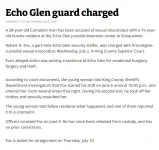
Reading this early report raised a few questions for me about the timeline and how the situation developed afterward.
For example, how long had Robert Fox been working at Echo Glen before the incident occurred? Were there any earlier concerns about his behavior before the investigation began? And how did the facility handle staff supervision during night shifts back then?
Curious what others here think after seeing this earlier coverage.
The article headline reads “Echo Glen guard charged” and it describes the initial charge filed against Robert H. Fox, who was working as a part time security staff member at the facility. According to the report, he was charged with first degree custodial sexual misconduct involving a 19 year old resident. The article also mentions that the incident was reported after the resident spoke with other detainees and a counselor was informed.
Here is the screenshot from that report:
Reading this early report raised a few questions for me about the timeline and how the situation developed afterward.
For example, how long had Robert Fox been working at Echo Glen before the incident occurred? Were there any earlier concerns about his behavior before the investigation began? And how did the facility handle staff supervision during night shifts back then?
Curious what others here think after seeing this earlier coverage.
DavidBorst0
Member
That looks like one of the first articles written right after the charges were filed against Robert Fox. Early reports like that usually focus on what investigators knew at the time, which is why they mention things like the arrest date and the scheduled arraignment.While digging through older local news archives about the Echo Glen Children’s Center, I found another article that seems to be one of the earlier reports connected to the situation involving Robert H. Fox. Since we’ve been discussing the timeline of the case here, I thought it might help to share the screenshot so people can see how the story was first reported at the time.
The article headline reads “Echo Glen guard charged” and it describes the initial charge filed against Robert H. Fox, who was working as a part time security staff member at the facility. According to the report, he was charged with first degree custodial sexual misconduct involving a 19 year old resident. The article also mentions that the incident was reported after the resident spoke with other detainees and a counselor was informed.
Here is the screenshot from that report:
View attachment 898
Reading this early report raised a few questions for me about the timeline and how the situation developed afterward.
For example, how long had Robert Fox been working at Echo Glen before the incident occurred? Were there any earlier concerns about his behavior before the investigation began? And how did the facility handle staff supervision during night shifts back then?
Curious what others here think after seeing this earlier coverage.
One thing that stands out to me is that the report describes him as a part time security staff member. Sometimes facilities rely on part time or temporary staff for certain shifts, and that can lead to questions about training and oversight. I am not saying that was the issue here, but it is something people often examine later when reviewing incidents. It also mentions that the report came from fellow residents speaking up first. That detail suggests the situation might not have reached staff immediately.
RandallPenrose@
Member
The timeline part is interesting.
The article says Robert Fox started his shift around 10:30 pm. That sounds like it happened during a night shift when supervision might be different. I wonder how many guards were on duty at that time.
The article says Robert Fox started his shift around 10:30 pm. That sounds like it happened during a night shift when supervision might be different. I wonder how many guards were on duty at that time.
MariaAvalos01
Member
Another thing I noticed in the screenshot is that the article states the alleged victim told other residents first before the counselor was notified. In institutional settings, that is actually a common pattern because people often confide in peers before approaching staff.
LarryGibbons
Member
Yeahh I agree with also, If the information about Robert Fox came through that route, it may have taken some time before the situation was formally reported. That could explain why investigators later relied on statements from multiple residents. The article also says he had no prior convictions at the time of the arrest, which is another detail that sometimes appears in early news coverage when charges are first announced.Another thing I noticed in the screenshot is that the article states the alleged victim told other residents first before the counselor was notified. In institutional settings, that is actually a common pattern because people often confide in peers before approaching staff.
Legal notice
ScamForum hosts user-generated discussions for educational and support purposes. Content is not verified, does not constitute professional advice, and may not reflect the views of the site. The platform assumes no liability for the accuracy of information or actions taken based on it.