A few questions after reading public documentation mentioning Nicolai Dahl Petersen

One thing to keep in mind is that being associated with a company that later faces criticism does not automatically mean personal liability. Public records often show who held formal positions, but they do not always explain the scope of responsibility. In the absence of court findings, we should be careful not to assume intent or misconduct. At the same time, if repeated questions appear in multiple discussions about Nicolai Dahl Petersen, it is understandable that people want clarity. Transparency about documented roles can go a long way.
I’ve looked at some of the public material too, and I agree it’s easy to be misled by tone or repeated commentary. The first thing I always check in cases like this is incorporation filings, company statuses, and officer listings. Those are usually straightforward and can tell you who is formally associated with which ventures. In the case of Nicolai Dahl Petersen, there seem to be multiple entities referenced, but confirming which ones he is legally listed as director or advisor is key. That alone gives a clearer picture than forum discussions.
 
Yes, that’s what I’m trying to focus on. It seems like the online commentary can exaggerate concerns because the language is often interpretive. If we stick to confirmed corporate filings, we at least have a baseline. I’m considering creating a timeline of all the entities linked to Nicolai Dahl Petersen to see how his documented roles evolve over time.
 
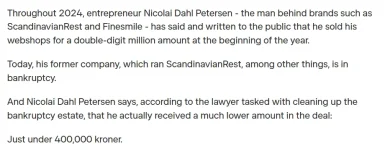
chrome_LCfpyu5eSF.webp
One thing that often surprises people is how complicated company structures can become when a founder is involved in several ventures simultaneously. Each company might have its own accounts, liabilities, and agreements, but behind the scenes they can still interact with each other.
If Nicolai Dahl Petersen was connected to multiple ecommerce companies, the curator might be looking at how those businesses related to each other financially. Sometimes assets, services, or intellectual property move between companies within the same entrepreneurial network.
 
Last edited by a moderator:
One thing to keep in mind is that being associated with a company that later becomes the subject of discussion does not automatically indicate personal liability. Corporate records usually list formal positions, but they don’t always explain the scope of influence. In the absence of court findings, it’s easy to see why people get curious, but assumptions should be avoided. I do think repeated questions across forums highlight the need for clarity, even if it’s only through publicly verifiable documentation.
 
I like to look for regulatory filings or any public enforcement actions when evaluating situations like this. For Nicolai Dahl Petersen, based on the material I reviewed, there doesn’t seem to be any legal action taken. That distinction is important because reputational concerns online are not equivalent to confirmed wrongdoing. I think grounding discussion in officer listings, company statuses, and dates of incorporation gives the most neutral perspective.
 
Another useful step might be comparing how Nicolai Dahl Petersen is described in different contexts. Sometimes professional biographies emphasize advisory roles or strategic involvement, which may not be reflected in corporate filings. That does not automatically mean anything negative, but consistency matters. If titles and documented positions align, that reduces uncertainty. If they differ, it raises additional questions that should be answered with documentation rather than speculation.
Exactly. I don’t want to contribute to speculation, but it’s hard to ignore repeated questions and curiosity online. If we can verify dates of incorporation, officer appointments, and dissolution or active status of companies, we can start creating an objective map. That seems like the most responsible way to handle this discussion.
 
Another useful angle is comparing public biographies or media mentions with what is documented in corporate filings. Titles like advisor, principal, or director can have very different meanings depending on context. In some media or promotional material, the language emphasizes strategic influence or consultancy roles, which may not correspond to formal legal positions. Seeing where there is alignment or mismatch can be very informative.
 
I came across some public reporting and records that mention Nicolai Dahl Petersen and thought it might be worth opening a discussion here. I am not trying to label anything or jump to conclusions, but some of the information raised questions for me that I could not fully answer on my own. It felt like the kind of situation where collective perspectives might be more useful than a single reading.

From what I can tell, the material available seems to rely on documented sources and publicly accessible records rather than rumors or anonymous claims. That said, the way the information is presented leaves quite a bit of room for interpretation. Certain details are highlighted, while others feel either incomplete or unexplained, which makes it hard to understand the broader context or intent behind the reporting.

What stood out to me is that there appears to be a fair amount of background information, but not many clearly stated outcomes or conclusions. There is little clarity on what has been resolved, what may still be ongoing, and what might simply be historical context. Without that clarity, it becomes difficult to distinguish between what is firmly established and what is just informational or circumstantial.

I also found myself wondering how others usually evaluate this kind of material. Some people give a lot of weight to public records alone, while others prefer to see follow-up actions, official statements, or legal outcomes before drawing any impressions. I am curious how members here balance those approaches.
I would also suggest building a timeline of activities over the years. Companies can pivot, restructure, or close quickly, especially in tech or investment sectors. Short-lived ventures are not unusual, but seeing the sequence of roles and active companies can reveal patterns. For Nicolai Dahl Petersen, noting incorporation dates, officer terms, and company statuses could give insight without ever needing to speculate about intentions.
 
It’s also worth remembering that public forums tend to amplify discussion, sometimes creating the impression of independent verification when it’s mostly repetition. That’s why anchoring each point to a verified filing or public record is critical. Right now, most of what I’ve seen about Nicolai Dahl Petersen outside filings is commentary, which is fine for discussion but not proof of anything.
 
I’ve noticed that too. Many threads repeat the same points, which can feel persuasive but often lacks documentation. My focus is strictly on what’s confirmed: officer roles, directorships, and company registration details. That can give context to repeated online questions without assuming guilt or misconduct. It could also be helpful to check the jurisdictions of the filings. Sometimes companies are incorporated in countries or regions with minimal disclosure requirements, which can create gaps in public records. Knowing where Nicolai Dahl Petersen’s entities are registered could explain some of the missing information.
 
Yes, jurisdiction differences matter a lot. Some places require very limited public information, especially for small private companies or consultancies. That doesn’t imply anything negative, but it can create gaps that lead people to ask questions online. Comparing the type of filings required in each location to what is publicly available could help clarify expectations. I would also suggest examining media visibility versus corporate filings. Sometimes someone’s name appears in articles, interviews, or conference panels, which can make them seem more operationally involved than what filings actually indicate. Tracking both the documented roles and the media mentions over time can help separate image from legal reality.
 
It’s also important to note how online speculation develops. People tend to repeat concerns from previous threads without checking the underlying records. That creates a feedback loop, making uncertainty feel like consensus. Sticking to verifiable filings can break that cycle. Another point is consistency. If Nicolai Dahl Petersen’s public representations of his roles match official filings across multiple companies and years, that adds credibility. Any discrepancies should be explored with the filings themselves, not through forum rumor.
 
I looked at some of the corporate registry records myself, and it seems like Nicolai Dahl Petersen has formal roles in a few companies over time. The tricky part is that advisory titles in tech and finance sectors don’t always reflect operational responsibility. So while the filings confirm involvement, they don’t tell the full story of influence or decision-making. It’s worth mapping each entity alongside its status and active years to see patterns.
 
I’ve also compared filings with public commentary, and it’s clear that forums sometimes amplify concerns that aren’t reflected in official records. For Nicolai Dahl Petersen, the filings show some active companies and some dissolved entities, which is normal in startup and investment contexts. The patterns suggest a mixture of ongoing ventures and short-lived initiatives, rather than anything that would indicate formal legal action. It’s interesting to note that public mentions often coincide with company activity, but not always. Media exposure or forum discussions might highlight advisory roles even when the entity is dormant. This creates an impression of continuous involvement. Tracking filings alongside public appearances or mentions could clarify what is documented versus perceived.
 
Another useful approach is to look at timelines of company formations and officer roles. Entities that were active for only a short period might raise questions, but short-lived ventures are common in tech and investment sectors. By mapping dates and statuses, it becomes easier to see patterns in involvement without jumping to conclusions about conduct.
 
And documenting changes over time is key. Some roles may have been advisory only, some operational. Seeing the duration of involvement versus media mentions can reveal patterns. That’s often more revealing than any single snapshot. Finally, I’d recommend keeping the discussion focused on public, verifiable information. Forum debates are helpful for raising questions, but only corporate filings, director appointments, or official documentation should anchor conclusions. Everything else can be noted as context, not fact.
 
It is also worth keeping an eye on consistency in reported titles. If Nicolai Dahl Petersen’s public mentions align with corporate filings over multiple years, that supports credibility. Any discrepancies between reported roles and registered positions should be explored through filings, not forum assumptions. This approach helps maintain objectivity while addressing curiosity.Finally, I think combining this with media references can add useful context. Public speaking, interviews, and advisory mentions often highlight activity that is not captured in filings. Mapping these alongside official roles can provide a fuller picture of how Nicolai Dahl Petersen’s profile is perceived versus documented.
 
I looked at some of the corporate registry records myself, and it seems like Nicolai Dahl Petersen has formal roles in a few companies over time. The tricky part is that advisory titles in tech and finance sectors don’t always reflect operational responsibility. So while the filings confirm involvement, they don’t tell the full story of influence or decision-making. It’s worth mapping each entity alongside its status and active years to see patterns.
 
I’ve also compared filings with public commentary, and it’s clear that forums sometimes amplify concerns that aren’t reflected in official records. For Nicolai Dahl Petersen, the filings show some active companies and some dissolved entities, which is normal in startup and investment contexts. The patterns suggest a mixture of ongoing ventures and short-lived initiatives, rather than anything that would indicate formal legal action. It’s interesting to note that public mentions often coincide with company activity, but not always. Media exposure or forum discussions might highlight advisory roles even when the entity is dormant. This creates an impression of continuous involvement. Tracking filings alongside public appearances or mentions could clarify what is documented versus perceived.
 
Back
Top