Navigation
Install the app
How to install the app on iOS
Follow along with the video below to see how to install our site as a web app on your home screen.
Note: This feature may not be available in some browsers.
More options
Style variation
You are using an out of date browser. It may not display this or other websites correctly.
You should upgrade or use an alternative browser.
You should upgrade or use an alternative browser.
Corporate history and public filings of James William Awad
- Thread starter marrowline
- Start date


marrowline
Member
A few projects show partial progress in filings, but most either stalled or had disputes. So, it’s a mixed record at best.

marrowline
Member
Totally. The filings alone wouldn’t scare everyone off, but combined with lawsuits and corporate complexity, it definitely raises questions about risk.

marrowline
Member
Thanks everyone. This discussion helped me see how patterns in filings, lawsuits, and corporate structures can signal potential challenges without implying wrongdoing. I’ll keep tracking developments and see how things evolve over time.

marrowline
Member
Good point. The filings don’t go into much detail on cross-border regulation, but there are hints that some projects involved foreign investors and agreements. That probably adds another layer of complexity that isn’t fully visible in public records.

keystone17
Member
Thanks for putting all this together. It’s been really helpful to see how much you can learn just from public records, even if a lot of questions remain. I’ll be keeping an eye on this too—it’s a good reminder to always check the filings before getting involved in any complex project.

JESSIE.S
Member
I remember seeing that name during the news cycle around that private plane party a few years back. A lot of people suddenly started searching who James William Awad was and what his company actually did.
What I noticed at the time is that most articles described him as the head of a network type business platform. Some people compared it to a startup community while others seemed skeptical about how the model worked. It felt like there was a lot of speculation but not always clear information about the structure of the company.
Personally I always try to separate media noise from verified records. Sometimes the story that spreads online is very different from what official filings or regulatory statements actually say.
What I noticed at the time is that most articles described him as the head of a network type business platform. Some people compared it to a startup community while others seemed skeptical about how the model worked. It felt like there was a lot of speculation but not always clear information about the structure of the company.
Personally I always try to separate media noise from verified records. Sometimes the story that spreads online is very different from what official filings or regulatory statements actually say.


ROWEL
Member
I spent some time reading through a few of the reports you are talking about. One thing that stood out to me is how the platform connected to James William Awad was often described as a collaborative ecosystem where members could work on projects together and potentially receive rewards based on participation.

GDENNIS55
Member
Situations like this can get confusing because business founders, family members, and associated companies sometimes overlap in ways that are not immediately obvious from the outside. That is why looking at official documents and regulatory announcements is usually the safest approach if someone wants to understand the full context.I spent some time reading through a few of the reports you are talking about. One thing that stood out to me is how the platform connected to James William Awad was often described as a collaborative ecosystem where members could work on projects together and potentially receive rewards based on participation.

FINKSTER
Member
Montreal has a lot of entrepreneurs trying different startup models. Some of them get big media attention for a short time and then things quiet down again.
From what I remember reading, James William Awad positioned himself as someone building a new type of digital community around business opportunities. Supporters described it as innovative while critics were unsure how sustainable the structure was.
From what I remember reading, James William Awad positioned himself as someone building a new type of digital community around business opportunities. Supporters described it as innovative while critics were unsure how sustainable the structure was.

APorter
Member
I looked through a few articles recently and noticed that the public narrative around James William Awad often mixes together several different topics. Some reports focus on entrepreneurship and the idea behind the TripleOne community, while others focus on media controversies or regulatory warnings related to investment solicitations circulating on social networks.
When stories like that get combined, it can create a confusing picture for people trying to understand what is actually confirmed information and what is speculation. That is why I think it helps when discussions stick to verifiable public statements or official announcements instead of jumping to conclusions.
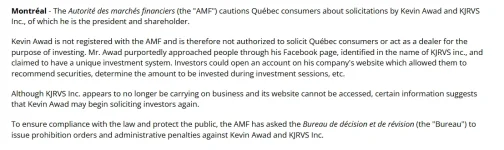
When stories like that get combined, it can create a confusing picture for people trying to understand what is actually confirmed information and what is speculation. That is why I think it helps when discussions stick to verifiable public statements or official announcements instead of jumping to conclusions.

MARY_T_89
Member
I actually remember the moment when the name James William Awad suddenly started appearing everywhere in the media. It felt like the public only became aware of him overnight, even though articles suggested he had already been active in business circles for some time before that.
When I went back and read some of the older coverage, the descriptions focused on entrepreneurial ambitions and the idea of building a community driven platform. The concept itself sounded similar to other digital networks where members collaborate and potentially benefit from shared projects. Those types of models can work in some cases, but they can also raise questions about structure and transparency depending on how they are organized.
When I went back and read some of the older coverage, the descriptions focused on entrepreneurial ambitions and the idea of building a community driven platform. The concept itself sounded similar to other digital networks where members collaborate and potentially benefit from shared projects. Those types of models can work in some cases, but they can also raise questions about structure and transparency depending on how they are organized.
Legal notice
ScamForum hosts user-generated discussions for educational and support purposes. Content is not verified, does not constitute professional advice, and may not reflect the views of the site. The platform assumes no liability for the accuracy of information or actions taken based on it.