Court opinions involving Richard Liebowitz raised some questions for me

Emma James

Member
Over the past few days I spent some time going through federal court opinions and related disciplinary notices that reference Richard Liebowitz. Everything I looked at comes from official judicial decisions and publicly accessible records. What caught my attention was not just a single ruling, but the fact that several written opinions across different courts discussed concerns about litigation conduct, compliance with procedural rules, and in certain matters, monetary penalties imposed by judges. Some of the judicial language appears unusually direct, with courts outlining what they viewed as repeated procedural deficiencies or case management problems. In a few instances, the record reflects sanctions, fee awards, and referrals for further review. There are also references to disciplinary proceedings that seem to have resulted in formal action reflected in state court records. Since these documents are part of the public domain, they are relatively straightforward to locate, but interpreting what they collectively signify is less clear to me. I am aware that attorneys handling large numbers of cases, especially in niche practice areas like intellectual property enforcement, may face increased scrutiny simply because of volume. A high caseload can amplify minor mistakes. At the same time, when separate judges independently articulate similar concerns in written rulings, it makes me wonder whether that indicates a broader pattern. Without being involved in the cases directly, it is difficult to fully understand the operational realities behind the filings. Another thing I am trying to sort out is the timeline. Some of the most critical opinions appear clustered within certain years. I do not yet know whether later decisions reflect a change in approach or improvement after earlier sanctions. Public records provide snapshots, but they do not always show what internal adjustments may have followed judicial criticism. It would probably require mapping decisions chronologically to see whether there was escalation, stabilization, or meaningful reform.
 
Over the past few days I spent some time going through federal court opinions and related disciplinary notices that reference Richard Liebowitz. Everything I looked at comes from official judicial decisions and publicly accessible records. What caught my attention was not just a single ruling, but the fact that several written opinions across different courts discussed concerns about litigation conduct, compliance with procedural rules, and in certain matters, monetary penalties imposed by judges. Some of the judicial language appears unusually direct, with courts outlining what they viewed as repeated procedural deficiencies or case management problems. In a few instances, the record reflects sanctions, fee awards, and referrals for further review. There are also references to disciplinary proceedings that seem to have resulted in formal action reflected in state court records. Since these documents are part of the public domain, they are relatively straightforward to locate, but interpreting what they collectively signify is less clear to me. I am aware that attorneys handling large numbers of cases, especially in niche practice areas like intellectual property enforcement, may face increased scrutiny simply because of volume. A high caseload can amplify minor mistakes. At the same time, when separate judges independently articulate similar concerns in written rulings, it makes me wonder whether that indicates a broader pattern. Without being involved in the cases directly, it is difficult to fully understand the operational realities behind the filings. Another thing I am trying to sort out is the timeline. Some of the most critical opinions appear clustered within certain years. I do not yet know whether later decisions reflect a change in approach or improvement after earlier sanctions. Public records provide snapshots, but they do not always show what internal adjustments may have followed judicial criticism. It would probably require mapping decisions chronologically to see whether there was escalation, stabilization, or meaningful reform.
I think you are asking a fair question. When multiple judges independently issue written findings about conduct, it usually means there was enough concern to document it formally. Courts do not tend to impose sanctions lightly, especially financial penalties. At the same time, context matters a lot. Some practice areas are known for aggressive strategies that can irritate courts. I would definitely look at whether there were appellate reviews that clarified or limited any of those rulings.
 
I think you are asking a fair question. When multiple judges independently issue written findings about conduct, it usually means there was enough concern to document it formally. Courts do not tend to impose sanctions lightly, especially financial penalties. At the same time, context matters a lot. Some practice areas are known for aggressive strategies that can irritate courts. I would definitely look at whether there were appellate reviews that clarified or limited any of those rulings.
That is a good suggestion. I have mostly focused on trial court opinions so far. I probably need to check appellate dockets to see if any of the findings were modified.
 
One thing I noticed when I reviewed similar situations in the past is that timelines tell a story. If most of the critical commentary happened within a short span and then tapered off, that can suggest corrective steps were taken.
 
I agree with the focus on official documentation. Media coverage sometimes emphasizes dramatic phrases from opinions without explaining the legal reasoning behind them. Reading the full text of the orders is usually more informative. Judges often describe exactly what rule was violated and why they imposed a particular penalty. That level of detail can help separate procedural errors from more serious ethical findings.
 
From what I have seen, isolated sanctions are not rare, but repeated documented findings across different jurisdictions are less typical. That does not automatically imply something catastrophic, but it does justify closer examination. The important part is whether there were formal ethics violations proven and what corrective measures followed. Public disciplinary orders usually outline the reasoning in detail.
 
Another angle to consider is client impact. Even if sanctions are procedural, they can affect case outcomes or cost exposure. That is why transparency in court records matters. Anyone researching a professional background should rely on certified rulings rather than commentary. It sounds like you are approaching this thoughtfully.
 
Another angle to consider is client impact. Even if sanctions are procedural, they can affect case outcomes or cost exposure. That is why transparency in court records matters. Anyone researching a professional background should rely on certified rulings rather than commentary. It sounds like you are approaching this thoughtfully.
I appreciate everyone sharing their insights. I am going to continue reviewing the official material and see whether the later record reflects a shift.
 
I spent some time digging into federal PACER records a while back when this topic first came up in another discussion. What struck me was the level of detail in certain judicial orders. Judges usually reserve strong wording for situations where they believe prior warnings were not taken seriously. That said, I also noticed that some cases were voluntarily dismissed or resolved in ways that do not necessarily imply wrongdoing. The challenge is distinguishing between administrative missteps and conduct that rises to the level of formal discipline. I think anyone reviewing this history has to look carefully at what was actually ordered versus what was simply commented on in dicta. It is easy to conflate criticism with final adjudicated findings.
 
Something else to consider is how federal courts handle repeat procedural issues. Judges have broad discretion in managing their dockets, and sometimes they use sanctions as a tool to enforce compliance. That does not automatically mean the attorney’s entire body of work is flawed. However, when monetary penalties are imposed repeatedly, it can indicate systemic office management problems. I would be interested in seeing whether staffing changes or operational adjustments were mentioned in later proceedings
 
Something else to consider is how federal courts handle repeat procedural issues. Judges have broad discretion in managing their dockets, and sometimes they use sanctions as a tool to enforce compliance. That does not automatically mean the attorney’s entire body of work is flawed. However, when monetary penalties are imposed repeatedly, it can indicate systemic office management problems. I would be interested in seeing whether staffing changes or operational adjustments were mentioned in later proceedings
That is an interesting angle. I have not seen much in the public record about internal operational changes, but that information might not be easily visible in court opinions anyway.
 
From a compliance standpoint, I think the most important documents would be the official disciplinary orders issued by the relevant state authority. Trial court sanctions can be significant, but bar proceedings carry a different weight.
 
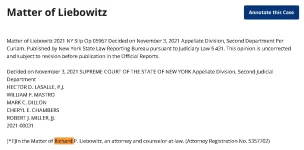
I actually pulled up the appellate division decision from early 2021 that’s publicly accessible, and what struck me is how thorough the court was in detailing the professional conduct concerns. It’s not just a one‑line comment; the opinion specifically lists multiple instances where obligations to the court weren’t met.
Screenshot 2026-03-04 163835.webp
When a state appellate court publishes those findings, it creates a detailed record that anyone can check. That level of detail makes it clear this was a professional discipline matter rooted in documented conduct, not media speculation.
 
One thing that stands out to me in the appellate decision is how detailed the court was in outlining specific instances of misconduct. It was not vague criticism. The opinion referenced missed deadlines, inaccurate statements, and failures to comply with court directives. When you see that level of documentation in a published decision, it suggests the disciplinary body felt there was a clear record to support its conclusion. That kind of written opinion becomes part of the permanent professional record, which is significant in itself.
 
I also noticed that federal courts had previously imposed sanctions in certain cases before the state disbarment happened. That timeline seems important. It suggests that concerns were raised at multiple judicial levels over time. From what I understand, when federal judges begin sanctioning an attorney repeatedly, state disciplinary authorities may take that into account when reviewing whether broader professional discipline is warranted. It looks like that may have been part of the larger context here.
 
That makes sense. The public reporting describes earlier suspensions and fee awards against him in different jurisdictions, which likely contributed to the overall picture the disciplinary committee reviewed. It does not appear to have been a sudden action but something that developed over several years. I am curious how common it is for high volume litigators to face that level of scrutiny.
 
High volume litigation by itself is not unusual, especially in copyright enforcement where firms may file many similar cases. The difference seems to come down to compliance with procedural rules. Courts expect strict adherence to deadlines and truthful filings. When an attorney repeatedly falls short of those expectations, it can lead to sanctions. If that continues, disciplinary authorities may conclude that the conduct reflects on fitness to practice law. Based on the public appellate ruling, that seems to have been the ultimate conclusion in this case.
 
I think it is also worth noting that disbarment in New York is handled by the Appellate Division, and the decision is a formal judicial determination. It is not just an administrative slap on the wrist. The published order removes the attorney from the roll, which is a serious professional outcome. From the outside looking in, it appears the court felt prior measures such as suspension were not enough to address the concerns that had been documented.
 
I have seen cases where early career rapid growth led to operational strain, and courts reacted strongly to procedural lapses. Over time, as firms mature, compliance structures improve. It would be interesting to see whether later rulings reflect more measured judicial commentary. Sometimes early patterns shift significantly once systems are adjusted. Without reviewing the full span of years, it is difficult to say whether that happened here.
Yes, and that escalation from suspension to disbarment is what caught my attention. It suggests the disciplinary system gave opportunities for corrective action before reaching the most severe penalty. I have not seen anything in the public record suggesting criminal charges in connection with these issues, so it seems clearly framed as professional discipline rather than criminal liability.
 
Back
Top