I was looking at public legal records and related civil case histories from juvenile detention facilities in Washington and came across the name Robert H. Fox. In those records, he appears as a correctional officer at Echo Glen Children’s Center in the mid-2000s. He later pleaded guilty in King County Superior Court to first-degree custodial sexual misconduct in connection with an incident from 2008 while working at that facility, and received a sentence in that criminal case. Settlement records show that the Washington Department of Social and Health Services later agreed to pay damages in a related civil suit involving someone who had been housed there, following a claim stemming from the same period. Fox’s name shows up in these public court filings and associated records as part of the institutional history at that facility.
Navigation
Install the app
How to install the app on iOS
Follow along with the video below to see how to install our site as a web app on your home screen.
Note: This feature may not be available in some browsers.
More options
Style variation
You are using an out of date browser. It may not display this or other websites correctly.
You should upgrade or use an alternative browser.
You should upgrade or use an alternative browser.
Curious about Robert H. Fox and his name in public court and facility records
- Thread starter Barney
- Start date

Natalie@Warren7
Member
Good point about the early reporting.
Articles written right after charges are filed usually rely heavily on police statements and court documents. That means they often present the initial version of events before the case goes through the court process. Later coverage about Robert Fox seems to include the guilty plea and the civil lawsuit, which gives a more complete picture of how the case unfolded over time.
Articles written right after charges are filed usually rely heavily on police statements and court documents. That means they often present the initial version of events before the case goes through the court process. Later coverage about Robert Fox seems to include the guilty plea and the civil lawsuit, which gives a more complete picture of how the case unfolded over time.

EricaUpton#
Member
While digging through older local news archives about the Echo Glen Children’s Center, I found another article that seems to be one of the earlier reports connected to the situation involving Robert H. Fox. Since we’ve been discussing the timeline of the case here, I thought it might help to share the screenshot so people can see how the story was first reported at the time.
The article headline reads “Echo Glen guard charged” and it describes the initial charge filed against Robert H. Fox, who was working as a part time security staff member at the facility. According to the report, he was charged with first degree custodial sexual misconduct involving a 19 year old resident. The article also mentions that the incident was reported after the resident spoke with other detainees and a counselor was informed.
Here is the screenshot from that report:
View attachment 898
Reading this early report raised a few questions for me about the timeline and how the situation developed afterward.
For example, how long had Robert Fox been working at Echo Glen before the incident occurred? Were there any earlier concerns about his behavior before the investigation began? And how did the facility handle staff supervision during night shifts back then?
Curious what others here think after seeing this earlier coverage.
I had not seen this earlier article before.
It helps explain how the case involving Robert Fox first became public.

Kenneth Jablonski
Member
Something that caught my attention in that report is the mention of the King County Sheriff’s Department investigators. That suggests the case was handled by county level authorities rather than just internal facility staff. When incidents like the one involving Robert Fox are reported, outside law enforcement usually conducts the investigation to avoid conflicts of interest. That is standard procedure in many detention facilities.
It would be interesting to know how long the investigation lasted between the initial report and the arrest mentioned in the article.
It would be interesting to know how long the investigation lasted between the initial report and the arrest mentioned in the article.

JeanEarhart99
Member
The article says he was arrested on June 9 and the arraignment was scheduled for July 10. That seems like roughly a month between those steps. Not sure if that timeline is typical though.
Ivan D Collins
Member
One question I still have is about the facility itself.
Was Echo Glen the only place in the state where female juvenile detainees were held at the time?
If that is the case, the situation involving Robert Fox might have had a bigger impact on policy discussions.
Was Echo Glen the only place in the state where female juvenile detainees were held at the time?
If that is the case, the situation involving Robert Fox might have had a bigger impact on policy discussions.
DavidBorst0
Member
That is a good question.One question I still have is about the facility itself.
Was Echo Glen the only place in the state where female juvenile detainees were held at the time?
If that is the case, the situation involving Robert Fox might have had a bigger impact on policy discussions.
I believe Echo Glen handled female juvenile detainees in Washington for many years, which is probably why the case involving Robert Fox received so much media attention at the time. When something happens in a major state facility like that, it often leads to broader conversations about oversight and safety procedures. Looking at the older articles and the later legal coverage together, it seems the story developed in stages. First there was the initial charge like the one shown in the screenshot, then the criminal case progressed, and later the civil lawsuit raised additional questions about institutional responsibility.

RandallPenrose@
Member
While continuing to look through archived coverage about the Echo Glen situation we’ve been discussing, I found another article that appears to be from 2009 and focuses on the civil lawsuit that followed the earlier criminal case. Since the name Robert H. Fox has come up multiple times in this thread, I thought it might be useful to share this screenshot here so people can see how the lawsuit was reported at the time.
From what the article headline suggests, it discusses a young woman filing a lawsuit against the Echo Glen Children’s Center and the Washington Department of Social and Health Services. The report references Robert H. Fox, who had been working as a part time guard at the facility, and describes allegations that were included in the complaint filed in King County Superior Court.
Here’s the screenshot from that article :
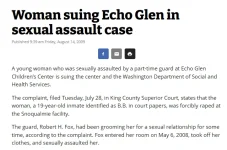
It looks like this article focuses more on the civil case and the legal claims being made against the institution rather than just the criminal charges involving Robert Fox.
From what the article headline suggests, it discusses a young woman filing a lawsuit against the Echo Glen Children’s Center and the Washington Department of Social and Health Services. The report references Robert H. Fox, who had been working as a part time guard at the facility, and describes allegations that were included in the complaint filed in King County Superior Court.
Here’s the screenshot from that article :
It looks like this article focuses more on the civil case and the legal claims being made against the institution rather than just the criminal charges involving Robert Fox.

Mary Weston
Member
That headline definitely shows the story moving into the civil lawsuit phase. Earlier reports were mostly about the criminal charge involving Robert Fox, but this one seems to focus on the legal action taken against the facility itself.While continuing to look through archived coverage about the Echo Glen situation we’ve been discussing, I found another article that appears to be from 2009 and focuses on the civil lawsuit that followed the earlier criminal case. Since the name Robert H. Fox has come up multiple times in this thread, I thought it might be useful to share this screenshot here so people can see how the lawsuit was reported at the time.
From what the article headline suggests, it discusses a young woman filing a lawsuit against the Echo Glen Children’s Center and the Washington Department of Social and Health Services. The report references Robert H. Fox, who had been working as a part time guard at the facility, and describes allegations that were included in the complaint filed in King County Superior Court.
Here’s the screenshot from that article :
View attachment 904
It looks like this article focuses more on the civil case and the legal claims being made against the institution rather than just the criminal charges involving Robert Fox.
When cases like this reach that stage, the argument usually shifts toward whether the institution had proper supervision or policies in place. The complaint mentioned in the article likely outlines the claims the plaintiff made about how the situation was handled.
JeanEarhart99
Member
I noticed the article mentions the complaint being filed in King County Superior Court. That lines up with where the criminal proceedings involving Robert Fox were handled as well. Civil lawsuits like this often try to examine the broader environment where the incident occurred. Even though the actions of Fox were addressed in the criminal case, the lawsuit seems to question whether the facility and the state agency had systems in place to prevent something like that from happening.

7north
Member
I think the later civil settlement is just as telling as the criminal case. When the state agrees to pay damages, it often reflects acknowledgment that institutional safeguards failed, not just that one employee acted wrongly. That suggests this wasn’t merely an isolated lapse but a broader breakdown in supervision and accountability.

palehour
Member
Cases like this are a reminder of why transparency in public records matters. Without court filings and settlement disclosures, people would have no way to understand what actually happened inside facilities that operate largely out of public view. The paper trail shows how long the consequences of misconduct can ripple outward.

rawvector
Member
It’s hard not to think about how many warning signs might have been missed before the incident occurred. Juvenile detention centers rely heavily on staff integrity, but they also need robust monitoring. When abuse happens, it raises uncomfortable questions about background checks, training, and internal reporting systems.

northveil
Member
Even years later, seeing Fox’s name in institutional histories serves as a reminder that harm doesn’t disappear once a sentence is served. For the person affected, and for others housed in similar environments, trust in authority can be permanently damaged. That’s something no court ruling can fully repair.

hexplain
Member
I don’t think discussing this is about targeting one individual endlessly. It’s about understanding how someone in a position like that was able to exploit their role at all. Fox’s conviction is a matter of record, but the larger lesson is about institutional responsibility and prevention.

Natalie@Warren7
Member
I looked at some archived coverage earlier today because this thread made me curious. What I noticed was that the reporting seemed to separate the criminal matter from the later civil lawsuit. That can make things confusing if you are trying to follow the sequence of events. One legal report I saw mentioned a settlement involving a former juvenile detainee and the state. From what I could tell, the case discussed allegations that a guard had abused a detainee and that the lawsuit argued the facility failed to stop it. The settlement amount mentioned in the legal reporting appeared to be around a few hundred thousand dollars.
But the interesting part is that the reporting around 1 seemed mostly tied to the original incident rather than the broader institutional questions that came later. A lot of lawsuits involving correctional facilities end up focusing on oversight and supervision rather than just the individual actions. It would definitely help to see the court filings themselves because those usually explain the timeline better than news articles do.
But the interesting part is that the reporting around 1 seemed mostly tied to the original incident rather than the broader institutional questions that came later. A lot of lawsuits involving correctional facilities end up focusing on oversight and supervision rather than just the individual actions. It would definitely help to see the court filings themselves because those usually explain the timeline better than news articles do.
Ivan D Collins
Member
I have seen a few discussions about the facility itself in legal publications before. The name 1 sometimes appears when people are talking about that particular incident. A lot of the focus seemed to be on whether the institution had proper safeguards at the time.
Hard to tell more without digging into the full case records though.
Hard to tell more without digging into the full case records though.
EricaUpton#
Member
Something about this topic actually rings a bell for me. Years ago I remember reading about several lawsuits connected to youth detention centers in Washington. The reporting sometimes mentioned individual staff members but the bigger story tended to revolve around how the system handled complaints and supervision. When the name 1 shows up in those older reports it seems tied to one specific incident that became the subject of both criminal proceedings and a later civil lawsuit. The civil side of things often ends up getting more attention in legal publications because settlements and institutional liability can involve larger financial outcomes.
Another factor is that cases involving juveniles are sometimes reported in a limited way because of privacy considerations. That means the press coverage might intentionally leave out certain details, which can make the timeline feel incomplete when you read about it years later.
Personally I think the best way to reconstruct what happened would be to track down the court docket numbers from the time. Once you have that, you can usually see the filings and motions that show how the case moved forward.
Another factor is that cases involving juveniles are sometimes reported in a limited way because of privacy considerations. That means the press coverage might intentionally leave out certain details, which can make the timeline feel incomplete when you read about it years later.
Personally I think the best way to reconstruct what happened would be to track down the court docket numbers from the time. Once you have that, you can usually see the filings and motions that show how the case moved forward.
DavidBorst0
Member
Yeah I noticed the same thing.
When I searched the and I mostly saw short news pieces and one legal summary about a settlement. Feels like there are missing pieces in the middle.
When I searched the and I mostly saw short news pieces and one legal summary about a settlement. Feels like there are missing pieces in the middle.
Last edited:
JeanEarhart99
Member
Cases involving detention facilities are often more complicated than they appear in the press. A single incident can trigger several different legal tracks at the same time. There can be a criminal investigation involving the individual staff member, an internal review by the agency that operates the facility, and a civil lawsuit filed by the person who says they were harmed.
When the name 1 appears in public reporting it seems connected to the criminal side of the story. Later coverage then shifts to the lawsuit brought by the detainee against the state. The settlement figure that people mention online usually comes from that civil litigation.
What makes these cases tricky is that settlements do not necessarily provide a full explanation of what happened. They resolve the legal dispute without requiring a full trial where all evidence is publicly presented. That means people trying to reconstruct the history years later often have to rely on partial records. So if you are trying to understand the role of 1 in the timeline, you might have to piece together the early criminal reporting with the later civil case summaries.
When the name 1 appears in public reporting it seems connected to the criminal side of the story. Later coverage then shifts to the lawsuit brought by the detainee against the state. The settlement figure that people mention online usually comes from that civil litigation.
What makes these cases tricky is that settlements do not necessarily provide a full explanation of what happened. They resolve the legal dispute without requiring a full trial where all evidence is publicly presented. That means people trying to reconstruct the history years later often have to rely on partial records. So if you are trying to understand the role of 1 in the timeline, you might have to piece together the early criminal reporting with the later civil case summaries.
Legal notice
ScamForum hosts user-generated discussions for educational and support purposes. Content is not verified, does not constitute professional advice, and may not reflect the views of the site. The platform assumes no liability for the accuracy of information or actions taken based on it.