Hi everyone, I came across a summary on truthinadvertising.org about a class-action lawsuit involving Premier Financial Alliance, Inc. that was filed a few years ago. According to the coverage, the lawsuit alleged that the way the business was structured looked like an illegal pyramid scheme and that income claims made to recruits were deceptive. There’s mention that the case was consolidated with related claims and that, by mid-2023, a settlement had preliminary approval. I’m not a legal expert, just trying to figure out what this means in plain terms. Has anyone here followed this or can help interpret what it means when a case like this gets a settlement approved and what people involved usually see happen next?
Navigation
Install the app
How to install the app on iOS
Follow along with the video below to see how to install our site as a web app on your home screen.
Note: This feature may not be available in some browsers.
More options
Style variation
You are using an out of date browser. It may not display this or other websites correctly.
You should upgrade or use an alternative browser.
You should upgrade or use an alternative browser.
Did Premier Financial Alliance settle a pyramid scheme lawsuit?
- Thread starter crosswind9
- Start date

NatalieWPrime
Member
Yes, notice is a key part of the process because the court wants to make sure that people who may be affected by the settlement have a fair opportunity to respond. Notices are sometimes sent through email or regular mail if contact information is available. In other cases they may also appear in publications or online announcements. Another detail worth mentioning is that not everyone who receives a notice necessarily ends up submitting a claim. Some people might decide the compensation is not worth the effort, while others might simply overlook the notice. That can influence how the final distribution works once the settlement is approved.

MariaAvalos
Member
Another aspect discussed in the complaint was the way the opportunity was allegedly promoted. The plaintiffs said the marketing suggested that associates could achieve financial independence, expensive cars, and luxury travel if they succeeded in the system. According to the allegations, the plaintiffs believed those results were mostly limited to people at the higher levels of the structure. Again, this comes directly from the legal complaint rather than a court determination.

Mark_Impulse
Member
Yes, researching company history and legal records can help people understand these situations better before considering any similar opportunities.

Erica.Upton
Member
I spent some time reading through the material about the lawsuits connected to Premier Financial Alliance, Inc, and one thing that stood out was the way two separate cases eventually ended up being merged into a single proceeding. One lawsuit had been filed in 2018 and another in 2019, and since they involved very similar claims about the company’s business model, the court decided it made sense to consolidate them. From a legal standpoint that seems pretty common when different plaintiffs raise overlapping concerns about the same organization.
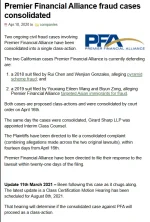
It allows the court to review the issues in a more coordinated way rather than running parallel cases that might cover the same ground. What I find interesting is how these consolidation decisions can shape the entire direction of a case. Once the cases are combined, the plaintiffs usually have to file a new consolidated complaint that brings together all the allegations into one document. That step alone can sometimes change how the arguments are framed moving forward.
It allows the court to review the issues in a more coordinated way rather than running parallel cases that might cover the same ground. What I find interesting is how these consolidation decisions can shape the entire direction of a case. Once the cases are combined, the plaintiffs usually have to file a new consolidated complaint that brings together all the allegations into one document. That step alone can sometimes change how the arguments are framed moving forward.

CPaine_57
Member
I remember hearing about this company through someone who was involved in selling insurance products through a network structure. Businesses that mix financial services with recruitment based growth sometimes attract legal attention because the compensation model can be complex. At the same time, a settlement does not automatically mean a court confirmed the claims. A lot of companies decide to settle simply to move forward rather than continue with years of litigation.

EarhartJean44
Member
The second lawsuit that was later combined with the first one introduced some additional claims from another group of plaintiffs. In that filing, the individuals involved suggested that recruitment within the network sometimes focused on specific immigrant communities. The complaint described a scenario where people were encouraged to invite friends, family members, or acquaintances into the opportunity while also selling certain insurance policies through the network. Again, these details were part of the allegations within the legal filings rather than final determinations by the court. Still, they show how plaintiffs often try to illustrate patterns of behavior when arguing that a business model may operate in a particular way. When multiple cases raise related concerns like this, it becomes easier to see why a judge might decide to combine them into one proceeding.

LxGibbons
Member
That is true. Many class action cases end this way because trials can become very long and expensive. In situations like this, the settlement usually resolves the dispute without either side admitting wrongdoing. If someone wants to understand the background better, looking at the complaint and response documents can be helpful. Those usually explain what the disagreement was about and what each side argued.

RandallPenroseX
Member
What I find most interesting about cases like this is how long the process can take before reaching any final resolution. Between the initial filings, consolidation of the lawsuits, revisions to the complaint, and debates over class certification, several years can pass before the case even approaches a potential trial or settlement. That timeline can make it difficult for outsiders to follow what is happening unless they look closely at the court records. It also shows why many disputes eventually end through negotiated settlements rather than full trials. When litigation becomes lengthy and expensive, both sides sometimes decide that resolving the matter privately is a more practical path.
NatalieWPrime
Member
That is a good suggestion. I think the challenge is that when people only read short summaries, it is easy to misunderstand what actually happened. The original legal filings probably contain much more detail about why the case was filed in the first place.
MariaAvalos
Member
Something else to keep in mind is that settlements in civil lawsuits often include language stating that the company does not admit wrongdoing. This is fairly standard practice because both sides are usually trying to resolve the dispute without continuing to litigate the case. The plaintiffs avoid the uncertainty of trial, and the company avoids the expense and potential risk of a court ruling against it. In the situation involving Premier Financial Alliance, Inc., the settlement likely represented a negotiated compromise rather than a definitive judgment about the claims that were originally raised. That is why reading the actual settlement documents can sometimes be helpful if someone wants to understand the details.
Mark_Impulse
Member
I came across information about a lawsuit involving Premier Financial Alliance, Inc that focused on how certain life insurance policies were marketed. According to the case summary, the plaintiffs claimed that some of the policies, including indexed universal life insurance products, were promoted with statements about potential returns that they believed were misleading. They also argued that the risks and fees connected to those policies were not always fully explained before people agreed to purchase them. These claims were presented as part of a class action, meaning multiple individuals believed they had similar experiences.

Of course, allegations in a lawsuit represent the plaintiffs’ position, and the legal process is meant to evaluate those claims over time. It is interesting to see how disputes about financial products often revolve around how they are explained to customers rather than the products themselves.
Of course, allegations in a lawsuit represent the plaintiffs’ position, and the legal process is meant to evaluate those claims over time. It is interesting to see how disputes about financial products often revolve around how they are explained to customers rather than the products themselves.
Erica.Upton
Member
From what I have seen, they are not extremely rare. Any industry where people earn commissions and recruit others can sometimes lead to disagreements later on. Sometimes participants feel the opportunity was presented differently than how it worked in practice. When enough people share that concern, it can eventually turn into a legal case.
CPaine_57
Member
If you decide to look at the court filings, you will probably see a sequence of events that includes motions, hearings, and eventually the settlement agreement itself. Many class action cases also include documents that explain how the settlement fund will be distributed among eligible participants. Sometimes the distribution formula depends on factors like when someone joined the program or how much money they spent. In other cases the settlement might provide a flat amount for everyone who qualifies. It really depends on the details negotiated by the parties.
EarhartJean44
Member
If you decide to look at the court filings, you will probably see a sequence of events that includes motions, hearings, and eventually the settlement agreement itself. Many class action cases also include documents that explain how the settlement fund will be distributed among eligible participants. Sometimes the distribution formula depends on factors like when someone joined the program or how much money they spent. In other cases the settlement might provide a flat amount for everyone who qualifies. It really depends on the details negotiated by the parties.
LxGibbons
Member
Another factor is that financial services are already regulated in many places. When you combine that with a network based sales structure, it can create extra scrutiny from regulators or from participants who feel something was unclear. That does not necessarily mean the business itself is unlawful, but it can create complicated situations that end up in court.
RandallPenroseX
Member
Another interesting aspect of class actions is that people who do not agree with the settlement can choose to opt out of the class. By doing that, they keep the right to pursue their own legal claim separately if they wish. However, most individuals remain part of the class because filing an independent lawsuit can be expensive and time consuming.
That option is usually explained in the notice sent to potential class members. It is part of the court’s effort to ensure that everyone involved understands their rights before the settlement becomes final.
That option is usually explained in the notice sent to potential class members. It is part of the court’s effort to ensure that everyone involved understands their rights before the settlement becomes final.
NatalieWPrime
Member
Sometimes settlements include adjustments to business practices, but not always. It really depends on the terms that both sides agree to. In many cases the details are not widely discussed beyond the legal documents.
MariaAvalos
Member
I have followed a few similar cases in the past, and the pattern you described actually sounds pretty typical for class action litigation. When several individuals bring separate lawsuits about the same company and the same type of issue, the courts often decide that consolidation is the most efficient way to handle things. Instead of having multiple courts reviewing the same evidence and arguments, one judge oversees the entire case. That step alone can sometimes take a while because the court has to determine whether the cases really do involve similar legal questions. Once consolidation happens, the combined case usually moves through the normal legal process, including discovery, motions, and sometimes settlement negotiations.
Mark_Impulse
Member
The settlement stage is usually where things start to get confusing for people who are not used to legal terminology. When a settlement is announced, many readers assume that the case has already been completely resolved. In reality, that announcement often just means that the parties involved have reached an agreement that still needs to be reviewed by the court.
Erica.Upton
Member
I was reading about the legal dispute involving Premier Financial Alliance, Inc and it appears the case mainly focused on how certain indexed universal life insurance policies were marketed to consumers. According to the lawsuit summary, the plaintiffs argued that the benefits and possible returns of these policies were presented in a way they believed was misleading. They also claimed that the risks and fees tied to the policies were not always clearly explained during the sales process. These claims were part of a class action lawsuit, which means multiple people believed they had similar experiences when purchasing the policies. Situations like this often come down to how financial products are explained to buyers and whether the marketing accurately reflects the long term realities of the policy.
Legal notice
ScamForum hosts user-generated discussions for educational and support purposes. Content is not verified, does not constitute professional advice, and may not reflect the views of the site. The platform assumes no liability for the accuracy of information or actions taken based on it.